Gizmos Student Exploration: Feel the Heat
Name: Date:
Student Exploration: Feel the Heat
Vocabulary: calorimeter, conductor, controlled experiment, dissolve, endothermic, exothermic,
insulator, solute, solution, solvent, surroundings, system
Prior Knowledge Questions (Do these BEFORE using the Gizmo.)
Eduardo hurts his knee during a basketball game. The trainer applies a cold pack, which gets
cold after being squeezed. The next day, Eduardo’s friend Beth is going sledding. Beth buys
some hand warmers and puts them into her gloves. All morning, her hands stay toasty warm.
1. How do you think these devices work? There are more than likely 2
solutions inside the packets. When squeezed, it breaks the
inside containers combining the solutions and creating either
an endothermic reaction for a cold pack or an exothermic
reaction for a heat pack.
2. Where do you think the “cold” and the heat comes from? For the endothermic,
when the substances mix, the reaction absorbs all the heat
inside the container, dropping the temperature of the packet.
For the exothermic, when the substances mix, the reaction
gives off heat, raising the temperature of the packet.
Gizmo Warm-up
As you saw with the instant cold pack and the hand warmers, some
reactions absorb energy while others release it. In the Feel the Heat
Gizmo, you will explore these energy changes while making your own
hot and cold packs.
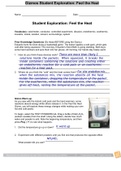
To begin, select the TEST POWDERS tab. Drag a bottle of NaC2H3O2
(sodium acetate) from the shelf. Using the sliders, decide how much
water and powder to add. Note the beginning temperature, and then
press Play ( ) to see what happens.
1. Did the temperature go up or down? It went up
2. Experiment with different powders until you find one that produces the opposite effect.
NH4NO3
What powder did you use?
2019
, Gizmos Student Exploration: Feel the Heat
When a powder dissolves in water a solution is formed. The powder is the solute and the
water is the solvent. Oftentimes energy changes accompany the formation of a solution. When
added to water, some powders cause the resulting solution to get hot, while others make it cold.
Some powders don’t produce a temperature change at all. When energy changes do occur,
they can be put to good use.
2019
Name: Date:
Student Exploration: Feel the Heat
Vocabulary: calorimeter, conductor, controlled experiment, dissolve, endothermic, exothermic,
insulator, solute, solution, solvent, surroundings, system
Prior Knowledge Questions (Do these BEFORE using the Gizmo.)
Eduardo hurts his knee during a basketball game. The trainer applies a cold pack, which gets
cold after being squeezed. The next day, Eduardo’s friend Beth is going sledding. Beth buys
some hand warmers and puts them into her gloves. All morning, her hands stay toasty warm.
1. How do you think these devices work? There are more than likely 2
solutions inside the packets. When squeezed, it breaks the
inside containers combining the solutions and creating either
an endothermic reaction for a cold pack or an exothermic
reaction for a heat pack.
2. Where do you think the “cold” and the heat comes from? For the endothermic,
when the substances mix, the reaction absorbs all the heat
inside the container, dropping the temperature of the packet.
For the exothermic, when the substances mix, the reaction
gives off heat, raising the temperature of the packet.
Gizmo Warm-up
As you saw with the instant cold pack and the hand warmers, some
reactions absorb energy while others release it. In the Feel the Heat
Gizmo, you will explore these energy changes while making your own
hot and cold packs.
To begin, select the TEST POWDERS tab. Drag a bottle of NaC2H3O2
(sodium acetate) from the shelf. Using the sliders, decide how much
water and powder to add. Note the beginning temperature, and then
press Play ( ) to see what happens.
1. Did the temperature go up or down? It went up
2. Experiment with different powders until you find one that produces the opposite effect.
NH4NO3
What powder did you use?
2019
, Gizmos Student Exploration: Feel the Heat
When a powder dissolves in water a solution is formed. The powder is the solute and the
water is the solvent. Oftentimes energy changes accompany the formation of a solution. When
added to water, some powders cause the resulting solution to get hot, while others make it cold.
Some powders don’t produce a temperature change at all. When energy changes do occur,
they can be put to good use.
2019