Each enzyme is assigned two names:
1) Recommended name :
* short, convenient; common suffix “ase” attached to the substrate (reactants) or to the action
performed (proteinase, DNase; lactate dehydrogenase, adenylyl cyclase ; some trivial names - pepsin)
2) Systematic name :
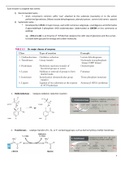
* Developed by IUBMB, 6 major classes, each with numerous subgroups, unambiguous and informative
D-glyceraldehyde 3-phosphate: NAD oxidoreductase. (abbreviated as GAPDH or less commonly as
G3PDH)
eg :- (EC1.2.1.12) is an Enzyme of ~37kDa that catalyzes the sixth step of glycolysis and thus serves
to break down glucose for energy and carbon molecules.
1. Oxidoreductase - Catalyze oxidation-reduction reaction
2. Transferases - catalyze transfer of C-, N-, or P- containing groups, such as Serine hydroxy-methyl transferase
1
,3. Hydrolases - Hydrolase Catalyze cleavage of bonds by addition of water, such as Urease
4. Lyases - Catalyze cleavage of C-C, C-S and certain C-N bonds, such as: Reaction catalyzed by pyruvate
decarboxylase:
Pyruvate + thiamine pyrophosphate (TPP) → hydroxyethyl-TPP + CO2
5. Isomerases - Catalyze racemization of optical or geometric isomers, such as triose phosphate isomerase
6. Ligases - Catalyze formation of bonds between carbon and O, S, N coupled to hydrolysis of high energy
phosphates, such as pyruvate carboxylase
2
, - (NMP) kinase catalyzes the following reaction:
- NMP kinase transfers a phosphoryl group from ATP to any nucleotide monophosphate (NMP) to form a nucleoside
diphosphate (NDP) and ADP. Consequently, it is a transferase, or member of group 2.
- Transferases that shift a phosphoryl group are designated 2.7.
- Various functional groups can accept the phosphoryl group.
- If a phosphate is the acceptor, the transferase is designated 2.7.4.
- The final number designates the acceptor more precisely.
- In regard to NMP kinase, a nucleoside monophosphate is the acceptor, and the enzyme’s designation is EC 2.7.4.4.
- A phosphate group is transferred from ATP to the C-6-OH group of glucose, so the enzyme is a transferase.
- Subclass 7 of transferases is enzymes transferring phosphorus-containing groups, and sub-subclass 1 covers those
phosphotransferases with an alcohol group as an acceptor.
- Entry 2 in this sub-subclass is ATP:d-glucose-6-phosphotransferase, and its classification number is 2.7.1.2.
- In use, this number is written preceded by the letters E.C., denoting the Enzyme Commission.
- For example, entry 1 in the same sub-subclass is E.C.2.7.1.1, ATP;d-hexose-6- phosphotransferase, an ATP-
dependent enzyme that transfers a phosphate to the 6-OH of hexoses (that is, it is nonspecific regarding its hexose
acceptor)
Properties of enzymes
• Enzymes are protein catalysts that increase the velocity of a chemical reaction.
• Nearly all known enzymes are proteins.
• However, proteins do not have an absolute monopoly on catalysis ; the discovery of catalytically active RNA
molecules provides compelling evidence that RNA was a biocatalyst early in evolution.
• Proteins as a class of macromolecules are highly effective catalysts for an enormous diversity of chemical reactions
because of their capacity to specifically bind a very wide range of molecules.
• By utilizing the full repertoire of intermolecular forces, enzymes bring substrates together in an optimal orientation,
the prelude to making and breaking chemical bonds.
• They catalyze reactions by stabilizing transition states, the highest-energy species in reaction pathways.
• By selectively stabilizing a transition state, an enzyme determines which one of several potential chemical reactions
actually takes place.
3
1) Recommended name :
* short, convenient; common suffix “ase” attached to the substrate (reactants) or to the action
performed (proteinase, DNase; lactate dehydrogenase, adenylyl cyclase ; some trivial names - pepsin)
2) Systematic name :
* Developed by IUBMB, 6 major classes, each with numerous subgroups, unambiguous and informative
D-glyceraldehyde 3-phosphate: NAD oxidoreductase. (abbreviated as GAPDH or less commonly as
G3PDH)
eg :- (EC1.2.1.12) is an Enzyme of ~37kDa that catalyzes the sixth step of glycolysis and thus serves
to break down glucose for energy and carbon molecules.
1. Oxidoreductase - Catalyze oxidation-reduction reaction
2. Transferases - catalyze transfer of C-, N-, or P- containing groups, such as Serine hydroxy-methyl transferase
1
,3. Hydrolases - Hydrolase Catalyze cleavage of bonds by addition of water, such as Urease
4. Lyases - Catalyze cleavage of C-C, C-S and certain C-N bonds, such as: Reaction catalyzed by pyruvate
decarboxylase:
Pyruvate + thiamine pyrophosphate (TPP) → hydroxyethyl-TPP + CO2
5. Isomerases - Catalyze racemization of optical or geometric isomers, such as triose phosphate isomerase
6. Ligases - Catalyze formation of bonds between carbon and O, S, N coupled to hydrolysis of high energy
phosphates, such as pyruvate carboxylase
2
, - (NMP) kinase catalyzes the following reaction:
- NMP kinase transfers a phosphoryl group from ATP to any nucleotide monophosphate (NMP) to form a nucleoside
diphosphate (NDP) and ADP. Consequently, it is a transferase, or member of group 2.
- Transferases that shift a phosphoryl group are designated 2.7.
- Various functional groups can accept the phosphoryl group.
- If a phosphate is the acceptor, the transferase is designated 2.7.4.
- The final number designates the acceptor more precisely.
- In regard to NMP kinase, a nucleoside monophosphate is the acceptor, and the enzyme’s designation is EC 2.7.4.4.
- A phosphate group is transferred from ATP to the C-6-OH group of glucose, so the enzyme is a transferase.
- Subclass 7 of transferases is enzymes transferring phosphorus-containing groups, and sub-subclass 1 covers those
phosphotransferases with an alcohol group as an acceptor.
- Entry 2 in this sub-subclass is ATP:d-glucose-6-phosphotransferase, and its classification number is 2.7.1.2.
- In use, this number is written preceded by the letters E.C., denoting the Enzyme Commission.
- For example, entry 1 in the same sub-subclass is E.C.2.7.1.1, ATP;d-hexose-6- phosphotransferase, an ATP-
dependent enzyme that transfers a phosphate to the 6-OH of hexoses (that is, it is nonspecific regarding its hexose
acceptor)
Properties of enzymes
• Enzymes are protein catalysts that increase the velocity of a chemical reaction.
• Nearly all known enzymes are proteins.
• However, proteins do not have an absolute monopoly on catalysis ; the discovery of catalytically active RNA
molecules provides compelling evidence that RNA was a biocatalyst early in evolution.
• Proteins as a class of macromolecules are highly effective catalysts for an enormous diversity of chemical reactions
because of their capacity to specifically bind a very wide range of molecules.
• By utilizing the full repertoire of intermolecular forces, enzymes bring substrates together in an optimal orientation,
the prelude to making and breaking chemical bonds.
• They catalyze reactions by stabilizing transition states, the highest-energy species in reaction pathways.
• By selectively stabilizing a transition state, an enzyme determines which one of several potential chemical reactions
actually takes place.
3