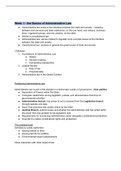
Week 1 - the Basics of Administrative Law
● Administrative law exists at the interface between the state and society – meaning
between civil servants and state institutions, on the one hand, and citizens, business
firms, organized groups, and non-citizens, on the other
● Similar to constitutional law
● Administrative law: serves instead to regulate more concrete issues at the interface
between the state and society
● Constitutional law: resolves in general the great issues of state and society
3 Modules
1. Foundations of Administrative Law
a. History
b. Decision-making
c. Comparative perspective
2. Judicial Review
a. Rule of law
b. Proportionality
3. Administrative law in the Global Context
Positioning Administrative Law
Administrative law is part of the triangle in a democratic system of governance - trias politica
● Separation of Powers within the State
● Triangular relationship among legislator, judicial, and administrative branches of
governmental activities
● Administrative branch: has power to act is received from the Legislative branch
through statutes and laws
● Each if the branches has certain check for the other
● Judicial Branch: judicial review and whether the administrative side has acted within
the power that was granted by the legislative side
● Requirements for functioning administrative sector alongside constitutional protections
● Important to realize constitutional rights and protections
The practical level
Activities by public authorities
● Issuing license to drive
● Issuing permits for building
● Environmental impact assessments
Close interaction with other areas of law
, ● Relevance of licensing and regulatory decisions in international legal disputes
● Impacts of administrative processes on realization of environmental law
What is Administrative law?
Content of Administrative Law
“Administrative law is mainly about:
- administrative authorities and their civil servants,
- how administrative authorities get public powers, → 3 branches and power
from the Legislative
- procedural rules for the use of public powers, → what procedural rules for it
- substantive requirements administrative authorities have to take into account when using
their powers,
- objection procedures and judicial protection against administrative action” →
judicial review
(Backes and Eliantonio, Administrative Law, 262-263)
- Also concerns of corruption → admin law can place corruption
- slow processes
Definition - Backes and Eliantonio, Administrative Law, at 294
“Administrative law mainly deals with the relationship between the executive and
private persons and/or organizations. → connection between the public and the
private
In a democracy, an administrative body is strictly bound by the law. First, it can only exercise
those powers which were assigned to it by means of legislation. (statutory power must be
granted)
According to the rule of law (legality principle) (functioning of society should follow rules and
order as a conceptionalistion), all competences of administrative bodies to perform juridical acts
based on public law must derive from legislation.”
⇒ much debate about the actual definition about Admin law and what it does
⇒ diverse perspectives
,Characteristics of administrative law
1. Public administration => a body distinct from the rest of society that pursues different
goals and must adhere to certain standards of conduct
2. Rules and Remedies (checks and balances) regarding public activities - if rules are not
followed there are remedies
Subjective model vs objective model
Red light theory vs green light theory
3. Constant tension: ‘for’ and ‘against’ the administration
4. Flexible scope => admin law evolves depending on:
- Societal and economic changes
- Constitutional/institutional structure
5. Administrative law as (hidden) behavioral law, or getting those working for the
administration to behave in a way the constitutional framework demands
● Public authorities are key for administrative law
● Raising taxes or other financial contributions is an important task for the administration
● Tasks of administration are e.g.
○ the provision of public goods and services (State now grants social security
benefits and sponsors theatres)
○ monitoring the quality of foodstuffs and food production
○ the implementation of an immigration and naturalization policy
⇒ administrative bodies perform public duties and exercise certain powers
administrative authorities + civil servants are necessary
● The nature of the State has changed from «police State» to «welfare State»
● administrative authorities are guided and bound by procedural rules and substantive
requirements that serve to protect the interests of all parties concerned
● they can interfere with your rights and interests
● legal remedies available to protect your rights and interests against the possible abuses
of the administration
Multilayer Governance
● several levels of administrative decision-making within a nation state:
○ national ministries
, ○ regional authorities of different kinds
○ Municipalities
○ other local bodies
● Depends on the organization of the state (centralized or federal)
In Germany, the Länder enjoy (limited) sovereignty; they are subjects of international law and
therefore competent, within certain boundaries, to conclude international treaties with other
States. The division of tasks and competences between the federation and the Länder is laid
down in the German Basic Law (Grundgesetz) and hence can only be altered by amending the
Grundgesetz.
In the Netherlands, provinces are much more restricted → unitary state
● Due to division of public powers, most countries have authorities specialized in certain
subject areas, which often require specific technical knowledge and equipment
● Regional and national authorities often cooperate closely with the European Commission
and European agencies
● administration is no longer a purely national affair but rather a joint venture of the
European, national, and regional authorities = multilayer governance
Various Instruments and Powers to Protect the General Interest
● Instruments = i.e., juridical and factual acts
● legislator can empower the administrative body to issue general rules and can give the
administrative body the competence to grant subsidies or permits and to take decisions
in individual cases
● Public law competences = competences that are exercised exclusively by public
authorities
○ private law subjects (citizens, enterprises) cannot have those e.g. right
to raise taxes or the right to issue residence permits to foreigners
→ only public law competence
● Private law acts = e.g. concluding a contract for the construction of a bridge, can also
serve the general interest
⇒ Administrative authorities can have both kinds of powers: public and private
Trias Politica (Separation of powers)
= division of power
● There must be division into
○ Legislature
○ Administration (Executive)
○ Judiciary
⇒ avoids power concentration or power abuse
ideal model of the democratic Trias Politica:
● the legislator is chosen by and is responsible to the people
● Administrative law exists at the interface between the state and society – meaning
between civil servants and state institutions, on the one hand, and citizens, business
firms, organized groups, and non-citizens, on the other
● Similar to constitutional law
● Administrative law: serves instead to regulate more concrete issues at the interface
between the state and society
● Constitutional law: resolves in general the great issues of state and society
3 Modules
1. Foundations of Administrative Law
a. History
b. Decision-making
c. Comparative perspective
2. Judicial Review
a. Rule of law
b. Proportionality
3. Administrative law in the Global Context
Positioning Administrative Law
Administrative law is part of the triangle in a democratic system of governance - trias politica
● Separation of Powers within the State
● Triangular relationship among legislator, judicial, and administrative branches of
governmental activities
● Administrative branch: has power to act is received from the Legislative branch
through statutes and laws
● Each if the branches has certain check for the other
● Judicial Branch: judicial review and whether the administrative side has acted within
the power that was granted by the legislative side
● Requirements for functioning administrative sector alongside constitutional protections
● Important to realize constitutional rights and protections
The practical level
Activities by public authorities
● Issuing license to drive
● Issuing permits for building
● Environmental impact assessments
Close interaction with other areas of law
, ● Relevance of licensing and regulatory decisions in international legal disputes
● Impacts of administrative processes on realization of environmental law
What is Administrative law?
Content of Administrative Law
“Administrative law is mainly about:
- administrative authorities and their civil servants,
- how administrative authorities get public powers, → 3 branches and power
from the Legislative
- procedural rules for the use of public powers, → what procedural rules for it
- substantive requirements administrative authorities have to take into account when using
their powers,
- objection procedures and judicial protection against administrative action” →
judicial review
(Backes and Eliantonio, Administrative Law, 262-263)
- Also concerns of corruption → admin law can place corruption
- slow processes
Definition - Backes and Eliantonio, Administrative Law, at 294
“Administrative law mainly deals with the relationship between the executive and
private persons and/or organizations. → connection between the public and the
private
In a democracy, an administrative body is strictly bound by the law. First, it can only exercise
those powers which were assigned to it by means of legislation. (statutory power must be
granted)
According to the rule of law (legality principle) (functioning of society should follow rules and
order as a conceptionalistion), all competences of administrative bodies to perform juridical acts
based on public law must derive from legislation.”
⇒ much debate about the actual definition about Admin law and what it does
⇒ diverse perspectives
,Characteristics of administrative law
1. Public administration => a body distinct from the rest of society that pursues different
goals and must adhere to certain standards of conduct
2. Rules and Remedies (checks and balances) regarding public activities - if rules are not
followed there are remedies
Subjective model vs objective model
Red light theory vs green light theory
3. Constant tension: ‘for’ and ‘against’ the administration
4. Flexible scope => admin law evolves depending on:
- Societal and economic changes
- Constitutional/institutional structure
5. Administrative law as (hidden) behavioral law, or getting those working for the
administration to behave in a way the constitutional framework demands
● Public authorities are key for administrative law
● Raising taxes or other financial contributions is an important task for the administration
● Tasks of administration are e.g.
○ the provision of public goods and services (State now grants social security
benefits and sponsors theatres)
○ monitoring the quality of foodstuffs and food production
○ the implementation of an immigration and naturalization policy
⇒ administrative bodies perform public duties and exercise certain powers
administrative authorities + civil servants are necessary
● The nature of the State has changed from «police State» to «welfare State»
● administrative authorities are guided and bound by procedural rules and substantive
requirements that serve to protect the interests of all parties concerned
● they can interfere with your rights and interests
● legal remedies available to protect your rights and interests against the possible abuses
of the administration
Multilayer Governance
● several levels of administrative decision-making within a nation state:
○ national ministries
, ○ regional authorities of different kinds
○ Municipalities
○ other local bodies
● Depends on the organization of the state (centralized or federal)
In Germany, the Länder enjoy (limited) sovereignty; they are subjects of international law and
therefore competent, within certain boundaries, to conclude international treaties with other
States. The division of tasks and competences between the federation and the Länder is laid
down in the German Basic Law (Grundgesetz) and hence can only be altered by amending the
Grundgesetz.
In the Netherlands, provinces are much more restricted → unitary state
● Due to division of public powers, most countries have authorities specialized in certain
subject areas, which often require specific technical knowledge and equipment
● Regional and national authorities often cooperate closely with the European Commission
and European agencies
● administration is no longer a purely national affair but rather a joint venture of the
European, national, and regional authorities = multilayer governance
Various Instruments and Powers to Protect the General Interest
● Instruments = i.e., juridical and factual acts
● legislator can empower the administrative body to issue general rules and can give the
administrative body the competence to grant subsidies or permits and to take decisions
in individual cases
● Public law competences = competences that are exercised exclusively by public
authorities
○ private law subjects (citizens, enterprises) cannot have those e.g. right
to raise taxes or the right to issue residence permits to foreigners
→ only public law competence
● Private law acts = e.g. concluding a contract for the construction of a bridge, can also
serve the general interest
⇒ Administrative authorities can have both kinds of powers: public and private
Trias Politica (Separation of powers)
= division of power
● There must be division into
○ Legislature
○ Administration (Executive)
○ Judiciary
⇒ avoids power concentration or power abuse
ideal model of the democratic Trias Politica:
● the legislator is chosen by and is responsible to the people