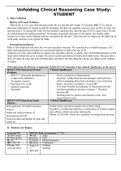
Unfolding Clinical Reasoning Case Study:
STUDENT
I. Data Collection
History of Present Problem:
Mike Kelly is a 51-year-old Caucasian male. He is 6 feet tall and weighs 275 pounds (BMI 37.3) with an
abnormal distribution of weight around his abdomen. He does not regularly exercise, does not like to cook, and
eats fast food 3–5x during the week. He has smoked 1 pack per day since the age of 20 (31 pack years). He has
no current diagnosed medical problems. He became concerned and came to the urgent care facility today
because he is more easily fatigued and has a headache for the past 3 days that has not improved. He didn’t go to
work today and that is not typical for Mike.
Personal/Social History:
Mike is self-employed and owns his own auto mechanic business. He currently has no health insurance. His
father had hypertension and died of a myocardial infarction (MI) at the age of 50.
Angelina, his wife, came with him to urgent care and shares that he is usually stoic with health problems so this
must really bother him or he is afraid. He took Excedrin and Motrin for pain and it didn’t help. She gave him a
dose of Castor oil since she is from Puerto Rico and that is the first thing they do for any illness in her country
of origin.
What data from the histories is important & RELEVANT; therefore it has clinical significance to the nurse?
RELEVANT Data from Present Clinical Significance:
Problem:
- BMI 37.5 (abnormal distribution of - Direct correlation to Hypertension
weight in the abdomen) - Exercise = Helps heart become stronger, and exerts less
- No regular exercise effort in pumping blood into circulation. Less work from
- Fast food 3-5x/ week heart = less force on arteries = Lower BP
- Smoked 1pack/day - Fast food: Possible development of atherosclerosis that
- Headache increases peripheral vascular resistance = Therefore
Increase BP
- Smoking narrows arteries and Hardens walls. Also
causes blood to clot
RELEVANT Data from Social Clinical Significance:
History:
Self employed/ No health insurance Family history put him at greater risk of heart attack
(stress) Excedrin is a medication that has a combination of Tylenol, aspirin
Father has medical history of and caffeine, which can create tachycardia
Motrin is a NSAID, which can contribute to raising blood pressure
hypertension and MI
Took Excedrin and Motrin for pain and
castor oil
II. Patient Care Begins:
Current VS: WILDA Pain Assessment (5th VS):
T: 98.9 (oral) Words: Ache
P: 88 (regular) Intensity: 8/10
R: 20 Location: Global headache
BP: 220/118 Duration: Continuous
O2 sat: 95% Aggravat Nothing
room air (RA) e: Nothing
Alleviate
:
,What VS data is RELEVANT that must be recognized as clinically significant to the nurse?
RELEVANT VS Clinical Significance:
Data:
● BP: 220/118 ● patient has an extremely high blood pressure, can cause further complications
● Pain 8/10 such as left ventricular hypertrophy, coronary atherosclerotic disease,
● Continuous arrhythmias, heart failure, nephrosclerosis & renal failure
global ● management of pain
headache
Current
Assessment:
GENERAL Appears uncomfortable
APPEARANCE:
RESP: Breath sounds clear with equal aeration bilaterally, nonlabored respiratory effort
CARDIAC: Pink, warm & dry, no edema, heart sounds regular-S1S2, pulses bounding, equal
with palpation at
radial/pedal/post-tibial landmarks
NEURO: Alert & oriented to person, place, time, and situation (x4)
GI: Abdomen soft/non-tender, bowel sounds audible per auscultation in all 4 quadrants
GU: Voiding without difficulty, urine clear/yellow
SKIN: Skin integrity intact
What assessment data is RELEVANT that must be recognized as clinically significant to the nurse?
RELEVANT Assessment Data: Clinical Significance:
-Blood Pressure of 220/118 >190 systolic is hypertensive emergency
-bounding pulses Fluid overload and hypertensive
III. Clinical Reasoning Begins…
1. What is the primary problem that your patient is most likely presenting with?
Primary Hypertension
2. What is the underlying cause/pathophysiology of this concern?
In primary hypertension, there is no clear cause, but is thought to be linked to:
modifiable
poor diet: doesn’t like to cook, eats fast food 3-5x per week
lack of exercise: does not exercise regularly
obesity: BMI 37.3 abnormal distribution around abdomen
non modifiable
genetics: father had hypertension and diet of MI
3. What nursing priority will guide your plan of care?
Lower blood pressure
Order blood works including BMP, BUN, serum lipid profile
12 Lead EKG
Routine Urinalysis
Taking blood
pressure Serum uric
acid
, Restricted diet (salts)
Encourage exercise
Visual changes, dizziness, headache, chest pain, dizziness
STUDENT
I. Data Collection
History of Present Problem:
Mike Kelly is a 51-year-old Caucasian male. He is 6 feet tall and weighs 275 pounds (BMI 37.3) with an
abnormal distribution of weight around his abdomen. He does not regularly exercise, does not like to cook, and
eats fast food 3–5x during the week. He has smoked 1 pack per day since the age of 20 (31 pack years). He has
no current diagnosed medical problems. He became concerned and came to the urgent care facility today
because he is more easily fatigued and has a headache for the past 3 days that has not improved. He didn’t go to
work today and that is not typical for Mike.
Personal/Social History:
Mike is self-employed and owns his own auto mechanic business. He currently has no health insurance. His
father had hypertension and died of a myocardial infarction (MI) at the age of 50.
Angelina, his wife, came with him to urgent care and shares that he is usually stoic with health problems so this
must really bother him or he is afraid. He took Excedrin and Motrin for pain and it didn’t help. She gave him a
dose of Castor oil since she is from Puerto Rico and that is the first thing they do for any illness in her country
of origin.
What data from the histories is important & RELEVANT; therefore it has clinical significance to the nurse?
RELEVANT Data from Present Clinical Significance:
Problem:
- BMI 37.5 (abnormal distribution of - Direct correlation to Hypertension
weight in the abdomen) - Exercise = Helps heart become stronger, and exerts less
- No regular exercise effort in pumping blood into circulation. Less work from
- Fast food 3-5x/ week heart = less force on arteries = Lower BP
- Smoked 1pack/day - Fast food: Possible development of atherosclerosis that
- Headache increases peripheral vascular resistance = Therefore
Increase BP
- Smoking narrows arteries and Hardens walls. Also
causes blood to clot
RELEVANT Data from Social Clinical Significance:
History:
Self employed/ No health insurance Family history put him at greater risk of heart attack
(stress) Excedrin is a medication that has a combination of Tylenol, aspirin
Father has medical history of and caffeine, which can create tachycardia
Motrin is a NSAID, which can contribute to raising blood pressure
hypertension and MI
Took Excedrin and Motrin for pain and
castor oil
II. Patient Care Begins:
Current VS: WILDA Pain Assessment (5th VS):
T: 98.9 (oral) Words: Ache
P: 88 (regular) Intensity: 8/10
R: 20 Location: Global headache
BP: 220/118 Duration: Continuous
O2 sat: 95% Aggravat Nothing
room air (RA) e: Nothing
Alleviate
:
,What VS data is RELEVANT that must be recognized as clinically significant to the nurse?
RELEVANT VS Clinical Significance:
Data:
● BP: 220/118 ● patient has an extremely high blood pressure, can cause further complications
● Pain 8/10 such as left ventricular hypertrophy, coronary atherosclerotic disease,
● Continuous arrhythmias, heart failure, nephrosclerosis & renal failure
global ● management of pain
headache
Current
Assessment:
GENERAL Appears uncomfortable
APPEARANCE:
RESP: Breath sounds clear with equal aeration bilaterally, nonlabored respiratory effort
CARDIAC: Pink, warm & dry, no edema, heart sounds regular-S1S2, pulses bounding, equal
with palpation at
radial/pedal/post-tibial landmarks
NEURO: Alert & oriented to person, place, time, and situation (x4)
GI: Abdomen soft/non-tender, bowel sounds audible per auscultation in all 4 quadrants
GU: Voiding without difficulty, urine clear/yellow
SKIN: Skin integrity intact
What assessment data is RELEVANT that must be recognized as clinically significant to the nurse?
RELEVANT Assessment Data: Clinical Significance:
-Blood Pressure of 220/118 >190 systolic is hypertensive emergency
-bounding pulses Fluid overload and hypertensive
III. Clinical Reasoning Begins…
1. What is the primary problem that your patient is most likely presenting with?
Primary Hypertension
2. What is the underlying cause/pathophysiology of this concern?
In primary hypertension, there is no clear cause, but is thought to be linked to:
modifiable
poor diet: doesn’t like to cook, eats fast food 3-5x per week
lack of exercise: does not exercise regularly
obesity: BMI 37.3 abnormal distribution around abdomen
non modifiable
genetics: father had hypertension and diet of MI
3. What nursing priority will guide your plan of care?
Lower blood pressure
Order blood works including BMP, BUN, serum lipid profile
12 Lead EKG
Routine Urinalysis
Taking blood
pressure Serum uric
acid
, Restricted diet (salts)
Encourage exercise
Visual changes, dizziness, headache, chest pain, dizziness