Easements – Problem Questions
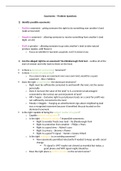
1) Identify possible easements
- Positive easement – giving someone the right to do something over another’s land
(walk across land)
- Negative easement – allowing someone to receive something from another’s land
(light, air etc)
- Profit à prendre – allowing someone to go onto another’s land to take natural
produce (apples, wild flowers)
o Focus on whether it has been acquired, not if it exists in law
2) Can the alleged right be an easement? Re-Ellenborough Park test – outline all at the
start of answer and refer back to them on the facts
Is there a dominant and servient tenement?
Is there diversity of ownership?
o You cannot enjoy an easement over your own land; would be a quasi-
easement – Roe v Siddons
Does the right accommodate the dominant tenement?
o Right must be sufficiently connected to and benefit the land, not the owner
personally
o Does it increase the value of the land? Is it a commercial advantaged
connected to the normal use and enjoyment of land?
o Hill v Tupper – Exclusive right to put pleasure boats on a canal for profit was
not sufficiently connected to the land
o Moody v Steggles – Hanging an advertisement sign above neighboring land
was a recognized easement because it benefited the pub located on the
dominant tenement
Is the right capable of being the subject matter of a grant?
o Capable grantor and grantee?
o Is the right sufficiently definite? Impossible easements:
Right to wander freely over land – Re Ellenborough Park
Right to protection from weather – Philips v Pears
Right to a good view – Aldred’s case
Right to privacy – Browne v Flower
Right to a good TV signal – Hunter v Canary Wharf
o Is the right analogous to an existing easement?
New easements permitted reluctantly if needed to keep up with social
change
TV signal in 1997 maybe not viewed as essential but today, a
good phone and WIFI signal might/should be
o Does the right place a positive burden on the servient owner?
1) Identify possible easements
- Positive easement – giving someone the right to do something over another’s land
(walk across land)
- Negative easement – allowing someone to receive something from another’s land
(light, air etc)
- Profit à prendre – allowing someone to go onto another’s land to take natural
produce (apples, wild flowers)
o Focus on whether it has been acquired, not if it exists in law
2) Can the alleged right be an easement? Re-Ellenborough Park test – outline all at the
start of answer and refer back to them on the facts
Is there a dominant and servient tenement?
Is there diversity of ownership?
o You cannot enjoy an easement over your own land; would be a quasi-
easement – Roe v Siddons
Does the right accommodate the dominant tenement?
o Right must be sufficiently connected to and benefit the land, not the owner
personally
o Does it increase the value of the land? Is it a commercial advantaged
connected to the normal use and enjoyment of land?
o Hill v Tupper – Exclusive right to put pleasure boats on a canal for profit was
not sufficiently connected to the land
o Moody v Steggles – Hanging an advertisement sign above neighboring land
was a recognized easement because it benefited the pub located on the
dominant tenement
Is the right capable of being the subject matter of a grant?
o Capable grantor and grantee?
o Is the right sufficiently definite? Impossible easements:
Right to wander freely over land – Re Ellenborough Park
Right to protection from weather – Philips v Pears
Right to a good view – Aldred’s case
Right to privacy – Browne v Flower
Right to a good TV signal – Hunter v Canary Wharf
o Is the right analogous to an existing easement?
New easements permitted reluctantly if needed to keep up with social
change
TV signal in 1997 maybe not viewed as essential but today, a
good phone and WIFI signal might/should be
o Does the right place a positive burden on the servient owner?