NURS 280 comp 2 review Q&A with rationale
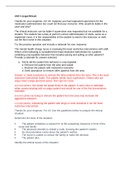
UNIT 4 (Legal/Ethical) Thanks for your response. For #3: Suppose you had requested supervision for the medication administration but could not find your instructor. Who would be liable in this case and why? The clinical instructor can be liable if supervision was requested but not available for a student. The student has a duty to perform correct administration of meds, same as a registered nurse. It is the responsibility of the student to wait for the instructor or seek out the floor nurse in this situation. Try this practice question and include a rationale for your response: The mental health charge nurse is reviewing the least restrictive interventions with staff. Which of the following is considered the least restrictive intervention for a patient exhibiting unacceptable behavior that includes pacing and yelling at other patients? Provide a rationale for answer selected. a. Firmly tell the patient this behavior is unacceptable b. Remove the patient from the area and isolate c. Restrain the patient with meds/wrist restraints d. Seek assistance to remove other patients from the area Answer: d. Seek assistance to remove the other patients from the area. This is the least restrictive intervention listed. This patient needs more supervision. Clients who are angry need a large personal space. Don’t get too close. a is not correct. You would not speak firmly to the patient. A calm voice is indicated when communicating with an angry patient and would be one of the first interventions indicated. b is not correct as trying to remove the patient from the area may increase the aggressive behavior. c is not correct, restraining the patient with drugs or wrist restraints is not the least restrictive intervention. Thanks for your response. For #3: Use the guidelines below to analyze the ethical situation. Determine the facts of the situation: The patient verbalizes a request for no life-sustaining measures in front of the nurse and family. The physician decides to initiate a code, knowing the patient's wishes. No documentation exists about the patient's wishes. The nurse is unable to contact the family to make the decision. The patient dies. Identify the ethical issues of the situation: The patient has the right to autonomy and does make a decision. The nurse is obligated to do good for the patient (beneficence) by informing the physician of the patient's wishes and attempting to contact the family. The nurse has the duty to be faithful to commitments (fidelity) and attempts to abide by the patient's wishes by informing the physician prior to the code. We may be administering KCL via IV for patients if the K levels drops too low. What are nursing priorities when administering KCL IV? See drug alert box page 177 in IGGY for potassium guidelines. A NPSG is to never give K by IV push due to cardiac arrest. Iggy notes 5-10meq/hr is maximum recommended infusion rate and to not exceed 20meq/hr. Potassium is always diluted and infused slowly. It’s important to make sure the patient has adequate urine output before administering K. Also, skeletal muscle weakness is associated with hypokalemia and patients may be too weak to stand. Provide assistance for safety as patients with hypokalemia are at risk for falls. Cardiac monitoring is necessary, we will see PVCs and possibly other dysrhythmias when K level is low. Also, patients with low K levels should not be taking potassium depleting diuretics. Review the medication record to ensure medications that are contraindicated such as K depleting diuretics are not prescribed for these patients
Información del documento
- Subido en
- 16 de junio de 2022
- Número de páginas
- 25
- Escrito en
- 2021/2022
- Tipo
- Examen
- Contiene
- Preguntas y respuestas