Introduction (Ch 1)
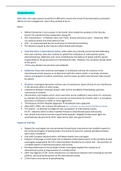
Main idea: the major powers would find it difficult to reverse the trend of internationally coordinated
efforts at crisis management, even if they wished to do so.
Notes:
• Mikhail Gorbachev’s rise to power in the Soviet Union ended the paralysis of the Security
Council → a period of close cooperation among P5
• Still, interventions – in Rwanda, Haiti, East Timor, Kosovo and Sierra Leone – show that UNSC
can easily be drawn into international crises
• 9/11 - an unprecedented but too brief show of international solidarity
• The divisions caused by the Iraq war unfortunately went deeper.
• View that there is international society: while states are primarily concerned with defending
their own interests, they also combine to uphold the institutions of international society:
international law, diplomacy and, more contentiously, the balance of power and the special
responsibility of the great powers for international order. However, the consensus breaks down
at this point.
→ this view divides into pluralists and solidarists
• Solidarists: those who hold that sovereignty is conditional and that the existence of an
international society requires us to determine both the ends to which, in principle, all states,
nations and peoples should be committed, and the means by which international order should
be upheld.
• Pluralists: sovereignty demands minimal rules of coexistence, above all that of non-interference
in the domestic affairs of other states.
• coexistence between sovereign powers rules out the possibility of developing a genuine
community of mankind
• Interventions may happen and in some cases they can be justified (in cases when it is necessary
to maintain the balance of power or to counter an intervention by a hostile state + as exception,
permission of alliances to deter or resist aggression)
• → Holocaust, Pol Pot, Rwanda happened → broadened vision appeared
• After WW1, WW2, the LoN and UN reflected the confusion on the pluralist/solidarist divide
• The Charter - an attempt to bridge the two conceptions of international society.
Ch VII - collective action to deter manifest threats to international peace and security
• how should international society respond when peoples’ allegedly fundamental rights are
systematically abused not by other states but by their own governments?
Impact of Cold War
• Respect for sovereignty not only prevented humanitarian intervention but entailed respect for
the territorial integrity of existing states. The merits of claims for national self-determination
were never considered.
• Only with European decolonisation, self-determination was used again
• Paralysis of SC(usage of veto) static and unreflective interpretation given to the principle of state
sovereignty marginalised the UN in what had been intended as its central role – the provision of
a credible system of international peace and security.
• the deep attachment to the principle of state sovereignty explains the resistance of
international society to improvement of a solidarist kind
• other two legacies of CW: 1) the introduction of a distinction between the humanitarian and the
political, and security dimensions of the international society.
• 2) the theory and practice of peacekeeping.
Main idea: the major powers would find it difficult to reverse the trend of internationally coordinated
efforts at crisis management, even if they wished to do so.
Notes:
• Mikhail Gorbachev’s rise to power in the Soviet Union ended the paralysis of the Security
Council → a period of close cooperation among P5
• Still, interventions – in Rwanda, Haiti, East Timor, Kosovo and Sierra Leone – show that UNSC
can easily be drawn into international crises
• 9/11 - an unprecedented but too brief show of international solidarity
• The divisions caused by the Iraq war unfortunately went deeper.
• View that there is international society: while states are primarily concerned with defending
their own interests, they also combine to uphold the institutions of international society:
international law, diplomacy and, more contentiously, the balance of power and the special
responsibility of the great powers for international order. However, the consensus breaks down
at this point.
→ this view divides into pluralists and solidarists
• Solidarists: those who hold that sovereignty is conditional and that the existence of an
international society requires us to determine both the ends to which, in principle, all states,
nations and peoples should be committed, and the means by which international order should
be upheld.
• Pluralists: sovereignty demands minimal rules of coexistence, above all that of non-interference
in the domestic affairs of other states.
• coexistence between sovereign powers rules out the possibility of developing a genuine
community of mankind
• Interventions may happen and in some cases they can be justified (in cases when it is necessary
to maintain the balance of power or to counter an intervention by a hostile state + as exception,
permission of alliances to deter or resist aggression)
• → Holocaust, Pol Pot, Rwanda happened → broadened vision appeared
• After WW1, WW2, the LoN and UN reflected the confusion on the pluralist/solidarist divide
• The Charter - an attempt to bridge the two conceptions of international society.
Ch VII - collective action to deter manifest threats to international peace and security
• how should international society respond when peoples’ allegedly fundamental rights are
systematically abused not by other states but by their own governments?
Impact of Cold War
• Respect for sovereignty not only prevented humanitarian intervention but entailed respect for
the territorial integrity of existing states. The merits of claims for national self-determination
were never considered.
• Only with European decolonisation, self-determination was used again
• Paralysis of SC(usage of veto) static and unreflective interpretation given to the principle of state
sovereignty marginalised the UN in what had been intended as its central role – the provision of
a credible system of international peace and security.
• the deep attachment to the principle of state sovereignty explains the resistance of
international society to improvement of a solidarist kind
• other two legacies of CW: 1) the introduction of a distinction between the humanitarian and the
political, and security dimensions of the international society.
• 2) the theory and practice of peacekeeping.