NURS 246 Clinical Lab Fetal Heart Rate Patterns
Readings
Foundations of Maternal-Newborn Nursing by Murray and McKinney: Chapter 14
ATI, Maternal Newborn Nursing, edition 10.0: Chapter 13
Video: Electronic Fetal Monitoring
Fetal Monitoring
What is external fetal monitoring and what equipment is used? The EFM uses external
transducers placed on the mother’s abdomen to assess FHR and UA. The ultrasound
transducer works by reflecting high frequency sound waves off a moving interface; in this
case the fetal heart and valves. The tocotransducer measures UA transabdominally. The
device is placed over the fundus above the umbilicus and held securely in place by using
an elastic belt. It can measure and record the frequency and approximate duration of UC’s
but not their intensity.
How does internal Fetal Monitoring differ from external monitoring and what equipment is used?
Uses a spiral electrode applied to the fetal presenting part to assess the FHR and an intrauterine
pressure catheter to assess UA and uterine resting tone. The technique of continuous internal
FHR or UA monitoring provides a more accurate appraisal of fetal well-being during labor than
external monitoring because it is not interrupted by fetal or maternal movement or affected by
maternal size. For this type of monitoring the membranes must be ruptured, the cervix
sufficiently dilated and the presenting part low enough to allow placement of the spiral electrode
or IUPC or both.
Revised 7/19
This study source was downloaded by 100000839743722 from CourseHero.com on 01-06-2022 05:07:03 GMT -06:00
https://www.coursehero.com/file/78811705/Fetal-Monitoring1-1docx/
, NURS 246 Clinical Lab
Fetal Heart Rate Patterns
Why is the baby monitored?
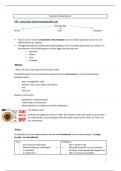
The monitor strip
Mark the strip and label the following:
a. Intervals between bold lines are 1 minute
b. Intervals between small boxes equal 10 seconds
c. Fetal heart rate (scale on top of paper)
d. Contraction tracing (scale on bottom of paper)
Define Normal Fetal Heart Rate baseline. The average rate during a 10 minutes segment that
excludes periodic or episodic changes, periods of marked variability, and segments of the
baseline that differ by more than 25beats/min. There must be at least two minutes of interpretable
baseline.
What is baseline variability
a. Absent: amplitude range undetectable
Revised 7/19
This study source was downloaded by 100000839743722 from CourseHero.com on 01-06-2022 05:07:03 GMT -06:00
https://www.coursehero.com/file/78811705/Fetal-Monitoring1-1docx/
Readings
Foundations of Maternal-Newborn Nursing by Murray and McKinney: Chapter 14
ATI, Maternal Newborn Nursing, edition 10.0: Chapter 13
Video: Electronic Fetal Monitoring
Fetal Monitoring
What is external fetal monitoring and what equipment is used? The EFM uses external
transducers placed on the mother’s abdomen to assess FHR and UA. The ultrasound
transducer works by reflecting high frequency sound waves off a moving interface; in this
case the fetal heart and valves. The tocotransducer measures UA transabdominally. The
device is placed over the fundus above the umbilicus and held securely in place by using
an elastic belt. It can measure and record the frequency and approximate duration of UC’s
but not their intensity.
How does internal Fetal Monitoring differ from external monitoring and what equipment is used?
Uses a spiral electrode applied to the fetal presenting part to assess the FHR and an intrauterine
pressure catheter to assess UA and uterine resting tone. The technique of continuous internal
FHR or UA monitoring provides a more accurate appraisal of fetal well-being during labor than
external monitoring because it is not interrupted by fetal or maternal movement or affected by
maternal size. For this type of monitoring the membranes must be ruptured, the cervix
sufficiently dilated and the presenting part low enough to allow placement of the spiral electrode
or IUPC or both.
Revised 7/19
This study source was downloaded by 100000839743722 from CourseHero.com on 01-06-2022 05:07:03 GMT -06:00
https://www.coursehero.com/file/78811705/Fetal-Monitoring1-1docx/
, NURS 246 Clinical Lab
Fetal Heart Rate Patterns
Why is the baby monitored?
The monitor strip
Mark the strip and label the following:
a. Intervals between bold lines are 1 minute
b. Intervals between small boxes equal 10 seconds
c. Fetal heart rate (scale on top of paper)
d. Contraction tracing (scale on bottom of paper)
Define Normal Fetal Heart Rate baseline. The average rate during a 10 minutes segment that
excludes periodic or episodic changes, periods of marked variability, and segments of the
baseline that differ by more than 25beats/min. There must be at least two minutes of interpretable
baseline.
What is baseline variability
a. Absent: amplitude range undetectable
Revised 7/19
This study source was downloaded by 100000839743722 from CourseHero.com on 01-06-2022 05:07:03 GMT -06:00
https://www.coursehero.com/file/78811705/Fetal-Monitoring1-1docx/