Escrito por estudiantes que aprobaron Inmediatamente disponible después del pago Leer en línea o como PDF ¿Documento equivocado? Cámbialo gratis 4,6 TrustPilot
logo-home
Examen

LCP4804 PORTFOLIO MEMO - MAY/JUNE 2022 - SEMESTER 1 - WITH DETAILED FOOTNOTES AND BIBLIOGRAPHY

Puntuación
-
Vendido
-
Páginas
18
Grado
A+
Subido en
09-06-2022
Escrito en
2021/2022

LCP4804 PORTFOLIO MEMO - MAY/JUNE 2022 - SEMESTER 1 - WITH DETAILED FOOTNOTES AND BIBLIOGRAPHY . QUESTION 1 (a) Write down the definition of customary law as it appears from section 1 of the Recognition of Customary Marriages Act 120 of 1998; and then use its wording to explain the nature, role and function of this component of the South African legal system as appears in case law. (10) (b) Apply extracts (i) and (ii) below to analyse the differences between the status, nature and characteristics of customary law under the pre- and the post- constitutional periods in South African law – (i) Section 11(1) of the Black Administration Act 38 of 1927 reads in part: “It shall be in the discretion of the Commissioners’ Courts in all suits or proceedings between Blacks involving questions of customs followed by Blacks, to decide such questions according to the Black law applying to such customs except in so far [as] it shall have been repealed or modified: provided that such Black law shall not be opposed to the principles of public policy or natural justice...” (pre-constitutional law); and – (ii) Section 211(3) of the Constitution of the Republic of South Africa, 1996 reads: “The courts must apply customary law when that law is applicable, subject to the Constitution and any legislation that specifically deals with customary law.” (post- constitutional law). (NB-The value of your answer will be enhanced by the application of relevant case law). (20) QUESTION 2 Examine the following scenario and answer the questions that follow: X is the most senior son of B, a deceased traditional leader of one of the prominent kingdoms in South Africa. He hopes to succeed his father as a traditional leader and head of the relevant traditional authority in terms of legislation and customs presently practised by the jural community. The royal family has identified him (X) as the person qualified for appointment to those roles and has presented his particulars to the government for that purpose in terms of section 11 of the Traditional Leadership and Governance Framework Act 41 of 2003. X has an elder sister Y who also aspires to succeed her father as the traditional leader and head of the said traditional authority. She believes that she has a stronger right than X to succeed her father (B), and that her feminine gender is no bar to her assumption of that role. However, Y's bid has not been supported by the royal family and consequently has not been recommended by the traditional authority in terms of the Act. Y has launched a high court application to be declared the rightful successor to the position left vacant by her father's (B's) death. The traditional authority is supporting X in his defence against Y's High Court application. Critically evaluate X's and Y's chances of success for appointment in the position of traditional leader and head of the traditional authority. (i) Taking into account the historical traditions and the culture surrounding appointments to traditional leadership in South Africa, what considerations do you think would have persuaded the traditional authority to support X rather than Y in their recommendations to the government, notwithstanding Y’s age and the provisions of section 11 of the Traditional Leadership and Governance Framework Act, 41 of 2003 and case law. Provide reasons. (10) (ii) If the traditional authority has not amended its past practices for appointing traditional leaders, and no contemporary practices have been adopted in line with the values of the new constitutional order, which version of customary law would it have to apply in its recommendations and give reasons. (10) (iii) If a contemporary practice has emerged among the entire community, mainstreaming compliance with the Bill of Rights in the appointment processes of traditional functionaries, which version of customary law would the traditional authority be obliged to apply in its recommendations and give reasons. (15) QUESTION 3 (a) Write critical comments on the following judgments (excluding details on facts) with reference to the pressing transformation and women’s empowerment agenda in customary law: (1) Mayelane v Ngwenyama and Another 2013 (8) BCLR 918 (CC). (5) (2) Mabena v Letsoalo 1998 (2) SA 1068 (T). (5) (b) The institution of sisa/mafisa/nqoma was the main indigenous empowerment instrument during the pre-colonial period. With reference to its constitutive elements, illustrate how the applicable attributes of ubuntu reflected therein, contributed to the principle of umuntu ngumuntu ngabantu/motho ke motho ka batho in preventing the onset of poverty in society. (10) [20] QUESTION 4 Write a comprehensive essay for presentation at an international conference on good governance highlighting the potential of the values engrained in the indigenous philosophy – kgosi ke kgosi ka batho/inkosi yinkosi ngabantu – to limit public power. (this principle means - the source of royal authority is the community). Your reference to the Constitutional Court in Pilane and Another v Pilane and Others 2013 (4) BCLR 431 (CC) may indicate whether in your view a wonderful opportunity was not missed to illustrate this indigenous principle of enforcing freedom of expression; freedom of assembly/demonstration as well as freedom of association. Your views will take into account that the court substituted Roman-Dutch principles for the African ones in its efforts to resolve this customary law dispute. (15) TOTAL:{100} Extreme care is used by our Tutors to draft our documents, however the contents are provided “as is” without any representations or warranties, express or implied. The documents we provide is to be used for comparison, research and reference purposes ONLY.

Mostrar más Leer menos
Institución
Grado

Vista previa del contenido

LCP4804
QUESTION 1


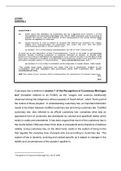
Customary law is defined in section 1 of the Recognition of Customary Marriages
Act 1 (hereafter referred to as RCMA) as the “usages and customs traditionally
observed among the indigenous African peoples of South Africa”, which “forms part of
the culture of those peoples”. In understanding customary law, an important distinction
needs to be drawn between codified customary law and living customary law. Codified
customary law, also referred to as official customary law, comprises what was an
oppressive form of customary law developed by colonial and apartheid states which
exists in codes and precedents. It has been argued that much of the customary law in
the courts before 1994 was drawn from texts or precedents and is therefore of dubious
validity. Living customary law, on the other hand, exists in the system of living norms
that regulate the everyday lives of people who live according to customary law. This
system of law is dynamic, evolving and context-specific as it adapts to changes in the
beliefs and circumstances of the people it applies to.


1 Recognition of Customary Marriages Act, 120 of 1998

Escuela, estudio y materia

Institución
Grado

Información del documento

Subido en
9 de junio de 2022
Número de páginas
18
Escrito en
2021/2022
Tipo
Examen
Contiene
Preguntas y respuestas

Temas

$25.40
Accede al documento completo:

¿Documento equivocado? Cámbialo gratis Dentro de los 14 días posteriores a la compra y antes de descargarlo, puedes elegir otro documento. Puedes gastar el importe de nuevo.
Escrito por estudiantes que aprobaron
Inmediatamente disponible después del pago
Leer en línea o como PDF


Documento también disponible en un lote

Conoce al vendedor

Seller avatar
Los indicadores de reputación están sujetos a la cantidad de artículos vendidos por una tarifa y las reseñas que ha recibido por esos documentos. Hay tres niveles: Bronce, Plata y Oro. Cuanto mayor reputación, más podrás confiar en la calidad del trabajo del vendedor.
LLBExampacksAndTutorials University of South Africa (Unisa)
Seguir Necesitas iniciar sesión para seguir a otros usuarios o asignaturas
Vendido
5407
Miembro desde
7 año
Número de seguidores
2508
Documentos
750
Última venta
3 semanas hace
LLB EXAMPACKS AND TUTORIALS

At LLB Exampacks and tutorials we focus on all law students studying at Unisa. Our Aim is to help prepare law students in their pursuit of legal careers ,and in their role as future leaders in South Africa. LLB Exam packs and tutorials is the only company that goes the extra-mile to make sure that law students get the best study materials at minimum cost. Our Vision is to offer the best study materials to our students.Our mission is to provide highest possible quality at the right price. Our commitment to offer nothing but the very best is reflected in our vision & mission statements.We now strive to take our institution to the next level so that we can serve our students even better and continue to keep them fully satisfied. As an institution we are fully committed to provide the best possible service at every point to all our students. It is our sincere commitment that we want to not just meet, but far exceed our student’s expectations when it comes to service & support. We try our best to ensure that there is absolutely no slippage in our service. So you are free to contact us any time and we very much look forward to serving you.

Lee mas Leer menos
3.3

434 reseñas

5
180
4
42
3
65
2
35
1
112

Recientemente visto por ti

Por qué los estudiantes eligen Stuvia

Creado por compañeros estudiantes, verificado por reseñas

Calidad en la que puedes confiar: escrito por estudiantes que aprobaron y evaluado por otros que han usado estos resúmenes.

¿No estás satisfecho? Elige otro documento

¡No te preocupes! Puedes elegir directamente otro documento que se ajuste mejor a lo que buscas.

Paga como quieras, empieza a estudiar al instante

Sin suscripción, sin compromisos. Paga como estés acostumbrado con tarjeta de crédito y descarga tu documento PDF inmediatamente.

Student with book image

“Comprado, descargado y aprobado. Así de fácil puede ser.”

Alisha Student

Preguntas frecuentes