QUIZ 1: Physical Assessment Q&A
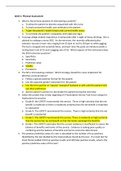
QUIZ 1: Physical Assessment 1. What is the primary purpose of interviewing a patient? a. To allow the patient to become acquainted with the nurse b. To teach preventive health care methods to the patient c. To geƚ ƚhe paƚienƚ͛Ɛ healƚh hiƐƚoƌLJ and cƵƌƌenƚ healƚh status d. To coƌƌelaƚe ƚhe paƚienƚ͛Ɛ complainƚƐ ǁiƚh objecƚiǀe ƐignƐ 2. A young college student experience is tachycardia after a night of heavy drinking. She is advised to undergo a stress EKG. As she exercises, the recently calibrated pulse oximeter records a heart rate ranging from 25 bpm at rest to 50 bpm to while jogging. The test is stopped and restarted twice, and each time the pulse ox immature yields a resting heart rate of 25 and a jogging rate of 50. Which aspects of this instrument does the EKG technician question? a. Specificity b. Sensitivity c. Predictive value d. Validity e. Prevalence 3. The NP is interviewing a lesbian. Which strategy should the nurse implement for effective communication? a. Follow a special question format for the patient b. Use the opposite-gender interpreter for the patient c. UƐe ƚhe ƚeƌm paƌƚneƌ oƌ ͞ƐpoƵƐe͟ inƐƚead of hƵƐband oƌ ǁife Ƶnƚil ƚhe paƚienƚ ƚellƐ you their preference d. AƐk ƚhe paƚienƚ͛Ɛ paƌƚneƌ ƚo Ɛiƚe beƐide ƚhe paƚienƚ dƵƌing ƚhe inƚeƌǀieǁ 4. Select the answer that is false regarding US Preventative Service Task Force ratings for implications for practice a. Grade B: the USPSTF recommends the service. There is high certainty that the net benefit is moderate or there is moderate certainty that the net benefit is moderate to substantial b. Grade A: The USPSTF recommends the service. There is high certainty that the net benefit is substantial c. Grade C: The USPSTF recommends the service. There is moderate or high certainty that the service has no net benefit or that the harms outweigh the benefits d. Grade I: The USPSTF concludes that the current evidence is insufficient to assess the balance of benefits and harms of the service. Evidence is lacking poor quality or conflicting and the balance of benefits and harms cannot be determined. 5. The positive predictive value of a test is calculated as the number of true positives identified by the test divided by the total positives found by the test. If a novel test for strep throat yielded 150 true positive results and 150 false positive results, what is the positive predictive value of this test? 1. What is the primary purpose of interviewing a patient? a. To get the patient’s health history and current health status 2. How should NP document a patient’s reason for seeking care? a. Record the symptoms in the patient’s word in the chief complaint. 3. Beside the abdomen the approach for examination of the body should follow a pattern (choose one) A. Inspection, palpation, percussion, Auscultation 4. A mother brings her eight-year-old daughter to the clinic because she found a tick in the girl hair and would like her daughter to be tested for Lyme disease. The nurse practitioners explains that the enzyme linked to immunosorbent assay (ELISA) is a test for Lyme disease. She explains it is effective in finding early cases of Lyme disease but can also give positive results in some people who do not have the Lyme disease, making additional testing necessary. This means that the Elisa test has which of the following:
Información del documento
- Subido en
- 8 de junio de 2022
- Número de páginas
- 26
- Escrito en
- 2021/2022
- Tipo
- Examen
- Contiene
- Preguntas y respuestas