NURSING 6001 QUIZ BANK QUESTIONS AND ANSWERS
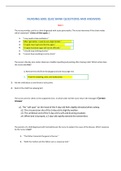
NURSING 6001 QUIZ BANK QUESTIONS AND ANSWERS The nurse provides care for a client diagnosed with acute pancreatitis. The nurse intervenes if the client makes which statement? ( Select all that apply. ) 1. “I may need to take antibiotics.” 2. 3. 4. 5. “I should stop drinking alcohol.” 6. “I cannot have anything to eat or drink.” The nurse in the day care center observes a toddler squatting and panting after chasing a ball. Which action does the nurse take first? 1. Remove the child from the playground and encourage rest. 2. 3. Ask the child about a sore throat or achy joints. 4. Restrict the child from playing ball. The nurse cares for clients in the outpatient clinic. In which order will the nurse return the messages? Correct Answer •1. The "soft spot" on the head of the 4-day-old feels slightly elevated when asleep. •2. The circumcision site of the 3-day-old is slightly swollen. •3. The umbilical cord of the 5-day-old is soft and draining exudate. •4. When bed is bumped, a 2-day-old rapidly extends the extremities. The parents of a child diagnosed with hemophilia ask the nurse to explain the cause of the disease. Which response by the nurse is best? 1. "The father transmits the gene to the son." 2. "Both the mother and the father carry a recessive trait." 3. 4. "There is a 50% chance that the mother will pass the trait to each of the daughters." The 6-month-old is brought to the clinic for a well-baby checkup. During the exam, the nurse expects to observe which assessment findings? Select all that apply. 1. A pincer grasp. 2. 3. Tripling of the birth weight. 4. Presence of the posterior fontanelle 5. 6. A client with an endotracheal tube requires suctioning. Which statement is an accurate description of how the nurse performs the procedure? 1. Inserts the suction catheter 4 in into the tube. Applies suction for 30 seconds, using a twirling motion as the catheter is withdrawn. 2. Hyperoxygenates the client. Inserts the suction catheter into the tube, and suctions while removing the catheter in a back and forth motion. 3. Explains the procedure to the client. Inserts the catheter gently while applying suction, and withdraws using a twisting motion. 4. A client comes to the outpatient psychiatric clinic for treatment of a fear of heights. The nurse knows that phobias involve which behaviors? 1. 2. Sublimation and internalization. 3. Rationalization and intellectualization. 4. Reaction formation and symbolization. The nurse cares for the prenatal client at 8 weeks’ gestation with a positive VDRL. When the nurse prepares the teaching plan, it is most important for the nurse to include which information? 1. Advise the client not to take any over-the-counter medications. 2. 3. Inform the client to refrain from sexual activity. 4. Maintain the confidentiality of sexual partners or contacts. The nurse performs range-of-motion (ROM) exercises for an elderly client recently immobilized. The nurse identifies which statement as correct about range-of-motion? 1. Passive ROM exercises increase muscle strength. 2. A full ROM must be completed for the elderly client. 3. Exercises should be completed to the point of discomfort. 4. The nurse cares for an older client scheduled for a colon resection this morning. The nurse notes the client had polyethylene glycol-electrolyte solution and a soapsuds enema the previous evening. This morning the client passes a medium amount of soft brown stool. Which conclusion by the nurse is most accurate? 1. 2. The client ate something after midnight. 3. This is an expected finding before this type of surgery. 4. The client passed the last stool left in the colon. The nurse cares for the newborn infant diagnosed with fetal alcohol syndrome. The nurse expects to see which characteristics? 1. An infant large for gestational age (LGA), craniofacial abnormalities, and hydrocephalus. 2. 3. An infant with a large head circumference, low birth weight, and excessive rooting and sucking behaviors. 4. An infant with a normal head circumference, low birth weight, and respiratory distress syndrome. The nurse watches as a parent and infant interact. The infant throws a toy to the floor numerous times. The parent picks up the toy and gives it back to the infant. If the parent does not immediately return the toy, the infant cries loudly. Which statement by the nurse is best?
Información del documento
- Subido en
- 3 de junio de 2022
- Número de páginas
- 178
- Escrito en
- 2021/2022
- Tipo
- Examen
- Contiene
- Preguntas y respuestas