C: Explore the physiology of the digestive
system and the use of corrective treatments
for dietary related diseases
The digestive system
Introduction
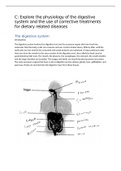
The digestive system involves the digestive tract and its accessory organs that turn food into
molecules that the body's cells can consume and use. Food is broken down, little by little, until the
molecules are too small to be consumed and waste products are extracted. A long continuous tube
that runs from the mouth to the anus consists of the digestive tract, also called the food canal or
gastrointestinal (GI) tract. The mouth, the pharynx, the oesophagus, the stomach, the small intestine
and the large intestine are included. The tongue and teeth are mouth-located accessory structures.
The main accessory organs that have a role in digestion are the salivary glands, liver, gallbladder, and
pancreas. Fluids are secreted into the digestive tract from these tissues.
,Digestive organs
Main organs
Mouth
The mouth is the first organ of the digestive system, and it is a space in which there are teeth and
tongue, opening the salivary glands, cutting and grinding the food by the teeth, and digesting the
starch into the sugar.
In adults, the number of teeth is 32. There are two jaws, the upper jaw and the lower jaw, and each
jaw has 16 teeth, separated into ten molars (4 premolars and 6 molars), four incisors and two
canines.
The four incisors and two canines have the purpose of cutting and breaking food into small bits, and
the ten molars grind the food to make it easier to chew.
Inside the mouth the tongue is an organ which has many functions. When it shifts the sound coming
from the larynx into recognizable words, it is the speech organ.
To aid with food chewing, the tongue combines the food with the saliva, the tongue pushes the food
inside the mouth cavity, and it is responsible for smelling the food.
Pharynx
A typical passageway for both food and air is the pharynx. For two distinct structures, which is the
reason why it has a dual function. Only air may travel through the middle or lower part of the
pharynx while allowing food and fluids to pass by. The dominant or upper section of the pharynx, on
the other side, is the one that allows the food to flow in. The pharynx also opens to two separate
passages, in addition to this. One is connected to the oesophagus, where food and fluids are guided,
and the other is connected to the trachea from which the air travels to the
lungs. However, The function of the pharynx in the digestive system is that after being swallowed, it
is the one that gets the food. The pharynx will be the first to obtain it as soon as the moistened and
chemically digested food or bolus is transferred to the back of the tongue. The bolus is then forced
into the oesophagus with the aid of the circular muscles lining the walls of the pharynx. The
swallowing reflex, which keeps the food from entering the windpipe or the trachea, makes this
process possible. The epiglottis, which is a flap-like device that protects the larynx that stops food
from entering the trachea, helps this. Aspiration and asphyxiation are precluded because of this.
Oesophagus
The oesophagus is a muscular conduit with a sphincter (valve) at each end, approximately 25cm
long. Its function is to move food and fluid from the mouth to the stomach after being swallowed. In
the oesophagus, no ingestion of nutrients takes place. A bolus is considered a mouthful of food
which has been chewed and swallowed. This is pushed towards the oesophagus from the pharynx
(throat), which is swept in peristaltic waves into the stomach. Such muscle contractions are
spontaneous, and usually should not be felt. The oesophagus is rolled through, or collapsed as food
does not get in,
Stomach
The stomach is a muscular sac that sits in the upper abdomen between the esophagus and the small
intestine. The stomach is not the only part of the digestive system that eats food, but rather is part
, of the digestive system and necessary for the rest of the intestines to churn food into a consistency
that is easier to digest. The stomach is J-shaped and it will stretch to store food temporarily.
Partial food digestion takes place here. The stomach muscles' churning motion mechanically breaks
down the meal.
For the chemical degradation of food, the stomach emits acids and enzymes. For protein
degradation, the enzyme pepsin is responsible.
In a controlled and governed way, the stomach releases food into the small intestine.
Small intestine (duodenum, jejunum, ileum)
An organ found inside the gastrointestinal tract is the small intestine. In the average human, it is
around 6.5 m and aids in the digestion and absorption of ingested food.
The duodenum is the most proximal segment of the small intestine. Its name stems from the Latin
duodenum digitorum, meaning the length of twelve fingers. It extends from the pylorus to the
duodenojejunal junction of the stomach. It is sufficient to split the duodenum into four parts:
dominant, descending, inferior and ascending. These components together form a 'C' pattern, which
is around 25 cm long and wraps around the pancreatic head.
Superior
The duodenum's first segment is known as 'the cap'. It ascends from the pylorus of the stomach
upwards and is bound by the hepatoduodenal ligament to the liver. The most prevalent site of
duodenal ulceration is this area.
Descending
The downward part of the pancreas curves inferiorly around the head. It is situated at the rear of the
transverse colon and at the rear of the right kidney. The descending duodenum is internally marked
by the main duodenal papilla, the opening at which bile and pancreatic secretions enter from the
Vater ampulla (hepatopancreatic ampulla).
Inferior
The lower duodenum, passing the posterior vena cava and aorta, passes laterally to the left. It is
situated inferior to the pancreas, and later to the artery and vein of the superior mesenteric.
Ascending
It ascends and bends anteriorly after the duodenum crosses the aorta to reach the jejunum at a
sharp turn known as the duodenojejunal flexure. At the duodenojejunal junction, a muscle slip called
the duodenum suspensory muscle is found. The contraction of this muscle widens the flexure angle
and serves to transfer the contents of the intestine into the jejunum.
The two distal parts of the small intestine are the jejunum and ileum. They are intraperitoneal, in
contrast to the duodenum.
They are attached via mesentery to the posterior abdominal wall (a double layer of peritoneum).
system and the use of corrective treatments
for dietary related diseases
The digestive system
Introduction
The digestive system involves the digestive tract and its accessory organs that turn food into
molecules that the body's cells can consume and use. Food is broken down, little by little, until the
molecules are too small to be consumed and waste products are extracted. A long continuous tube
that runs from the mouth to the anus consists of the digestive tract, also called the food canal or
gastrointestinal (GI) tract. The mouth, the pharynx, the oesophagus, the stomach, the small intestine
and the large intestine are included. The tongue and teeth are mouth-located accessory structures.
The main accessory organs that have a role in digestion are the salivary glands, liver, gallbladder, and
pancreas. Fluids are secreted into the digestive tract from these tissues.
,Digestive organs
Main organs
Mouth
The mouth is the first organ of the digestive system, and it is a space in which there are teeth and
tongue, opening the salivary glands, cutting and grinding the food by the teeth, and digesting the
starch into the sugar.
In adults, the number of teeth is 32. There are two jaws, the upper jaw and the lower jaw, and each
jaw has 16 teeth, separated into ten molars (4 premolars and 6 molars), four incisors and two
canines.
The four incisors and two canines have the purpose of cutting and breaking food into small bits, and
the ten molars grind the food to make it easier to chew.
Inside the mouth the tongue is an organ which has many functions. When it shifts the sound coming
from the larynx into recognizable words, it is the speech organ.
To aid with food chewing, the tongue combines the food with the saliva, the tongue pushes the food
inside the mouth cavity, and it is responsible for smelling the food.
Pharynx
A typical passageway for both food and air is the pharynx. For two distinct structures, which is the
reason why it has a dual function. Only air may travel through the middle or lower part of the
pharynx while allowing food and fluids to pass by. The dominant or upper section of the pharynx, on
the other side, is the one that allows the food to flow in. The pharynx also opens to two separate
passages, in addition to this. One is connected to the oesophagus, where food and fluids are guided,
and the other is connected to the trachea from which the air travels to the
lungs. However, The function of the pharynx in the digestive system is that after being swallowed, it
is the one that gets the food. The pharynx will be the first to obtain it as soon as the moistened and
chemically digested food or bolus is transferred to the back of the tongue. The bolus is then forced
into the oesophagus with the aid of the circular muscles lining the walls of the pharynx. The
swallowing reflex, which keeps the food from entering the windpipe or the trachea, makes this
process possible. The epiglottis, which is a flap-like device that protects the larynx that stops food
from entering the trachea, helps this. Aspiration and asphyxiation are precluded because of this.
Oesophagus
The oesophagus is a muscular conduit with a sphincter (valve) at each end, approximately 25cm
long. Its function is to move food and fluid from the mouth to the stomach after being swallowed. In
the oesophagus, no ingestion of nutrients takes place. A bolus is considered a mouthful of food
which has been chewed and swallowed. This is pushed towards the oesophagus from the pharynx
(throat), which is swept in peristaltic waves into the stomach. Such muscle contractions are
spontaneous, and usually should not be felt. The oesophagus is rolled through, or collapsed as food
does not get in,
Stomach
The stomach is a muscular sac that sits in the upper abdomen between the esophagus and the small
intestine. The stomach is not the only part of the digestive system that eats food, but rather is part
, of the digestive system and necessary for the rest of the intestines to churn food into a consistency
that is easier to digest. The stomach is J-shaped and it will stretch to store food temporarily.
Partial food digestion takes place here. The stomach muscles' churning motion mechanically breaks
down the meal.
For the chemical degradation of food, the stomach emits acids and enzymes. For protein
degradation, the enzyme pepsin is responsible.
In a controlled and governed way, the stomach releases food into the small intestine.
Small intestine (duodenum, jejunum, ileum)
An organ found inside the gastrointestinal tract is the small intestine. In the average human, it is
around 6.5 m and aids in the digestion and absorption of ingested food.
The duodenum is the most proximal segment of the small intestine. Its name stems from the Latin
duodenum digitorum, meaning the length of twelve fingers. It extends from the pylorus to the
duodenojejunal junction of the stomach. It is sufficient to split the duodenum into four parts:
dominant, descending, inferior and ascending. These components together form a 'C' pattern, which
is around 25 cm long and wraps around the pancreatic head.
Superior
The duodenum's first segment is known as 'the cap'. It ascends from the pylorus of the stomach
upwards and is bound by the hepatoduodenal ligament to the liver. The most prevalent site of
duodenal ulceration is this area.
Descending
The downward part of the pancreas curves inferiorly around the head. It is situated at the rear of the
transverse colon and at the rear of the right kidney. The descending duodenum is internally marked
by the main duodenal papilla, the opening at which bile and pancreatic secretions enter from the
Vater ampulla (hepatopancreatic ampulla).
Inferior
The lower duodenum, passing the posterior vena cava and aorta, passes laterally to the left. It is
situated inferior to the pancreas, and later to the artery and vein of the superior mesenteric.
Ascending
It ascends and bends anteriorly after the duodenum crosses the aorta to reach the jejunum at a
sharp turn known as the duodenojejunal flexure. At the duodenojejunal junction, a muscle slip called
the duodenum suspensory muscle is found. The contraction of this muscle widens the flexure angle
and serves to transfer the contents of the intestine into the jejunum.
The two distal parts of the small intestine are the jejunum and ileum. They are intraperitoneal, in
contrast to the duodenum.
They are attached via mesentery to the posterior abdominal wall (a double layer of peritoneum).