Numbers
•
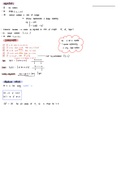
IR : real numbers
•
IN :
integers ( -2 , 1,0 )
④ rational numbers of
: → ratio
integers
•
→
decimal representation is always repeating
0,50
'
e-
g z
=
É =
0,6666 =
0,5
•
Irrational numbers > cannot be expressed as ratio of integers 11T
,
B
,
1091027
•
IN : natural numbers : [ 1. 2,3 . . . }
°:"^°ᵗ°^"Mb"[)
•
W : whole : 0
, 1,2 3,4 , . . -
± "" " "
if acb then btc (
•
ate <
symbol representing
◦
a
very large number
positive
$
u w Proof by contradiction (§ < 1)
it is between a and b
x exists if
o
{ xlacxcb }
o
Open : Ca , b) =
y g
⑧
{
⑧
Closed : [a ,b] = xla≤ ✗ ≤ b}
, t
a b
solving inequalities : 4x < 2×+1 ≤ 3×+2 / split
,
1
Absolute values
191 ≥ 0 for number a.
every
191=9 if a ≥ 0
191 = -
a if 9<0
az = 1011 for all values of a
,
as a must be ≥ 0 .
, properties
lab / lallbl 13×-21
e. g.
just
=
•
*
b≠0 191
§
•
= 191 =
i
{
/ by
= 1011 = a if a ≥o
a if a < 0
Ian / 1AM NEZ
-
• =
,
•
1×1 =
9 if I = -1-9
•
txt < a if -
a < ✗ < a
•
1×1 > g if ✗ c- a or x > a
e.
g. with
inequalities :
0<1×-51 < É } split
9
{
<
a txt 1×1
0<1×-51 1×-51 < É
X -
5 > 0 or
-
t < x -
S <
{
x -
5 < 0
{ < ✗ <
¥
0 °
i. ✗ < 5 Or × > 5 >
◦
<
I ,
4 'z 5 5
;
i. ✗ E ( 45 5) ,
U / 5. ¥ )
triangle inequality
latbl ≤ 101 -1lb /
and radians
trigonometry
180
✗
radian *
> degree
^
9,0° /
0° 30° 45° 60° 180° 360°
Cosa
Degrees
¥
=
IT IT IT ± 10,1) PE
0 IT 21T
Radians 3- and r=t
6- -4 ( cosy sino )
p⊖ ,
( x , y) : ✗ = ( 050
length of arc
( 1 radian = where a = r
A
a = TO I -1,07
5 OF Poll ,O )
< >
Pit
C
T
Sino =
?
tano =
y
1)
Pgp
co , -
, I
I ≤ 1 I I
[ Oso ≤ and ≤ Sino
-
≤ v
-
COSO =
¥
,Trigonometric identities
•
( 0sec / ⊖ ) = I
Sino I I
'
4 3
• Sec ⊖ = I
z z
COS ⊖ I
,
I
•
cot ⊖ = = COS -0
tano Sino
IT
I
¥
sin ⊖ I
• tan -0 = 3
( 050
PYTHAGOREAN IDENTITIES CO -
FUNCTIONS
(0520--1 Simo 1 (¥ ⊖)
=
cos
-
=
Sino
÷ sink
sin (
÷ cosy
Iz ⊖ )
OSOS
-
= [
L
Sec 20 = I + tan 20 [ 0sec 20
=
1+101-20
EVEN AND ODD DOUBLE ANGLES
[OSC -
⊖) = COSQ sin C- F) =
-
Sino
sin 20 =
Zsinocoso
↳ function ↳ odd function
{
even
cosz⊖ = cos 20 -
sin2⊖
^ ix. 4) 2<0520--1
I -
2sin2⊖
)⊖
>
1- ⊖
CX, -
y
✓
Graphs
or • @
6 • • •
v
↓
o 6 @
0 • @
>
, sets and logic
Week 2
* sets and logic NOT in calculus book
SETS
Basic concept of
•
a set.
•
count no .
elements in a set with finitely many elements .
•
understand what it means :
something is an element of a set
E symbol
when one set is a subset of another set
C
symbol
difference between something being an element of a set us .
subset of a set
Definition of intersection ( n) and union ( U)
•
•
An interval is a set of real numbers
•
Use of interval notation
•
IR : real numbers
•
IN :
integers ( -2 , 1,0 )
④ rational numbers of
: → ratio
integers
•
→
decimal representation is always repeating
0,50
'
e-
g z
=
É =
0,6666 =
0,5
•
Irrational numbers > cannot be expressed as ratio of integers 11T
,
B
,
1091027
•
IN : natural numbers : [ 1. 2,3 . . . }
°:"^°ᵗ°^"Mb"[)
•
W : whole : 0
, 1,2 3,4 , . . -
± "" " "
if acb then btc (
•
ate <
symbol representing
◦
a
very large number
positive
$
u w Proof by contradiction (§ < 1)
it is between a and b
x exists if
o
{ xlacxcb }
o
Open : Ca , b) =
y g
⑧
{
⑧
Closed : [a ,b] = xla≤ ✗ ≤ b}
, t
a b
solving inequalities : 4x < 2×+1 ≤ 3×+2 / split
,
1
Absolute values
191 ≥ 0 for number a.
every
191=9 if a ≥ 0
191 = -
a if 9<0
az = 1011 for all values of a
,
as a must be ≥ 0 .
, properties
lab / lallbl 13×-21
e. g.
just
=
•
*
b≠0 191
§
•
= 191 =
i
{
/ by
= 1011 = a if a ≥o
a if a < 0
Ian / 1AM NEZ
-
• =
,
•
1×1 =
9 if I = -1-9
•
txt < a if -
a < ✗ < a
•
1×1 > g if ✗ c- a or x > a
e.
g. with
inequalities :
0<1×-51 < É } split
9
{
<
a txt 1×1
0<1×-51 1×-51 < É
X -
5 > 0 or
-
t < x -
S <
{
x -
5 < 0
{ < ✗ <
¥
0 °
i. ✗ < 5 Or × > 5 >
◦
<
I ,
4 'z 5 5
;
i. ✗ E ( 45 5) ,
U / 5. ¥ )
triangle inequality
latbl ≤ 101 -1lb /
and radians
trigonometry
180
✗
radian *
> degree
^
9,0° /
0° 30° 45° 60° 180° 360°
Cosa
Degrees
¥
=
IT IT IT ± 10,1) PE
0 IT 21T
Radians 3- and r=t
6- -4 ( cosy sino )
p⊖ ,
( x , y) : ✗ = ( 050
length of arc
( 1 radian = where a = r
A
a = TO I -1,07
5 OF Poll ,O )
< >
Pit
C
T
Sino =
?
tano =
y
1)
Pgp
co , -
, I
I ≤ 1 I I
[ Oso ≤ and ≤ Sino
-
≤ v
-
COSO =
¥
,Trigonometric identities
•
( 0sec / ⊖ ) = I
Sino I I
'
4 3
• Sec ⊖ = I
z z
COS ⊖ I
,
I
•
cot ⊖ = = COS -0
tano Sino
IT
I
¥
sin ⊖ I
• tan -0 = 3
( 050
PYTHAGOREAN IDENTITIES CO -
FUNCTIONS
(0520--1 Simo 1 (¥ ⊖)
=
cos
-
=
Sino
÷ sink
sin (
÷ cosy
Iz ⊖ )
OSOS
-
= [
L
Sec 20 = I + tan 20 [ 0sec 20
=
1+101-20
EVEN AND ODD DOUBLE ANGLES
[OSC -
⊖) = COSQ sin C- F) =
-
Sino
sin 20 =
Zsinocoso
↳ function ↳ odd function
{
even
cosz⊖ = cos 20 -
sin2⊖
^ ix. 4) 2<0520--1
I -
2sin2⊖
)⊖
>
1- ⊖
CX, -
y
✓
Graphs
or • @
6 • • •
v
↓
o 6 @
0 • @
>
, sets and logic
Week 2
* sets and logic NOT in calculus book
SETS
Basic concept of
•
a set.
•
count no .
elements in a set with finitely many elements .
•
understand what it means :
something is an element of a set
E symbol
when one set is a subset of another set
C
symbol
difference between something being an element of a set us .
subset of a set
Definition of intersection ( n) and union ( U)
•
•
An interval is a set of real numbers
•
Use of interval notation