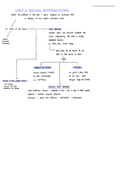
UNIT 4: SOCIAL INTERACTIONS
and of than effect
Decisions
preferences more 1
person .
modelling the constraining
on behaviour of other people 's anticipated actions .
L
The effects of self -
interest > social dilemmas
situations where self -
interested individuals take
that
✓ actions
independently ,
result in
socially
positive
suboptimal outcomes .
( Industrial
Revolution ) traffic climate change
e.
g. jams ,
>
when do for the
people not account
effect of their actions on others
Forms
Tradgedy of the Commons Free
riding
bears
common
property 1 resources one
person / party
are often over exploited all the costs, while
e.
g. overfishing everyone enjoys the benefits
in how interact
motives
people
•
self -
interest ✓
for others
• concern
resolving social dilemmas
for fairness
preference
•
•
social preferences : Altruism willingness to bear a cost in order to benefit another
•
Repetition harnesses reciprocal behaviour
•
Institutions punish bad behaviour (
government + communities )
, game theory
of how model social
Game theory is a
way modelling people interact
,
to interactions and explain
social dilemmas .
when does self interest-
Games models of promote wellbeing / lead
players strategic interactions
• '
are .
to undesirable results
•
strategic interaction :
when in a social interaction involving 2 or more
people ( players)
people are aware of how their actions
, ,
affect their own and others '
outcomes and vice versa .
,
strategy
•
:
an action that a player may take in a social interaction
the player is aware of the mutual dependence of that action 's outcome on themselves and others
•
Outcome :
from
the situation that results the combination of strategies by both players
A states the payoffs earned by each player for each possible outcome / combo of strategies
game
•
.
•
players :
in the
taking the actions
parties game
description of social interaction
the invisible hand game the prisoner 's dilemma
pursuing self -
interest produces highest payoff
Players payoffs in the dominant
strategy equilibrium are
•
•
Feasible strategies : action each
player can take lower for each player than if neither played the
,
Information dominant
strategy
•
.
for every lower values ]
Payoffs outcomes possible combination [ Players prefer
•
:
of actions
derives from predicted is the best feasible outcome
V
>
represent the utility each player •
outcome not .
row ,
column
each outcome
•
NO .
of outcomes = no .
strategies ✗ no .
players Reasons :
Equilibrium in the game •
self -
interest
the free
Best
response :
strategy that will give a
player
• -
riding
highest payoff given ,
the strategies other players select
Dominant strategy strategy : that will give a
player the
of other do
highest payoff ,
irrespective what
players
I :| or
= .
and of than effect
Decisions
preferences more 1
person .
modelling the constraining
on behaviour of other people 's anticipated actions .
L
The effects of self -
interest > social dilemmas
situations where self -
interested individuals take
that
✓ actions
independently ,
result in
socially
positive
suboptimal outcomes .
( Industrial
Revolution ) traffic climate change
e.
g. jams ,
>
when do for the
people not account
effect of their actions on others
Forms
Tradgedy of the Commons Free
riding
bears
common
property 1 resources one
person / party
are often over exploited all the costs, while
e.
g. overfishing everyone enjoys the benefits
in how interact
motives
people
•
self -
interest ✓
for others
• concern
resolving social dilemmas
for fairness
preference
•
•
social preferences : Altruism willingness to bear a cost in order to benefit another
•
Repetition harnesses reciprocal behaviour
•
Institutions punish bad behaviour (
government + communities )
, game theory
of how model social
Game theory is a
way modelling people interact
,
to interactions and explain
social dilemmas .
when does self interest-
Games models of promote wellbeing / lead
players strategic interactions
• '
are .
to undesirable results
•
strategic interaction :
when in a social interaction involving 2 or more
people ( players)
people are aware of how their actions
, ,
affect their own and others '
outcomes and vice versa .
,
strategy
•
:
an action that a player may take in a social interaction
the player is aware of the mutual dependence of that action 's outcome on themselves and others
•
Outcome :
from
the situation that results the combination of strategies by both players
A states the payoffs earned by each player for each possible outcome / combo of strategies
game
•
.
•
players :
in the
taking the actions
parties game
description of social interaction
the invisible hand game the prisoner 's dilemma
pursuing self -
interest produces highest payoff
Players payoffs in the dominant
strategy equilibrium are
•
•
Feasible strategies : action each
player can take lower for each player than if neither played the
,
Information dominant
strategy
•
.
for every lower values ]
Payoffs outcomes possible combination [ Players prefer
•
:
of actions
derives from predicted is the best feasible outcome
V
>
represent the utility each player •
outcome not .
row ,
column
each outcome
•
NO .
of outcomes = no .
strategies ✗ no .
players Reasons :
Equilibrium in the game •
self -
interest
the free
Best
response :
strategy that will give a
player
• -
riding
highest payoff given ,
the strategies other players select
Dominant strategy strategy : that will give a
player the
of other do
highest payoff ,
irrespective what
players
I :| or
= .