

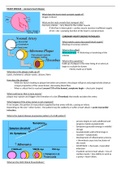
HEART DISEASE – coronary heart disease
What does the heart need constant supply of?
Oxygen & blood
What are the main vessels that transport this?
Coronary arteries – carry blood to the cardiac muscle
- If this flow is interrupted = cardiac muscle receives insufficient supply
of O2 = die = pumping function of the heart is compromised.
CORONARY HEART DISEASE PATHOLOGY
What mainly causes decreased blood supply?
Blocking of coronary arteries
What is this called?
Atherosclerosis thickening or hardening of the
arteries
What is this caused by?
build-up of plaque in the inner lining of an artery &
begin to occlude the lumen
- Mainly made up of lipids
What else is the plaque made up of?
Lipids, cholesterol, cellular waste, calcium, fibrin
How does this develop?
- While the factors leading to plaque formation are present, the plaque will grow and progressively obstruct
a larger proportion of the vessel lumen, decreasing blood flow.
- When a critical limit is reached (around 75% of the lumen), symptoms begin = chest pain (angina)
What could occur that is more severe?
plaque may rupture and triggers the formation of a clot (Thrombus) that totally occludes the artery.
What happens if the artery lumen is not reopened?
If not reopen, the portion of myocardium supplied by that artery will die, causing an infarct.
Depending on the size + other factors - the patient may die suddenly or suffer a heart attack = acute myocardial
infarction.
What is the typical disease progression pattern of a CHD patient?
- process begins in early adulthood and
progress mainly asymptomatic
- Symptoms generally emerge in middle/
old age
- Asymptomatic until critical stage is
reached = symptomatic
- Development of inflammatory process
+ thrombosis cause total occlusion of
the vessel.
- SYMPTOMS = chest pain, myocardial
infarction
- If patient survives heart attack = loss of
cardiac muscle = lose ability to work as
a pump = heart failure.
What are the CHD Clinical Presentations?
, • SUDDEN CARDIAC DEATH
• HEART ATTACK = myocardial infarction (MI) – heart muscle dies, so action of heart comprised so can lead
to progressive heart failure.
• ANGINA (chest pain on exertion or stress)
• progressive HEART FAILURE (shortness of breath, ankle oedema & fatigue)
• some patients become chronically disabled with poor quality of life
Therefore, what is CHD caused by?
atheroma & thrombosis
When does this develop?
- develops silently from childhood
- manifests as adult disease or death
Low Quality of Life in CHD Patients
Quality of life is measured using questionnaire
SF36 – validated measure of measuring quality
of life – put into a large number of domains
Survival following Acute Myocardial Infarction
(Scotland 1986-95, Men & Women, n= 208,400)
- survival after 10 years following an acute
myocardial infarction can be low (below
30%)
Why is there only just over 50% of people at the start
of the graph?
Due to rapid sudden death following a MI
Why do some patients experience sudden cardiac death?
- Cannot reach the hospital in time + dramatic presentation
- MI occurs in early hours of morning
- Heart suddenly stops working sue to disturbance of the electrical system that keeps the heart beating
Survival following first admission with CHD
(280,404 Men & Women in Scotland 1986-95)
This shows that heart failure has a greater impact on survival
probability, compared with a myocardial infarction.
- Even those admitted to hospital, the survival following an acute
MI is below 50% after 10 years
What does the heart need constant supply of?
Oxygen & blood
What are the main vessels that transport this?
Coronary arteries – carry blood to the cardiac muscle
- If this flow is interrupted = cardiac muscle receives insufficient supply
of O2 = die = pumping function of the heart is compromised.
CORONARY HEART DISEASE PATHOLOGY
What mainly causes decreased blood supply?
Blocking of coronary arteries
What is this called?
Atherosclerosis thickening or hardening of the
arteries
What is this caused by?
build-up of plaque in the inner lining of an artery &
begin to occlude the lumen
- Mainly made up of lipids
What else is the plaque made up of?
Lipids, cholesterol, cellular waste, calcium, fibrin
How does this develop?
- While the factors leading to plaque formation are present, the plaque will grow and progressively obstruct
a larger proportion of the vessel lumen, decreasing blood flow.
- When a critical limit is reached (around 75% of the lumen), symptoms begin = chest pain (angina)
What could occur that is more severe?
plaque may rupture and triggers the formation of a clot (Thrombus) that totally occludes the artery.
What happens if the artery lumen is not reopened?
If not reopen, the portion of myocardium supplied by that artery will die, causing an infarct.
Depending on the size + other factors - the patient may die suddenly or suffer a heart attack = acute myocardial
infarction.
What is the typical disease progression pattern of a CHD patient?
- process begins in early adulthood and
progress mainly asymptomatic
- Symptoms generally emerge in middle/
old age
- Asymptomatic until critical stage is
reached = symptomatic
- Development of inflammatory process
+ thrombosis cause total occlusion of
the vessel.
- SYMPTOMS = chest pain, myocardial
infarction
- If patient survives heart attack = loss of
cardiac muscle = lose ability to work as
a pump = heart failure.
What are the CHD Clinical Presentations?
, • SUDDEN CARDIAC DEATH
• HEART ATTACK = myocardial infarction (MI) – heart muscle dies, so action of heart comprised so can lead
to progressive heart failure.
• ANGINA (chest pain on exertion or stress)
• progressive HEART FAILURE (shortness of breath, ankle oedema & fatigue)
• some patients become chronically disabled with poor quality of life
Therefore, what is CHD caused by?
atheroma & thrombosis
When does this develop?
- develops silently from childhood
- manifests as adult disease or death
Low Quality of Life in CHD Patients
Quality of life is measured using questionnaire
SF36 – validated measure of measuring quality
of life – put into a large number of domains
Survival following Acute Myocardial Infarction
(Scotland 1986-95, Men & Women, n= 208,400)
- survival after 10 years following an acute
myocardial infarction can be low (below
30%)
Why is there only just over 50% of people at the start
of the graph?
Due to rapid sudden death following a MI
Why do some patients experience sudden cardiac death?
- Cannot reach the hospital in time + dramatic presentation
- MI occurs in early hours of morning
- Heart suddenly stops working sue to disturbance of the electrical system that keeps the heart beating
Survival following first admission with CHD
(280,404 Men & Women in Scotland 1986-95)
This shows that heart failure has a greater impact on survival
probability, compared with a myocardial infarction.
- Even those admitted to hospital, the survival following an acute
MI is below 50% after 10 years

