Molarity_and_Solution_Calculations
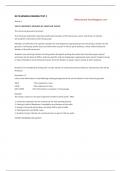
CHEM 120 Unit 3 Discussion 2: Molarity and Solution Calculations Question Professionals in a scientific laboratory and in the healthcare field need to accurately prepare solutions for a number of reasons. If you wear contacts, you probably use a saline solution to rinse your contacts. What solutions do you use at work? How would you calculate the amount of solute to the solvent to prepare this solution? If you do not wear contacts but you use or make cleaning solutions for your housework, how would you accurately prepare solutions to clean? What solutions do you use that use percent concentration? Answer 1 3rd post I use apple cider vinegar for multitude of things in my home, from cleaning my produce, or even taking a shot of it in morning to help boot my metabolism. It is an essential product in my household. The apple cider vinegar I use is already diluted by the manufacturer to 5% acidity in a 32 FL OZ (946 ml) bottle. Vinegar is a naturally-occurring liquid that contains many chemicals, so it can’t just be written in a simple formula. It has Two main Chemical formulas H2O (water) CH3COOH (weak acid – acetic acid) Apple cider is 5% meaning there are 5 grams of acetic acid in 100 g of solution. I can use mass/mass % to find the total gram of acetic acid in the bottle. Since there is 946 ml (g) of solution I need to multiply 946 by 5 divided by 100 (946x5/100) to get the amount of acetic acid in 946g bottle 946 x 5 = 4730 /100 = 47.3g of acetic acid in 946g bottle of Apple Cider vinegar Answer 2 2nd Post 2g of NaCl in a 500mL solution 1. Mass/volume (g/mL) % = mass of solute/volume of solution (mL) X 100 1 L = 1000 mL 500/1000 = 0.5L 2g NaCl/ 500mL = 0.004 x 100= 0.40% 2. Molarity = moles of solute/volume of solution (L) To determine 1 mole of NaCl, need to add both elements atomic number together Na= 23 Cl = 35.45 23 + 35.45 = 58.45g 1 mole of NaCl = 58.45 2g NaCl x (1 mol/ 58.45 NaCl) = 0.034 mol NaCl 0.034 mol NaCl/ 0.5L = 0.068M 3. Osmolarity = i x M NaCl disassociates into Na+1+ Cl-1, therefore i = 2 2 x 0.068M = 0.136M Answer 3 1st post 10g of CaBr2 in a 3L solution 3. Mass/volume (g/mL) % = mass of solute/volume of solution (mL) X 100 1 L = 1000 mL 3L = 3000ml 10g CaBr2/ 3000mL = 0.00333 x 100= 0.33% 4. Molarity = moles of solute/volume of solution (L) To determine 1 mole of CaBr2, need to add both elements atomic number together Ca = 40.078 Br = 79.904 there are two Br 40.078 + 2(79.904) = 199.886 1 mole of CaBr2 = 199.886 10g CaBr2 x (1 mol/ 199.886g CaBr2) = 0.050 mol CaBr2 0.050 mol CaBr2/ 3L = 0.0167 M 3. Osmolarity = i x M CaBr2 disassociates into Ca2+ Br-, Br-, therefore i =3. 3 x 0.0167M = 0.0501M According to the textbook, a solution is a homogeneous mixture of two or more substances. The solute is what is being dissolved, the solvent is what the solute is being dissolved in. The solute is normally less in quantity than that of the solvent. What solutions do you use at work? How would you calculate the amount of solute to the solvent to prepare this solution? A solution that is commonly used is an anticoagulant heparin solution to prevents blood clot formations or help dissolve it. This is a mixture of heparin solution in sodium chloride (NaCl). To calculate the amount of solute to solvent, I would use the equation: Percent by volume= (volume of solute/ volume of solution) x 100% If you do not wear contacts but you use or make cleaning solutions for your housework, how would you accurately prepare solutions to clean? I do not wear contacts, but I do use natural cleaning solutions in my house to avoid toxins. The Solution I use is mixing lemon juice with olive oil or vinegar in order to clean a hard wood floor or other surfaces. For my appliances like a microwave or stainless-steel refrigerator. I combine 1 cup of water with 2 tablespoons of lemon juice and tbs of apple cyder vinegar I put the solution into a pot and bring it to boiling point. I let it cool, and use a clean rag, soak it into the solution and clean the kitchen appliances with it. What solutions do you use that use percent concentration? Some solutions that I may find in my house could be bleach, dish washing soap, apple cider vinegar.
Escuela, estudio y materia
- Institución
- Chem
- Grado
- Chem
Información del documento
- Subido en
- 23 de mayo de 2022
- Número de páginas
- 5
- Escrito en
- 2022/2023
- Tipo
- Examen
- Contiene
- Preguntas y respuestas
Temas
-
chem 120 unit 3 discussion 2 molarity and solution calculations question professionals in a scientific laboratory and in the healthcare field need to accurately prepare solutions for a number of rea