Carbohydrates
Structure
A simple sugar (also known as a monosaccharide) is a kind of sugar that cannot be hydrolysed to
produce a simpler sugar. The standard chemical formula for a monosaccharide is CnH2nOn. As a
result of this chemical law, monosaccharides and other carbohydrates are referred to as carbon
hydrates.
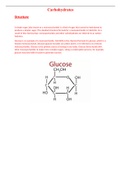
Glucose is an example of a monosaccharide. C6H12O6 is the chemical formula for glucose, which is a
hexose monosaccharide. Because glucose includes six carbon atoms, it is referred to as a hexose
monosaccharide. Glucose is the primary source of energy in our body. Glucose forms bonds with
other monosaccharides to make more complex sugars. Using a condensation process, for example,
glucose may bind with fructose to generate sucrose.
, Carbohydrates
Polysaccharide
A polysaccharide is a carbohydrate that can
be broken down into two or more
monosaccharides by hydrolysis.
Monosaccharides are linked together by
glycosidic linkages.
Glycogen is an example of a polysaccharide.
Glycogen is a multi-branched glucose
polymer generated mostly in liver and
muscle cells. Glycogen is used by our bodies
to store long-term energy.
How monosaccharides combine
A condensation reaction occurs when two molecules are linked together to produce a bigger, more
complex molecule, with water being lost in the process (which in this case would be
monosaccharides bonding to form a polysaccharide.)
Glycogen is made up of continually branching long chains of glucose molecules. These glucose
molecules in glycogen are connected together by alpha 1-4 and alpha 1-6 glycosidic linkages (which
result in the loss of water). The branching of a glycogen molecule occurs every 8 to 12 glucose
subunits.
Alpha 1-4 glycosidic linkages connect all glucose molecules in the linear chain of glycogen. An alpha
1-6 glycosidic bond forms branches from this linear chain. As a result, the alpha 1-6 bond connects
, Carbohydrates
the glucose molecule at the branch point to the main chain. The branch's remaining glucose
molecules have alpha 1-4 connections.
Overall function of carbohydrates in the body
Carbohydrates provide us energy by breaking down glucose and releasing it into our
circulation.
How the structure of glycogen relates to its function
Spirals - Glycogen is stored in spirals, which is relevant to its function because spiral storage allows it
to achieve its maximum compression, allowing more of it to be stored in the liver and muscle cells.
Branching - Because glycogen contains multiple branches, it has a larger surface area for enzymes to
hydrolyse the substrate. The structure connects to the function because the many branches allow
for fast hydrolysis, resulting in higher glucose levels in a shorter amount of time.
Structure
A simple sugar (also known as a monosaccharide) is a kind of sugar that cannot be hydrolysed to
produce a simpler sugar. The standard chemical formula for a monosaccharide is CnH2nOn. As a
result of this chemical law, monosaccharides and other carbohydrates are referred to as carbon
hydrates.
Glucose is an example of a monosaccharide. C6H12O6 is the chemical formula for glucose, which is a
hexose monosaccharide. Because glucose includes six carbon atoms, it is referred to as a hexose
monosaccharide. Glucose is the primary source of energy in our body. Glucose forms bonds with
other monosaccharides to make more complex sugars. Using a condensation process, for example,
glucose may bind with fructose to generate sucrose.
, Carbohydrates
Polysaccharide
A polysaccharide is a carbohydrate that can
be broken down into two or more
monosaccharides by hydrolysis.
Monosaccharides are linked together by
glycosidic linkages.
Glycogen is an example of a polysaccharide.
Glycogen is a multi-branched glucose
polymer generated mostly in liver and
muscle cells. Glycogen is used by our bodies
to store long-term energy.
How monosaccharides combine
A condensation reaction occurs when two molecules are linked together to produce a bigger, more
complex molecule, with water being lost in the process (which in this case would be
monosaccharides bonding to form a polysaccharide.)
Glycogen is made up of continually branching long chains of glucose molecules. These glucose
molecules in glycogen are connected together by alpha 1-4 and alpha 1-6 glycosidic linkages (which
result in the loss of water). The branching of a glycogen molecule occurs every 8 to 12 glucose
subunits.
Alpha 1-4 glycosidic linkages connect all glucose molecules in the linear chain of glycogen. An alpha
1-6 glycosidic bond forms branches from this linear chain. As a result, the alpha 1-6 bond connects
, Carbohydrates
the glucose molecule at the branch point to the main chain. The branch's remaining glucose
molecules have alpha 1-4 connections.
Overall function of carbohydrates in the body
Carbohydrates provide us energy by breaking down glucose and releasing it into our
circulation.
How the structure of glycogen relates to its function
Spirals - Glycogen is stored in spirals, which is relevant to its function because spiral storage allows it
to achieve its maximum compression, allowing more of it to be stored in the liver and muscle cells.
Branching - Because glycogen contains multiple branches, it has a larger surface area for enzymes to
hydrolyse the substrate. The structure connects to the function because the many branches allow
for fast hydrolysis, resulting in higher glucose levels in a shorter amount of time.