Summary molecular basis of
diseases
1
,Chapter 1 Human molecular
genetics: introduction
The majority of diseases find their origin in the genome. There are many ways in which the genomic
make up can cause disease.
Cystic fibrosis (CF)
A classic example of the many ways in which the genetic makeup can lead to disease is cystic fibrosis
(CF). Patients with CF have a defect in the CFTR channel that transports chloride.
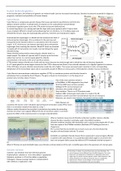
In the lungs, the CFTR transporter transports
chloride out of the cells into the excreted
mucus layer this mucus layer traps
microorganisms and carries these away with
the mucus by movement of the cilia
As in CF patient this transporter has a certain
defect, it cannot or less export chloride,
thereby causing sticky mucus because the
water content attracted by osmosis is less
Due to its stickiness, this mucus layer
cannot be transported by the
movement of cilia the trapped
microorganisms are therefore not
eradicated: the most important
feature of CF therefore is the high
frequency of lung infections
As CFTR functions in more tissues than the lungs, it logically follows that CF comes with more
complications than just lung infections.
CFTR imports chloride into the epithelial cells of the sweat gland this uptake of chloride is
hampered in CFTR patients, therefore they have salty sweat
This can be monitored by measuring the conductance of the sweat, as this increases
with ion concentration
The most important feature of CF for diagnosis (in babies already) is obstruction of the bile
duct
2
,There is not only one mutation in the CFTR gene that can cause CF, the CF phenotype can namely
arise from various types of mutation s in the CFTR gene (as also seen with other diseases). Over 1200
mutations that cause CF have been found. These different types/locations of mutations give rise to
different types of CFTR defects, labelled I-VI.
Any complication in the life-cycle of the CFTR channel is very likely to cause a CF phenotype
p.Phe580del is a missense mutation that is the most common mutation found in the CFTR
channel underlying CF causes misfolding of the CFTR
As thus CF is one of these six defect types, not all patients can be treated by the same medication.
The medication thus has to fit the defect type in order to see clinical improvement.
Medication can be given according to the type of mutation causing CF
PTC: premature termination codon PTC read-through medication by Ataluren
PTC is hidden from the ribosome yields about 20% functional CFTR, which is
enough to observe significant clinical improvement
Corrector drugs: used for the p.Phe580del variant Lumacaftor: aids in the correct folding
of CFTR
Certain missense mutations cause the CFTR to
be less functional treated with potentiator
drugs: these correct for the misfunction of the
CFTR, such as Ivacaftor which restores the
CFTR function
There is also a very small fraction of CF
patients that have a missense mutation that
leads to the incorrect splicing of the CFTR
treated with potentiators that work by
correcting the splice site
Truncations of the CFTR that destabilise the
CFTR are treated with stabilising drugs
The CF phenotype is not only determined by the type and location of the mutation
in the CFTR gene, but also by modifier genes: modifier genes also have an influence
on a phenotype.
One modifier gene is the one that expresses SLC26A9 solute carrier that
also transports chloride
The SLC26A9 ‘TT’ variant decreases the potency of Ivacaftor
3
, Chapter 2 Elements of human
molecular genetics
Genomic variation
A variant is a certain deviation in the genetic code from the reference genome. Examples of variants
are polymorphisms, mutations and copy number variations (CNVs). Note that the reference genome
is a standardised human genome that has been agreed upon in an annual genetics consortium
aimed to average-out all rare/regional variants, to make it as comparable as possible.
human genomes are for ~ 99.5% identical, but the non-identical 0.5% is enough to yield big
enough differences
A variant is a polymorphism when one or more percent of the alleles in the population is that variant,
whereas it is a mutation when less than one percent of the alleles in the population is that variant. A
CNV is a deletion or duplication of more than one Kbs.
Variants that are often mutations are:
Single nucleotide variations (SNVs): substitution of
one base pair
Synonymous: codes for the same protein
Non-synonymous: codes for not the same
protein
Missense: codon for a different amino
acid
Nonsense: introduction of a stop codon
Silent: codon encodes still the same
amino acid
Splice site: mutation in a region that
does not affect a protein but has an
effect, specifically at a splice site
Promoter: mutation in a region that
does not affect a protein but has an
effect, specifically at a promoter site
Insertion or deletion (indel) < 10 bp
Deletion
o Multiple of 3 (codon)
o Not multiple of 3: frameshift
o Large deletion: partial or whole gene deletion
Insertion
o Multiple of 3
o Not a multiple of 3: frameshift
o Large insertion: partial or whole gene duplication
o Expansion of trinucleotide repeat: dynamic mutation
Repeat expansion 2 to 6000 bp
CNV: deletion or duplication > 1000 bp
Structural abnormalities: translocations, inversions
Aneuploidy: one chromosome extra
Some of these can cause aberrant splicing
4
diseases
1
,Chapter 1 Human molecular
genetics: introduction
The majority of diseases find their origin in the genome. There are many ways in which the genomic
make up can cause disease.
Cystic fibrosis (CF)
A classic example of the many ways in which the genetic makeup can lead to disease is cystic fibrosis
(CF). Patients with CF have a defect in the CFTR channel that transports chloride.
In the lungs, the CFTR transporter transports
chloride out of the cells into the excreted
mucus layer this mucus layer traps
microorganisms and carries these away with
the mucus by movement of the cilia
As in CF patient this transporter has a certain
defect, it cannot or less export chloride,
thereby causing sticky mucus because the
water content attracted by osmosis is less
Due to its stickiness, this mucus layer
cannot be transported by the
movement of cilia the trapped
microorganisms are therefore not
eradicated: the most important
feature of CF therefore is the high
frequency of lung infections
As CFTR functions in more tissues than the lungs, it logically follows that CF comes with more
complications than just lung infections.
CFTR imports chloride into the epithelial cells of the sweat gland this uptake of chloride is
hampered in CFTR patients, therefore they have salty sweat
This can be monitored by measuring the conductance of the sweat, as this increases
with ion concentration
The most important feature of CF for diagnosis (in babies already) is obstruction of the bile
duct
2
,There is not only one mutation in the CFTR gene that can cause CF, the CF phenotype can namely
arise from various types of mutation s in the CFTR gene (as also seen with other diseases). Over 1200
mutations that cause CF have been found. These different types/locations of mutations give rise to
different types of CFTR defects, labelled I-VI.
Any complication in the life-cycle of the CFTR channel is very likely to cause a CF phenotype
p.Phe580del is a missense mutation that is the most common mutation found in the CFTR
channel underlying CF causes misfolding of the CFTR
As thus CF is one of these six defect types, not all patients can be treated by the same medication.
The medication thus has to fit the defect type in order to see clinical improvement.
Medication can be given according to the type of mutation causing CF
PTC: premature termination codon PTC read-through medication by Ataluren
PTC is hidden from the ribosome yields about 20% functional CFTR, which is
enough to observe significant clinical improvement
Corrector drugs: used for the p.Phe580del variant Lumacaftor: aids in the correct folding
of CFTR
Certain missense mutations cause the CFTR to
be less functional treated with potentiator
drugs: these correct for the misfunction of the
CFTR, such as Ivacaftor which restores the
CFTR function
There is also a very small fraction of CF
patients that have a missense mutation that
leads to the incorrect splicing of the CFTR
treated with potentiators that work by
correcting the splice site
Truncations of the CFTR that destabilise the
CFTR are treated with stabilising drugs
The CF phenotype is not only determined by the type and location of the mutation
in the CFTR gene, but also by modifier genes: modifier genes also have an influence
on a phenotype.
One modifier gene is the one that expresses SLC26A9 solute carrier that
also transports chloride
The SLC26A9 ‘TT’ variant decreases the potency of Ivacaftor
3
, Chapter 2 Elements of human
molecular genetics
Genomic variation
A variant is a certain deviation in the genetic code from the reference genome. Examples of variants
are polymorphisms, mutations and copy number variations (CNVs). Note that the reference genome
is a standardised human genome that has been agreed upon in an annual genetics consortium
aimed to average-out all rare/regional variants, to make it as comparable as possible.
human genomes are for ~ 99.5% identical, but the non-identical 0.5% is enough to yield big
enough differences
A variant is a polymorphism when one or more percent of the alleles in the population is that variant,
whereas it is a mutation when less than one percent of the alleles in the population is that variant. A
CNV is a deletion or duplication of more than one Kbs.
Variants that are often mutations are:
Single nucleotide variations (SNVs): substitution of
one base pair
Synonymous: codes for the same protein
Non-synonymous: codes for not the same
protein
Missense: codon for a different amino
acid
Nonsense: introduction of a stop codon
Silent: codon encodes still the same
amino acid
Splice site: mutation in a region that
does not affect a protein but has an
effect, specifically at a splice site
Promoter: mutation in a region that
does not affect a protein but has an
effect, specifically at a promoter site
Insertion or deletion (indel) < 10 bp
Deletion
o Multiple of 3 (codon)
o Not multiple of 3: frameshift
o Large deletion: partial or whole gene deletion
Insertion
o Multiple of 3
o Not a multiple of 3: frameshift
o Large insertion: partial or whole gene duplication
o Expansion of trinucleotide repeat: dynamic mutation
Repeat expansion 2 to 6000 bp
CNV: deletion or duplication > 1000 bp
Structural abnormalities: translocations, inversions
Aneuploidy: one chromosome extra
Some of these can cause aberrant splicing
4