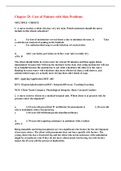
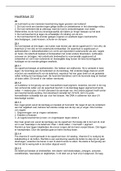
Chapter 25 Care of Patients with Skin Problems
Chapter 25: Care of Patients with Skin Problems MULTIPLE CHOICE 1. A nurse teaches a client who has very dry skin. Which statement should the nurse include in this clients education? a. Use lots of moisturizer several times a day to minimize dryness. b. Take a cold shower instead of soaking in the bathtub. c. Use antimicrobial soap to avoid infection of cracked skin. d. After you bathe, put lotion on before your skin is totally dry. ANS: D The client should bathe in warm water for at least 20 minutes and then apply lotion immediately because this will keep the moisture in the skin. Just using moisturizer will not be as helpful because the moisturizer is not what rehydrates the skin; it is the water. Bathing in warm water will rehydrate skin more effectively than a cold shower, and antimicrobial soaps are actually more drying than other kinds of soap. DIF: Applying/Application REF: 448 KEY: Hygiene|skinbreakdownMSC: IntegratedProcess: Teaching/Learning NOT: Client Needs Category: Physiological Integrity: Basic Careand Comfort 2. A nurse assesses clients on a medical-surgical unit. Which client is at greatest risk for pressure ulcer development? a. A 44-year-old prescribed IV antibiotics for pneumonia b. A 26-year-old who is bedridden with a fractured leg c. A 65-year-old withhemi-paralysisandincontinence d. A 78-year-old requiring assistance to ambulate with a walker ANS: C Being immobile and being incontinent are two significant risk factors for the development of pressure ulcers. The client with pneumonia does not have specific risk factors. The young client who has a fractured leg and the client who needs assistance with ambulation might be at moderate risk if they do not move about much, but having two risk factors makes the 65-year-old the person at highestrisk. DIF: Applying/Application REF: 451 KEY: Skinbreakdown|Braden Scale MSC: Integrated Process: Nursing Process: Assessment NOT: Client Needs Category: Physiological Integrity: Reduction of Risk Potential 3. Whentransferringaclientintoachair, anursenoticesthatthepressure-relievingmattressoverlayhasdeep imprints of the clients buttocks, heels, and scapulae. Which action should the nurse take next? a. Turn the mattress overlay to the opposite side. b. Do nothing because this is an expected occurrence. c. Apply a different pressure-relieving device. d. Reinforce the overlay with extra cushions. ANS: C Bottoming out, as evidenced by deep imprints in the mattress overlay, indicates that this device is not appropriateforthisclient, and adifferentdeviceorstrategy shouldbeimplemented to preventpressureulcer formation. DIF: Applying/Application REF: 455 KEY: Skinbreakdown MSC: Integrated Process: Nursing Process: Evaluation NOT: Client Needs Category: Safe and Effective Care Environment: Safety and Infection Control 4. A nurse cares for a client who has a deep wound that is being treated with a wet-to-damp dressing. Which intervention should the nurse include in this clients plan of care? a. Change the dressing every 6 hours. b. Assess the wound bed once a day. c. Change the dressing when it is saturated. d. Contact the provider when the dressing leaks. ANS: A Wet-to-damp dressings are changed every 4 to 6 hours to provide maximum dbridement. The wound should be assessed each time the dressing is changed. Dry gauze dressings should be changed when the outer layer becomes saturated. Synthetic dressings can be left in place for extended periods of time but need to be changed if the seal breaks and the exudate leaks. DIF: Applying/Application REF: 461 KEY: Skin lesions/wounds MSC: Integrated Process: Nursing Process: Implementation NOT: Client Needs Category: Physiological Integrity: Physiological Adaptation 5. A nurse is caring for a client who has a pressure ulcer on the right ankle. Which action should the nurse take first? a. Draw blood for albumin, prealbumin, and total protein. b. Prepare for and assist with obtaining a wound culture. c. Place the client in bed and instruct the client to elevate the foot. d. Assess the right leg for pulses, skin color, and temperature. ANS: D A client with an ulcer on the foot should be assessed for interruption in arterial flow to the area. This begins with the assessment of pulses and color and temperature of the skin. The nurse can also assess for pulses noninvasively with a Doppler flowmeter if unable to palpate with his or her fingers. Tests to determine nutritional statusand risk assessmentwould be completed after the initial assessment is done. Wound cultures aredone after it hasbeen determined thatdrainage, odor, andotherrisksforinfection arepresent. Elevation of the foot would impair the ability of arterial blood to flow to thearea. DIF: Applying/Application REF: 458 KEY: Skinbreakdown MSC: Integrated Process: Nursing Process: Assessment NOT: Client Needs Category: Safe and Effective Care Environment: Management of Care 6. After educating a caregiver of a home care client, a nurse assesses the caregivers understanding. Which statement indicates that the caregiver needs additional education?
Escuela, estudio y materia
- Institución
- Chamberlain College Of Nursing
- Grado
- MEDICAL SURGICAL CONCEPTS FOR INTERPROFESSIONAL CO
Información del documento
- Subido en
- 11 de mayo de 2022
- Número de páginas
- 20
- Escrito en
- 2022/2023
- Tipo
- Examen
- Contiene
- Preguntas y respuestas
Temas
-
chapter 25 care of patients with skin problems

Documento también disponible en un lote