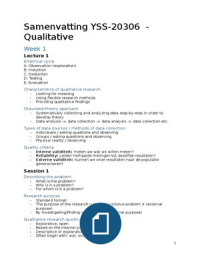
Samenvatting YSS-20306 -
Qualitative
Week 1
Lecture 1
Empirical cycle
A: Observation (exploration)
B: Induction
C: Deduction
D: Testing
E: Evaluation
Characteristics of qualitative research
- Looking for meaning
- Using flexible research methods
- Providing qualitative findings
Grounded-theory approach
- Systematically collecting and analyzing data step-by-step in order to
develop theory
- Data analysis -> data collection -> data analysis -> data collection etc.
Types of data sources / methods of data collection
- Individuals / asking questions and observing
- Groups / asking questions and observing
- Physical reality / observing
Quality criteria
- Interne validiteit: meten we wat we willen meten?
- Reliability: Leiden herhaalde metingen tot dezelfde resultaten?
- Externe validiteit: Kunnen we onze resultaten naar de populatie
generaliseren?
Session 1
Describing the problem
- What is the problem?
- Why is it a problem?
- For whom is it a problem?
Research purpose
- Standard format:
- The purpose of the research is to improve/solve problem X (external
purpose)
- By investigating/finding out/examine Y (internal purpose)
Qualitative research questions
- Explorative, open
- Based on the internal purpose
- Descriptive or explanatory
- Often begin with: wat, welke, hoe, waarom
1
, Research sub-questions
- May not expand or limit the central research question
- Are more specific than the central research question
- Interview sub-question: about opinions, feelings, preferences, experiences
- Observation sub-question: about behaviour, interaction, observable
communication
Lecture 2
The qualitative research process
1. Choose a subject and approach
2. Reviewing literature
3. Formulating research questions and purpose
4. Sampling
5. Ethical concerns
6. Data collection
7. Qualitative data analysis
(step 6 and 7 may be repeated)
8. Findings
9. Ensuring quality
10.Final report
Types of literature reviews
- Traditional (non-systematic)
- Systematic
- Meta-synthesis (qualitative)
- Meta-analysis (quantitative)
Research can be:
- Fundamental or applied
- Descriptive or explanatory
Emergent approach
- Adjusting the problem description, research purpose and research
questions during the research process
Characteristics of samples (quali)
- Relatively small sample size
- Research units are studied intensively
- Sequential selection of research units
- Looking for a wide range of different perspectives/experiences
Probability samples
- Simple random sampling
- Stratified random sampling
- Cluster sampling
Non-probability samples
- Convenience sampling
- Quota sampling
- Snowball sampling
- Purposive sampling: selecting research units intentionally according to the
needs of the study, 2 types:
2
Qualitative
Week 1
Lecture 1
Empirical cycle
A: Observation (exploration)
B: Induction
C: Deduction
D: Testing
E: Evaluation
Characteristics of qualitative research
- Looking for meaning
- Using flexible research methods
- Providing qualitative findings
Grounded-theory approach
- Systematically collecting and analyzing data step-by-step in order to
develop theory
- Data analysis -> data collection -> data analysis -> data collection etc.
Types of data sources / methods of data collection
- Individuals / asking questions and observing
- Groups / asking questions and observing
- Physical reality / observing
Quality criteria
- Interne validiteit: meten we wat we willen meten?
- Reliability: Leiden herhaalde metingen tot dezelfde resultaten?
- Externe validiteit: Kunnen we onze resultaten naar de populatie
generaliseren?
Session 1
Describing the problem
- What is the problem?
- Why is it a problem?
- For whom is it a problem?
Research purpose
- Standard format:
- The purpose of the research is to improve/solve problem X (external
purpose)
- By investigating/finding out/examine Y (internal purpose)
Qualitative research questions
- Explorative, open
- Based on the internal purpose
- Descriptive or explanatory
- Often begin with: wat, welke, hoe, waarom
1
, Research sub-questions
- May not expand or limit the central research question
- Are more specific than the central research question
- Interview sub-question: about opinions, feelings, preferences, experiences
- Observation sub-question: about behaviour, interaction, observable
communication
Lecture 2
The qualitative research process
1. Choose a subject and approach
2. Reviewing literature
3. Formulating research questions and purpose
4. Sampling
5. Ethical concerns
6. Data collection
7. Qualitative data analysis
(step 6 and 7 may be repeated)
8. Findings
9. Ensuring quality
10.Final report
Types of literature reviews
- Traditional (non-systematic)
- Systematic
- Meta-synthesis (qualitative)
- Meta-analysis (quantitative)
Research can be:
- Fundamental or applied
- Descriptive or explanatory
Emergent approach
- Adjusting the problem description, research purpose and research
questions during the research process
Characteristics of samples (quali)
- Relatively small sample size
- Research units are studied intensively
- Sequential selection of research units
- Looking for a wide range of different perspectives/experiences
Probability samples
- Simple random sampling
- Stratified random sampling
- Cluster sampling
Non-probability samples
- Convenience sampling
- Quota sampling
- Snowball sampling
- Purposive sampling: selecting research units intentionally according to the
needs of the study, 2 types:
2