Lecture 6: Organization Structure and Design
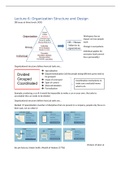
OB issues at three levels: (IGO)
Workspace has an
impact on how people
work
Change is everywhere
Individual applies for
everyone (each person
has a personality)
Organizational structure defines how job tasks are…
Specialization
Departmentalization (all the people doing different parts need to
be grouped
Chain of command Coordination mechanisms to
Span of control make sure everbody knows
(De)centralization what to do
Formalization
Example: producing a car it would be impossible to make a car on your own, the tasks to
accomplish this car needs to be divided
Organizational structure defines how job tasks are…
Divided Specialization (number of disciplines that are present in a company, people only focus on
their task, not on others!)
Division of labor at
the pin factory: (Adam Smith, Wealth of Nations (1776))
,Without division of labor (=one person performing all operations required to make a pin): A workman
not educated to this business … could scarce, perhaps, with his utmost industry, make one pin in a
day, and certainly could not make twenty. (so this is inefficient!)
With division of labor (=each person performing a distinct operation, = SPECIALIZATION): One man
draws out the wire; another straights it; a third cuts it; a fourth points it; a fifth grinds it at the top for
receiving the head; to make the head requires two or three distinct operations; to put it on is a
peculiar business; to whiten the pins is another; it is even a trade by itself to put them into the paper;
and the important business of making a pin is, in this manner, divided into about eighteen distinct
operations…they could, when they exerted themselves, make among them about twelve pounds of
pins in a day…Those ten persons, therefore, could make among them upwards of forty-eight
thousand pins in a day.
So Smith described the huge efficiency gains that can be gained by division of labor
Division of labor Work specialization
Until optimal point: the
more you specialize, the
more the productivity goes
up. Beyond this point, there
is a negative relationship
(task manager is to find this
point, but is very hard)
For some people, doing the
same thing over and over
again is what they want,
because it provides them
structure, routine, it gives
cognitive energy for
different purposes. If they
keep changing their work, is
gives them a cognitive
burden
so it is for each person
different!
Grouping jobs departmentalization
Grouping by functions (the fact that people are in the same group, it accounts for learning gaines.
They communicate in the same language, having the same educational background. Downside: the
walls between the groups are very hard to permeate)
Especially the wall between
production and marketing:
production is aiming for
efficiency, large series, less
change over time. But marketing
is aiming at serving the customer
,needs, requires a lot of flexibility
= classical clash between departments!
Grouping by products or services (sets of activities that some how represent a class of services
delivered by Walt Disney Why would Walt Disney not be a functional company? it is more
important for them to organize the knowledge that is required to run studio entertainment activities,
to have this knowledge in one department!) so in one unit because they believe it is the best way
to combine all knowledge needed in order to produce goods or services
Grouping by
geographical area (because it takes explicit knowledge to sell this products in Latin America or Asia
It requires different knowledge, different habets)
A university is always organized by faculty lines, the knowledge
areas!!!
Coordination: Chain of command (it represents who reports to
whom!)
Who reports to whom?
Authority is the formal right to give orders (form top to
bottom)
Unity of command: a person should have only one superior. If
not, ambiguity and power struggles may result
Long chains of command account for slow implementation
and filtered upward reporting
“The persons at the bottom are in the shit, the persons at the top are the best off and are treating
the workers like shit” how people look to management, you should prevent this!
Coordination: Span of control
, Narrow spans of control
Are expensive (more managerial levels) because you can only control a few people
Make upward vertical communication more complex (because there are more
managerial layers)
Overly tight supervision has negative effects on employee attitudes and behavior
(doesn’t account for everybody!)
Wide spans of control (it requires that you trust your
subordinates, mor than in narrow span of control) :
Are more efficient (because there are only two
managerial layers!)
But what if the span becomes too wide? you could lose control
Coordination: (De)centralization of authority
On the whole giving people more
autonomy is good for the decisions
‘island mentality’ nobody knows who the
person is, but the decisions are being
maded (can lead to dissatisfaction) they
make their own decisions without passing it
through to other units
Daily decisions
better for decentralized levels
Structural, strategic, tactical better for centralized levels
Coordination: Formalization
Formalization means standardization and control through
Explicit job descriptions
Organizational rules
Procedures
Protocols
So once things are being formalized (=being written down) and are accessible for all the people
who need this particular protocol or procedure, than it is standardization and control
OB issues at three levels: (IGO)
Workspace has an
impact on how people
work
Change is everywhere
Individual applies for
everyone (each person
has a personality)
Organizational structure defines how job tasks are…
Specialization
Departmentalization (all the people doing different parts need to
be grouped
Chain of command Coordination mechanisms to
Span of control make sure everbody knows
(De)centralization what to do
Formalization
Example: producing a car it would be impossible to make a car on your own, the tasks to
accomplish this car needs to be divided
Organizational structure defines how job tasks are…
Divided Specialization (number of disciplines that are present in a company, people only focus on
their task, not on others!)
Division of labor at
the pin factory: (Adam Smith, Wealth of Nations (1776))
,Without division of labor (=one person performing all operations required to make a pin): A workman
not educated to this business … could scarce, perhaps, with his utmost industry, make one pin in a
day, and certainly could not make twenty. (so this is inefficient!)
With division of labor (=each person performing a distinct operation, = SPECIALIZATION): One man
draws out the wire; another straights it; a third cuts it; a fourth points it; a fifth grinds it at the top for
receiving the head; to make the head requires two or three distinct operations; to put it on is a
peculiar business; to whiten the pins is another; it is even a trade by itself to put them into the paper;
and the important business of making a pin is, in this manner, divided into about eighteen distinct
operations…they could, when they exerted themselves, make among them about twelve pounds of
pins in a day…Those ten persons, therefore, could make among them upwards of forty-eight
thousand pins in a day.
So Smith described the huge efficiency gains that can be gained by division of labor
Division of labor Work specialization
Until optimal point: the
more you specialize, the
more the productivity goes
up. Beyond this point, there
is a negative relationship
(task manager is to find this
point, but is very hard)
For some people, doing the
same thing over and over
again is what they want,
because it provides them
structure, routine, it gives
cognitive energy for
different purposes. If they
keep changing their work, is
gives them a cognitive
burden
so it is for each person
different!
Grouping jobs departmentalization
Grouping by functions (the fact that people are in the same group, it accounts for learning gaines.
They communicate in the same language, having the same educational background. Downside: the
walls between the groups are very hard to permeate)
Especially the wall between
production and marketing:
production is aiming for
efficiency, large series, less
change over time. But marketing
is aiming at serving the customer
,needs, requires a lot of flexibility
= classical clash between departments!
Grouping by products or services (sets of activities that some how represent a class of services
delivered by Walt Disney Why would Walt Disney not be a functional company? it is more
important for them to organize the knowledge that is required to run studio entertainment activities,
to have this knowledge in one department!) so in one unit because they believe it is the best way
to combine all knowledge needed in order to produce goods or services
Grouping by
geographical area (because it takes explicit knowledge to sell this products in Latin America or Asia
It requires different knowledge, different habets)
A university is always organized by faculty lines, the knowledge
areas!!!
Coordination: Chain of command (it represents who reports to
whom!)
Who reports to whom?
Authority is the formal right to give orders (form top to
bottom)
Unity of command: a person should have only one superior. If
not, ambiguity and power struggles may result
Long chains of command account for slow implementation
and filtered upward reporting
“The persons at the bottom are in the shit, the persons at the top are the best off and are treating
the workers like shit” how people look to management, you should prevent this!
Coordination: Span of control
, Narrow spans of control
Are expensive (more managerial levels) because you can only control a few people
Make upward vertical communication more complex (because there are more
managerial layers)
Overly tight supervision has negative effects on employee attitudes and behavior
(doesn’t account for everybody!)
Wide spans of control (it requires that you trust your
subordinates, mor than in narrow span of control) :
Are more efficient (because there are only two
managerial layers!)
But what if the span becomes too wide? you could lose control
Coordination: (De)centralization of authority
On the whole giving people more
autonomy is good for the decisions
‘island mentality’ nobody knows who the
person is, but the decisions are being
maded (can lead to dissatisfaction) they
make their own decisions without passing it
through to other units
Daily decisions
better for decentralized levels
Structural, strategic, tactical better for centralized levels
Coordination: Formalization
Formalization means standardization and control through
Explicit job descriptions
Organizational rules
Procedures
Protocols
So once things are being formalized (=being written down) and are accessible for all the people
who need this particular protocol or procedure, than it is standardization and control