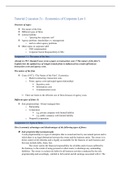
Tutorial 2 (session 3) – Economics of Corporate Law I
Overview of topics
The nature of the firm
Different types of firms
Limited liability
o “piercing the corporate veil”
Agency problem: shareholders vs. management
o and two other agency problems
Other topics in corporate L&E
o CEO compensation
o Corporate Social Responsibility (CSR)
Assignment 3.1: The nature of the firm
Already in 1937, Ronald Coase wrote a paper on transaction costs (“The nature of the firm”).
Explain how the optimal size of (single-owned) firms is influenced by a trade-off between
transaction costs and agency costs.
The nature of the firm
Coase (1937), “The Nature of the Firm”, Economica
o Market contracting: transaction costs
o Firms: agency costs (principal-agent relationship)
Incentive costs
Information costs
Communication costs
There are limits to the efficient size of firms because of agency costs.
Different types of firms (1)
Sole proprietorship / Owner-managed firm
o Partnership
o Corporation
e.g. private company with limited liability
e.g. public company with limited liability
o Nonprofit corporation
Assignment 3.2: Types of firms
Give (economic) advantages and disadvantages of the following types of firms:
Sole proprietorship (eenmanszaak)
A sole proprietorship is a type of enterprise that is owned and run by one natural person and in
which there is no legal distinction between the owner and the business entity. The owner is in
direct control of all elements and is legally accountable for the finances of such business and
this may include debts, loans, loss.
The owner carries the financial responsibility for all debts and/or losses suffered by
the business, to the extent of using personal or other assets, to discharge any outstanding
liabilities. The owner is exclusively liable for all business activities conducted by the sole
proprietorship and accordingly, entitled to full control and all earnings associated with it. The
, general aspect according to general business law is that this type of business ownership does
not embody a “legal entity” Furthermore, any attempted and unreliable distinctions of the
business do not change the classification under this title.
Advantages:
o A sole proprietor has complete control and decision-making power over the business;
o Sale or transfer can take place at the discretion of the sole proprietor;
o No corporate tax payments;
o Minimal legal costs to forming a sole proprietorship;
o Easy to form and dissolve: few formal business requirements.
Disadvantages:
o The sole proprietor of the business can be held personally liable for the debts and
obligations of the business. Additionally, this risk extends liabilities incurred as a
result of acts committed by employees of the company;
o All responsibilities and business decisions fall on the shoulders of the sole proprietor;
o Raising funds is difficult: Investors won't usually invest in sole proprietorships.
o Ends with death of proprietor.
Partnership (vennootschap onder firma)
A partnership is an arrangement in which two or more individuals share the profits and
liabilities. Various arrangements are possible:
1. General partnership: partners have unlimited liability, even innocent partners can be held
liable from what committed by other partners;
2. Limited liability partnership: some or all parties have limited liability, or limited
partnership: one or more of the parties are liable only to the extent of the amount of
money they have invested;
Advantages:
o Capital – Due to the nature of the business, the partners will fund the business with
startup capital. This means that the more partners there are, the more money they can
put into the business, which will allow better flexibility and more potential for growth.
It also means more potential profit, which will be equally shared between the partners;
o Flexibility – A partnership is generally easier to form, manage and run. They are less
strictly regulated than companies, in terms of the laws governing the formation and
because the partners have free choice in determine the way the business is run
(without interference by shareholders) .they are far more flexible in terms of
management, as long as all the partners can agree. (easier to reach agreement between
few partners rather than a lot of shareholders);
o Shared Responsibility – Partners can share the responsibility of the running of the
business. This will allow them to make the most of their abilities. Rather than splitting
the management and taking an equal share of each business task, they might well split
the work according to their skills. Thus, if one partner is good with figures, they might
deal with the book keeping and accounts, while the other partner might have a flare
for sales and therefore be the main sales person for the business;
o Decision Making – Partners share the decision making and can help each other out.
More partners mean more brains that can be picked for business ideas and for the
solving of problems that the business encounters.
Disadvantages:
Overview of topics
The nature of the firm
Different types of firms
Limited liability
o “piercing the corporate veil”
Agency problem: shareholders vs. management
o and two other agency problems
Other topics in corporate L&E
o CEO compensation
o Corporate Social Responsibility (CSR)
Assignment 3.1: The nature of the firm
Already in 1937, Ronald Coase wrote a paper on transaction costs (“The nature of the firm”).
Explain how the optimal size of (single-owned) firms is influenced by a trade-off between
transaction costs and agency costs.
The nature of the firm
Coase (1937), “The Nature of the Firm”, Economica
o Market contracting: transaction costs
o Firms: agency costs (principal-agent relationship)
Incentive costs
Information costs
Communication costs
There are limits to the efficient size of firms because of agency costs.
Different types of firms (1)
Sole proprietorship / Owner-managed firm
o Partnership
o Corporation
e.g. private company with limited liability
e.g. public company with limited liability
o Nonprofit corporation
Assignment 3.2: Types of firms
Give (economic) advantages and disadvantages of the following types of firms:
Sole proprietorship (eenmanszaak)
A sole proprietorship is a type of enterprise that is owned and run by one natural person and in
which there is no legal distinction between the owner and the business entity. The owner is in
direct control of all elements and is legally accountable for the finances of such business and
this may include debts, loans, loss.
The owner carries the financial responsibility for all debts and/or losses suffered by
the business, to the extent of using personal or other assets, to discharge any outstanding
liabilities. The owner is exclusively liable for all business activities conducted by the sole
proprietorship and accordingly, entitled to full control and all earnings associated with it. The
, general aspect according to general business law is that this type of business ownership does
not embody a “legal entity” Furthermore, any attempted and unreliable distinctions of the
business do not change the classification under this title.
Advantages:
o A sole proprietor has complete control and decision-making power over the business;
o Sale or transfer can take place at the discretion of the sole proprietor;
o No corporate tax payments;
o Minimal legal costs to forming a sole proprietorship;
o Easy to form and dissolve: few formal business requirements.
Disadvantages:
o The sole proprietor of the business can be held personally liable for the debts and
obligations of the business. Additionally, this risk extends liabilities incurred as a
result of acts committed by employees of the company;
o All responsibilities and business decisions fall on the shoulders of the sole proprietor;
o Raising funds is difficult: Investors won't usually invest in sole proprietorships.
o Ends with death of proprietor.
Partnership (vennootschap onder firma)
A partnership is an arrangement in which two or more individuals share the profits and
liabilities. Various arrangements are possible:
1. General partnership: partners have unlimited liability, even innocent partners can be held
liable from what committed by other partners;
2. Limited liability partnership: some or all parties have limited liability, or limited
partnership: one or more of the parties are liable only to the extent of the amount of
money they have invested;
Advantages:
o Capital – Due to the nature of the business, the partners will fund the business with
startup capital. This means that the more partners there are, the more money they can
put into the business, which will allow better flexibility and more potential for growth.
It also means more potential profit, which will be equally shared between the partners;
o Flexibility – A partnership is generally easier to form, manage and run. They are less
strictly regulated than companies, in terms of the laws governing the formation and
because the partners have free choice in determine the way the business is run
(without interference by shareholders) .they are far more flexible in terms of
management, as long as all the partners can agree. (easier to reach agreement between
few partners rather than a lot of shareholders);
o Shared Responsibility – Partners can share the responsibility of the running of the
business. This will allow them to make the most of their abilities. Rather than splitting
the management and taking an equal share of each business task, they might well split
the work according to their skills. Thus, if one partner is good with figures, they might
deal with the book keeping and accounts, while the other partner might have a flare
for sales and therefore be the main sales person for the business;
o Decision Making – Partners share the decision making and can help each other out.
More partners mean more brains that can be picked for business ideas and for the
solving of problems that the business encounters.
Disadvantages: