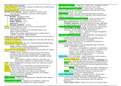
PSYCH2040 Chapter 1 Review: John Locke (17th century) – “blank slate” (“tabula rasa”); continuous; nurture;
Child Development: area of study; constancy & change from conception (egg many courses of development; plasticity at any age; passive child
and sperm) through adolescence Jean-Jacques Rousseau (18th century) – “noble savages”; discontinuous
Developmental Science: changes through life span (infancy, childhood, late childhood, adolescence); universal course; nature
Domains of Development – physical, cognitive, emotional, social (innate plan for growth); active child
-interconnected and influence each other; analyze together Charles Darwin – theory of evolution and natural selection; survival d/t
Periods of Development adaptive characteristics, passed on to next generation; early prenatal growth
1. Prenatal – conception to birth similar in many species
2. Infancy & Toddlerhood – birth to 2 G. Stanley Hall & Arnold Gesell (20th century) – nature; universal course;
3. Early Childhood – 2 to 6 discontinuous; children naturally knowledgeable about their needs
4. Middle Childhood – 6 to 11 -Maturational Process: genetically determined series of events
5. Adolescence – 11 to 18 -Normative Approach: measures of behaviour for many individuals,
6. Emerging Adulthood – 18 to 25 age-related averages represent typical development = “milestones”
Theory: orderly, integrated, evidence-based set of statements that T. Simon & A. Binet (20th century) – nature; universal course; discontinuous
describe/explain/predict behaviour -Stanford-Binet Intelligence Scale: assessment of cognitive
-guide and give meaning; use to understand, improve, and milestones, identify children with learning problems
optimize child development -Theory of Intelligence – defined as having good judgment,
-influenced by cultural values/belief systems; continue based on planning, and critical reflection
scientific verification (validity/reliability) James Mark Baldwin (20th century) – nature and nurture; discontinuous and
3 Basic Issues in Development: continuous/discontinuous, universal course of continuous; typical and individual development
development, nature vs nurture -children actively revise thinking, learn through habit/copying;
Continuous Development: gradually adding more of the same skills that were network between child and social surroundings
already there to begin with Erik Erikson - psychosocial theory (id, ego, superego); development in
Discontinuous Development: new ways of understanding/responding emerge relation to each culture’s life situation
at specific times; change is sudden -Psychosocial conflicts at each developmental stage, determines
-Stages: qualitative changes in thinking/feeling/behaving that healthy or maladaptive outcomes:
characterize specific developmental periods -basic trust vs. mistrust (birth-1); autonomy vs. shame/doubt
Universal Course of Development: each child develops the same way, despite (1-3), initiative vs. guilt (3-6), industry vs. inferiority (6-11),
different time periods and cultures identity vs. role confusion (adolescence), intimacy vs.
-Context: unique combinations of personal and environmental isolation (young adulthood), generativity vs. stagnation
circumstances that can result in different paths of change; multi- (middle), integrity vs. despair (old)
layered and complex (heredity, home/school, community, societal Behaviourism (Pavlov & Skinner) – directly observable (stimuli-response);
values, culture) continuous; many possible courses; emphasis on nurture
-Foster different cognitive capacities, social skills, and -Behaviour Modification: procedures that combine conditioning and
feelings about self/others (ex. individualistic vs collectivist) modelling to eliminate undesirable and increase desirable behaviours
Nature: humans programmed to develop a certain way, variation accounted -Pavlov (Classical Conditioning): punishments and rewards, neutral
for by variations in DNA stimulus with unconditioned stimulus, becomes conditioned stimulus
Nurture: physical and social world influence development from early on that produces conditioned response
Stability: lifelong characteristics, early experiences establish patterns -Watson – environment supreme force, adults mold behaviour
Plasticity: open to change based on influential experiences by controlling stimulus-response associations; continuous
Resilience: ability to adapt effectively to threats on development -Skinner (Operant Conditioning): frequency can increase with
-Personal characteristics, parental relationship, social support, reinforcements, and decrease with punishment
community resources, opportunities Social Learning Theory (Bandura) – modelling, imitation, observational
History of Developmental Theories: learning; continuous, many possible courses; emphasis on nurture
Medieval Times – childhood as separate period, vulnerable beings, religious -diverse factors influence motivation to imitate (R/P); importance of
beliefs (innocent or possessed) cognition (ability to listen and remember rules from observed
Reformation (16th century) – children born evil/stubborn, needed to be behaviours)
civilized, harsh rearing – later adopted more balanced approach -Social Cognitive Theory: children more selective in what they imitate
, Jean Piaget (20th century) – nurture; discontinuous; universal Dynamic Systems Perspective – child’s mind/body, physical/social worlds
-Cognitive-Development Theory: children actively construct form integrated system that guides mastery of new skills (dynamic)
knowledge as they explore their world -change in one part disrupts system, child actively reorganizes
- Stages: (SM-birth-2); (PO-2-7); (CO-7-11); (FO-11+) behaviour so system works again but more complex and effective
1. Sensorimotor – explore with eyes/ears/hands/mouth -continuous and discontinuous; many courses; nature and nurture
2. Preoperational – symbols, language, make-believe play Social Policy: planned set of actions by a group, institution, or governing
3. Concrete Operational – more logical and organized body to attain social goal
4. Formal Operational – abstract and systematic Public Policy: laws and government social policy programs
-Adaptation: structures of mind develop to better fit with or represent Individualist: self as separate from others, personal goals, independent
the external world Collectivist: self as part of group, group goals, interdependent
Recent Theoretical Perspectives: -more likely to have better policies on childcare
Information Processing – human mind as a symbol-manipulating system Need child-oriented policies because: children are the future and have basic
through which information flows; coded/translated/organized rights as human beings, investing now means investing later on (education,
-children are active, sense-making beings, modify own thinking in jobs, and crime rate)
response to environmental demands -who should pay (federal or provincial)? How does theoretical
-continuous (same thought processes but different extents), universal, position influence spending on child programs? (more likely to if
nature and nurture believe in nurture)
-useful for understanding problem solving/logic and classroom PSYCH2040 Chapter 2 Review:
interventions, but limited for non-linear situations (creativity & Hypothesis: prediction drawn from theory; can reflect on the theory’s
imagination) accuracy once the hypothesis is tested
Developmental Cognitive Neuroscience – study relationship b/w brain and Research Question: when little or no theory exists, offers guidance for
developing child’s cognitive, processing and behaviour patterns research methods and design
-how does genetic makeup combine with experiences to influence Common Research Methods:
growth and organization of the brain? -Systematic Observation
Ethology – adaptive or survival value of behaviour & evolutionary history -Naturalistic Observation – record behaviour in the field/natural
-imprinting, critical period, sensitive period environment (ex. park, school, home)
-continuous and discontinuous; universal; nature and nurture -Strengths: observe every day behaviour
Evolutionary Developmental Psychology – adaptive value of species-wide -Limitations: conditions not controlled, observer bias (looking
cognitive, emotional, and social competencies that change with age for specific findings, ignore others)
-continuous and discontinuous; universal; nature and nurture -Structured Observation – lab situation that evokes behaviour so every
Vygotsky - continuous and discontinuous; many courses; nature and nurture participant has equal opportunity to experience stimulus and response
-Sociocultural Theory: culture (values, beliefs, customs, and skills of -Strengths: same experience for all participants; study of
social group) is transmitted to next generation; children are active rarely-seen behaviours
and constructive; cognition is socially mediated -Limitations: not very typical behaviours, observer influence
-Social Interaction: cooperative dialogues b/w children and and bias
more knowledgeable members of society; needed for -Collecting Systematic Observations:
children to acquire ways of thinking and behaving -Event Sampling: record all instances of behaviour during specified
Bronfenbrenner – many courses, nature and nurture time period
-Ecological Systems Theory: child develops within complex system -Time Sampling: record whether certain behaviours occur during
of relationships affected by multiple levels of surrounding sample of short intervals
environment; not static force -Limitations of Observation:
-Microsystem = child’s immediate surroundings -Observer Bias: observers aware of purpose of study, may see/record
-Mesosystem = connections b/c microsystems (school, home, what they expect to see – better to have no knowledge of hypothesis
neighbourhood) -Observer Influence: participants act unnaturally b/c being watched
-Exosystem = social settings not containing children but -Ways to Minimize – habituation/adaptation period, train
affect them (workplace, extended family, health services) parents to do the observing
-Macrosystem = cultural values, laws, customs
-Chronosystem = temporal, life changes (imposed or arising)
Child Development: area of study; constancy & change from conception (egg many courses of development; plasticity at any age; passive child
and sperm) through adolescence Jean-Jacques Rousseau (18th century) – “noble savages”; discontinuous
Developmental Science: changes through life span (infancy, childhood, late childhood, adolescence); universal course; nature
Domains of Development – physical, cognitive, emotional, social (innate plan for growth); active child
-interconnected and influence each other; analyze together Charles Darwin – theory of evolution and natural selection; survival d/t
Periods of Development adaptive characteristics, passed on to next generation; early prenatal growth
1. Prenatal – conception to birth similar in many species
2. Infancy & Toddlerhood – birth to 2 G. Stanley Hall & Arnold Gesell (20th century) – nature; universal course;
3. Early Childhood – 2 to 6 discontinuous; children naturally knowledgeable about their needs
4. Middle Childhood – 6 to 11 -Maturational Process: genetically determined series of events
5. Adolescence – 11 to 18 -Normative Approach: measures of behaviour for many individuals,
6. Emerging Adulthood – 18 to 25 age-related averages represent typical development = “milestones”
Theory: orderly, integrated, evidence-based set of statements that T. Simon & A. Binet (20th century) – nature; universal course; discontinuous
describe/explain/predict behaviour -Stanford-Binet Intelligence Scale: assessment of cognitive
-guide and give meaning; use to understand, improve, and milestones, identify children with learning problems
optimize child development -Theory of Intelligence – defined as having good judgment,
-influenced by cultural values/belief systems; continue based on planning, and critical reflection
scientific verification (validity/reliability) James Mark Baldwin (20th century) – nature and nurture; discontinuous and
3 Basic Issues in Development: continuous/discontinuous, universal course of continuous; typical and individual development
development, nature vs nurture -children actively revise thinking, learn through habit/copying;
Continuous Development: gradually adding more of the same skills that were network between child and social surroundings
already there to begin with Erik Erikson - psychosocial theory (id, ego, superego); development in
Discontinuous Development: new ways of understanding/responding emerge relation to each culture’s life situation
at specific times; change is sudden -Psychosocial conflicts at each developmental stage, determines
-Stages: qualitative changes in thinking/feeling/behaving that healthy or maladaptive outcomes:
characterize specific developmental periods -basic trust vs. mistrust (birth-1); autonomy vs. shame/doubt
Universal Course of Development: each child develops the same way, despite (1-3), initiative vs. guilt (3-6), industry vs. inferiority (6-11),
different time periods and cultures identity vs. role confusion (adolescence), intimacy vs.
-Context: unique combinations of personal and environmental isolation (young adulthood), generativity vs. stagnation
circumstances that can result in different paths of change; multi- (middle), integrity vs. despair (old)
layered and complex (heredity, home/school, community, societal Behaviourism (Pavlov & Skinner) – directly observable (stimuli-response);
values, culture) continuous; many possible courses; emphasis on nurture
-Foster different cognitive capacities, social skills, and -Behaviour Modification: procedures that combine conditioning and
feelings about self/others (ex. individualistic vs collectivist) modelling to eliminate undesirable and increase desirable behaviours
Nature: humans programmed to develop a certain way, variation accounted -Pavlov (Classical Conditioning): punishments and rewards, neutral
for by variations in DNA stimulus with unconditioned stimulus, becomes conditioned stimulus
Nurture: physical and social world influence development from early on that produces conditioned response
Stability: lifelong characteristics, early experiences establish patterns -Watson – environment supreme force, adults mold behaviour
Plasticity: open to change based on influential experiences by controlling stimulus-response associations; continuous
Resilience: ability to adapt effectively to threats on development -Skinner (Operant Conditioning): frequency can increase with
-Personal characteristics, parental relationship, social support, reinforcements, and decrease with punishment
community resources, opportunities Social Learning Theory (Bandura) – modelling, imitation, observational
History of Developmental Theories: learning; continuous, many possible courses; emphasis on nurture
Medieval Times – childhood as separate period, vulnerable beings, religious -diverse factors influence motivation to imitate (R/P); importance of
beliefs (innocent or possessed) cognition (ability to listen and remember rules from observed
Reformation (16th century) – children born evil/stubborn, needed to be behaviours)
civilized, harsh rearing – later adopted more balanced approach -Social Cognitive Theory: children more selective in what they imitate
, Jean Piaget (20th century) – nurture; discontinuous; universal Dynamic Systems Perspective – child’s mind/body, physical/social worlds
-Cognitive-Development Theory: children actively construct form integrated system that guides mastery of new skills (dynamic)
knowledge as they explore their world -change in one part disrupts system, child actively reorganizes
- Stages: (SM-birth-2); (PO-2-7); (CO-7-11); (FO-11+) behaviour so system works again but more complex and effective
1. Sensorimotor – explore with eyes/ears/hands/mouth -continuous and discontinuous; many courses; nature and nurture
2. Preoperational – symbols, language, make-believe play Social Policy: planned set of actions by a group, institution, or governing
3. Concrete Operational – more logical and organized body to attain social goal
4. Formal Operational – abstract and systematic Public Policy: laws and government social policy programs
-Adaptation: structures of mind develop to better fit with or represent Individualist: self as separate from others, personal goals, independent
the external world Collectivist: self as part of group, group goals, interdependent
Recent Theoretical Perspectives: -more likely to have better policies on childcare
Information Processing – human mind as a symbol-manipulating system Need child-oriented policies because: children are the future and have basic
through which information flows; coded/translated/organized rights as human beings, investing now means investing later on (education,
-children are active, sense-making beings, modify own thinking in jobs, and crime rate)
response to environmental demands -who should pay (federal or provincial)? How does theoretical
-continuous (same thought processes but different extents), universal, position influence spending on child programs? (more likely to if
nature and nurture believe in nurture)
-useful for understanding problem solving/logic and classroom PSYCH2040 Chapter 2 Review:
interventions, but limited for non-linear situations (creativity & Hypothesis: prediction drawn from theory; can reflect on the theory’s
imagination) accuracy once the hypothesis is tested
Developmental Cognitive Neuroscience – study relationship b/w brain and Research Question: when little or no theory exists, offers guidance for
developing child’s cognitive, processing and behaviour patterns research methods and design
-how does genetic makeup combine with experiences to influence Common Research Methods:
growth and organization of the brain? -Systematic Observation
Ethology – adaptive or survival value of behaviour & evolutionary history -Naturalistic Observation – record behaviour in the field/natural
-imprinting, critical period, sensitive period environment (ex. park, school, home)
-continuous and discontinuous; universal; nature and nurture -Strengths: observe every day behaviour
Evolutionary Developmental Psychology – adaptive value of species-wide -Limitations: conditions not controlled, observer bias (looking
cognitive, emotional, and social competencies that change with age for specific findings, ignore others)
-continuous and discontinuous; universal; nature and nurture -Structured Observation – lab situation that evokes behaviour so every
Vygotsky - continuous and discontinuous; many courses; nature and nurture participant has equal opportunity to experience stimulus and response
-Sociocultural Theory: culture (values, beliefs, customs, and skills of -Strengths: same experience for all participants; study of
social group) is transmitted to next generation; children are active rarely-seen behaviours
and constructive; cognition is socially mediated -Limitations: not very typical behaviours, observer influence
-Social Interaction: cooperative dialogues b/w children and and bias
more knowledgeable members of society; needed for -Collecting Systematic Observations:
children to acquire ways of thinking and behaving -Event Sampling: record all instances of behaviour during specified
Bronfenbrenner – many courses, nature and nurture time period
-Ecological Systems Theory: child develops within complex system -Time Sampling: record whether certain behaviours occur during
of relationships affected by multiple levels of surrounding sample of short intervals
environment; not static force -Limitations of Observation:
-Microsystem = child’s immediate surroundings -Observer Bias: observers aware of purpose of study, may see/record
-Mesosystem = connections b/c microsystems (school, home, what they expect to see – better to have no knowledge of hypothesis
neighbourhood) -Observer Influence: participants act unnaturally b/c being watched
-Exosystem = social settings not containing children but -Ways to Minimize – habituation/adaptation period, train
affect them (workplace, extended family, health services) parents to do the observing
-Macrosystem = cultural values, laws, customs
-Chronosystem = temporal, life changes (imposed or arising)