WAVES AND PARTICLE NATURE OF LIGHT
Types of waves:
• Longitudinal:
o They propagate by the oscillation of particles displaced parallel to the line of travel
of the wave.
o These are caused by a vibrating object which causes pressure vibrations by pushing
molecules closer together as it oscillates.
• Transverse:
o The particles of the medium carrying the wave energy are displaced perpendicular
to the direction that the wave is traveling.
• Wavefront à The surface made up of all the points of the wave that are in phase with each
other.
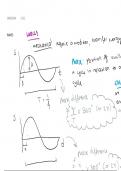
• Coherence à Waves with the same frequency and constant phase difference.
• Path Difference à For two waves starting at different points and arriving at the same point
the path difference is the difference in the length travelled by each wave in meters.
• Superposition à When two waves meet at the same point I space their displacement
combines and the total displacement at that point tis the sum of individual displacements.
• Phase Difference and Path Difference relationship:
o The phase difference in radians of two waves with the same frequency and
their path differences are related as shown:
Δ𝑥 = (𝜆/2𝜋)Δ𝜙
, • Standing/Stationary Waves:
o Standing waves can occur when two waves (with same frequency, wavelength and
amplitude) travelling in opposite direction meet and undergo superposition. No
energy is transferred in a stationary wave
o Nodes à points of zero amplitude which occur when the waves meet at antiphase,
having destructive interference which will result in the sum of the individual
amplitudes being 0.
o Anti-nodes à points of maximum amplitude which occur when the waves meet in
phase, having constructive interference which will result in the sum of the individual
amplitudes being 0.
• Speed of a transverse wave on a string:
• Refractive index, Snell’s law and Critical angle:
o Refraction occurs when a wave enters a
different medium, causing it to change direction as
it also changes speed, either towards or away from
the normal.
o If the new medium is more optically denser,
it will slow down and bend towards the normal.
o Critical angle is when the angle of refraction
increases until it reaches 90 degrees. When it is
exactly 90, the light is refracted across the
boundary and the angle of incidence has reached
the critical angle.
2
Types of waves:
• Longitudinal:
o They propagate by the oscillation of particles displaced parallel to the line of travel
of the wave.
o These are caused by a vibrating object which causes pressure vibrations by pushing
molecules closer together as it oscillates.
• Transverse:
o The particles of the medium carrying the wave energy are displaced perpendicular
to the direction that the wave is traveling.
• Wavefront à The surface made up of all the points of the wave that are in phase with each
other.
• Coherence à Waves with the same frequency and constant phase difference.
• Path Difference à For two waves starting at different points and arriving at the same point
the path difference is the difference in the length travelled by each wave in meters.
• Superposition à When two waves meet at the same point I space their displacement
combines and the total displacement at that point tis the sum of individual displacements.
• Phase Difference and Path Difference relationship:
o The phase difference in radians of two waves with the same frequency and
their path differences are related as shown:
Δ𝑥 = (𝜆/2𝜋)Δ𝜙
, • Standing/Stationary Waves:
o Standing waves can occur when two waves (with same frequency, wavelength and
amplitude) travelling in opposite direction meet and undergo superposition. No
energy is transferred in a stationary wave
o Nodes à points of zero amplitude which occur when the waves meet at antiphase,
having destructive interference which will result in the sum of the individual
amplitudes being 0.
o Anti-nodes à points of maximum amplitude which occur when the waves meet in
phase, having constructive interference which will result in the sum of the individual
amplitudes being 0.
• Speed of a transverse wave on a string:
• Refractive index, Snell’s law and Critical angle:
o Refraction occurs when a wave enters a
different medium, causing it to change direction as
it also changes speed, either towards or away from
the normal.
o If the new medium is more optically denser,
it will slow down and bend towards the normal.
o Critical angle is when the angle of refraction
increases until it reaches 90 degrees. When it is
exactly 90, the light is refracted across the
boundary and the angle of incidence has reached
the critical angle.
2