100% de satisfacción garantizada Inmediatamente disponible después del pago Tanto en línea como en PDF No estas atado a nada 4.2 TrustPilot
logo-home
Examen

Chapter 4. Professional Legal Liability

Puntuación
-
Vendido
1
Páginas
35
Grado
A+
Subido en
06-05-2022
Escrito en
2024/2025

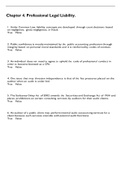
Chapter 4. Professional Legal Liability/ Chapter 4. Professional Legal Liability. 1. Under Common Law, liability concepts are developed through court decisions based on negligence, gross negligence, or fraud. True False 2. Public confidence is mostly maintained by the public accounting profession through integrity based on personal moral standards and it is reinforced by codes of conduct. True False 3. An individual does not need to agree to uphold the code of professional conduct in order to become licensed as a CPA. True False 4. One issue that may threaten independence is that of the fee pressures placed on the auditor when an audit is under bid. True False 5. The Sarbanes-Oxley Act of 2002 amends the Securities and Exchange Act of 1934 and places prohibitions on certain consulting services by auditors for their audit clients. True False 6. An auditor of a public client may perform internal audit outsourcing services for a client because such services coincide with external audit functions. True False 7. An auditor of a public client may assist a client in designing and implementing internal controls over financial reporting. True False 8. The SEC is concerned with situations between an auditor and a public company that allow the auditor to act as management of the client. True False 9. The Principles of the AICPA Code of Professional Conduct provide a very detailed set of rules that represent a low level of actions. True False 10. The Rules of Conduct govern the performance of CPAs in carrying out their public responsibilities. True False 11. Confidentiality is the cornerstone of the auditing profession. True False 12. Audit reports on financial statements can be signed only by those who are licensed as CPAs by their state board of accountancy True False 13. The AICPA's Code of Professional Conduct defines an indirect financial interest as an investment of one percent or less of a client's organization, and because the amount is so small it is considered immaterial True False 14. Gross negligence is a failure to use even minimal care or evidence of activities that show a recklessness or careless disregard for the truth. True False 15. Auditors are permitted to perform for a contingent fee an audit of the financial statements if the audit committee approves the agreement in advance of the services being provided. True False 16. The confidentiality between auditor and client is legally equivalent as the confidentiality shared between attorney and client. True False 17. Contingent fees are prohibited for tax professionals when preparing tax returns for clients True False 18. Contingent fees are prohibited for any client for which the auditor performs audit services, but are otherwise permitted. True False 19. Commissions and referral fees are allowed to audit firms as long as the audit client is informed of the fees. True False 20. According to the framework for professional decision making, the first step in decision-making is to structure the audit problem True False 21. The highest-order rights include rights granted by the government, such as civil rights, legal rights, rights to own property, and license privileges. True False 22. CPAs are no longer able to practice as a sole proprietorship. True False 23. An ethical dilemma occurs in a situation in which moral duties or obligations conflict. True False 24. An ethical dilemma occurs an ethically correct action may conflict with an individual’s immediate self-interest. True False 25. The expectations gap represents a misunderstanding whereby shareholders mistakenly believe that they are entitled to recover losses on investments for which the auditor provided an unqualified opinion on the financial statements. True False 26. The deep pocket theory represents a misunderstanding whereby shareholders mistakenly believe that they are entitled to recover losses on investments for which the auditor provided an unqualified opinion on the financial statements. True False 27. Rights theory focuses on evaluating actions in terms of the fundamental rights of the parties involved. True False 28. There is a hierarchy of rights to consider when applying rights theory. True False 29. On an audit, only CPAs are required to comply with the AICPA’s independence rules. True False 30. A covered member under the AICPA’s rules includes individuals on the engagement team, any individual in a position to influence the engagement team, and all professional staff in the office of the engagement. True False 31. The Principles of the AICPA Code of Professional Conduct are aspiration in nature; only the Rules of Conduct and their Interpretations are enforceable against members. True False 32. Rule 101 on integrity and objectivity only applies to covered members as defined by the AICPA. True False 33. The AICPA may revoke a member’s CPA license for violations of its Code of Professional Conduct. True False 34. If a member owns several shares of stock of a company during the first few months of the fiscal year under audit and then sells the shares before accepting the engagement, the firm does not violate the independence rules of the AICPA. True False 35. A contingency fee is a situation in which no fee will be charged unless a specified finding or result is attained. True False 36. Utilitarian theory is an approach for addressing ethical problems by identifying a hierarchy of rights that should be considered in solving ethical dilemmas. True False 37. The Sarbanes Oxley Act requires management to pre-approve any non-audit service by the auditor, including tax services not specifically prohibited. True False 38. Major threats to the independence of the auditor include compensation schemes, familiarity with the client, and time pressures. True False 39. Loans between the auditor and the client are permitted in some circumstances. True False 40. The auditor is permitted to violate the confidentiality rule in providing relevant information to an inquiry by a major shareholder of the client. True False 41. In determining auditor independence, the SEC considers which of the following as an independence impairment? A. An auditor performs the accounting work and then audits it. B. An auditor has no conflicting interest with the client. C. An auditor does not act as an advocate for the audit client. D. An auditor does not act as an employee of the audit client. 42. Mark Pulley is an auditor at Pulley and Hurst, LLC. If Pulley's five-year-old daughter owns shares of stock in McBurgers Corporation, then what is Pulley considered to have? A. An immaterial indirect financial interest in McBurgers Corporation. B. A material indirect financial interest in the McBurgers Corporation. C. A loophole for claiming independence from McBurgers Corporation. D. An direct financial interest in McBurgers Corporation. 43. Which of the following employment positions could an auditor’s spouse hold in a client without violating the independence requirements? A. Controller. B. Treasurer. C. Order entry staff. D. Internal audit director. 44. An audit firm is not considered independent when it performs which of the following services for a publicly traded audit client? A. Tax return preparation as approved by the board of directors. B. Basic accounting record keeping and financial statement preparation. C. Accounting information system design and implementation. D. Both B and C. E. None of the above. 45. Julie Webb, CPA takes out an automobile loan with First National Bank of Wellville (FNBW) while attending the University of Wellville. Julie graduates one year later and is hired as an auditor by Best and Driftwood, LLP. Her first assigned audit engagement is with First National Bank of Wellville, a client of Best and Driftwood. As a new audit assistant, Julie continues to pay her automobile loan payments each month. Which of the following best describes Julie’s independence status? A. Impaired because Julie has a direct financial interest in FNBW. B. Impaired because Julie has a material indirect financial interest in FNBW. C. Not impaired because Julie has an immaterial indirect financial interest in FNBW. D. Not impaired because Julie is permitted to take normal loans from FNBW. 46. Julie Webb, CPA takes out an automobile loan with First national Bank of Wellville (FNBW) while attending the University of Wellville. Julie graduates one year later and is hired as an auditor by Best and Driftwood, LLP. Her first assigned audit engagement is with First national Bank of Wellville, a client of Best and Driftwood. As a new audit assistant, Julie continues to pay her automobile loan payments each month. According to the AICPA, why is Julie is considered a covered member for FNBW independence purposes? A. She will be working on the engagement. B. She has a direct financial interest in FNBW. C. She graduated in the same area as the client is operating. D. She has an immaterial direct financial interest in FNBW. 47. In determining the types of activities, engagements and interactions an auditor should have with a client, what must the CPA and the audit firm do? A. Follow the rules exactly as they are written. B. Assess all of their relationships with every client to ensure that independence is intact. C. Focus on client satisfaction above all other considerations. D. Realize that ethics are only guidelines and a matter of personal judgment. 48. Which of the following represents a situation in which an auditor is independent of its client? A. The auditor is paid by the client organization rather than the SEC. B. The auditor takes a personal loan from the president of the company. C. The auditor’s dependent son holds 25 shares of the client’s common stock. D. The auditor has not received payment for the previous audit services. 49. For which of the following engagements are members of the AICPA required to act with integrity and objectivity? A. Tax preparation. B. Financial statement review services. C. Financial statement audits. D. All engagements. 50. Which one of the following is an example of a conflict of interest for a CPA? A. Performing tax services and a compilation engagement for a client. B. Serving as legal counsel and an auditor for a client. C. Providing an audit on internal financial controls and financial statements for a client. D. Serving as a chief financial officer as an employee and as a member of the board of directors. 51. Which of the following is not an aspect of Rule 201 of the General Standards of the Code of Professional Conduct? A. A member must not take on an engagement that is beyond the member's professional competence. B. A member must exercise duties prudently and professionally. C. A member must adequately plan and supervise the performance of professional services. D. A member firm must not advertise services to competing clients. 52. Which of following actions satisfies Rule 201 of the General Standards of the Code of Professional Conduct definition of professional competence? A. Having sufficient collegiate and continuing professional education to perform the audit. B. Only accepting engagements that the firm's members can competently perform. C. Adequately planning and supervising of professional performance. D. None of the above satisfy Rule 201. 53. A member of the AICPA must safeguard the confidentiality of client information. Which of the following is not a valid reason to disclose information to non-clients? A. To discuss information relating to inadequate disclosure in an audit report. B. To comply with a validly issued and enforceable subpoena or summons. C. To accommodate the review of client audit work papers under AICPA, PCAOB, or State Board of Accountancy authority. D. To explain to members of the press whether a client is likely to miss payroll in the forthcoming periods. 54. An audit firm is considered independent even if it performs which of the following services for a publicly traded audit client? A. Serving as a member of the client’s board of directors. B. Determining which accounting policies will be adopted by the client. C. Accounting information system design and implementation. D. Tax return preparation as approved by the board of directors. 55. Which of the following is an acceptable organizational form for an audit firm? A. A partnership. B. A professional corporation. C. A sole proprietorship. D. Any organizational form permitted by state law or regulation. 56. From whom should a CPA not accept a commission for recommending a product or service? A. A tax client. B. An audit client. C. A financial-planning client. D. A management-services client. E. Any of the above. 57. What is information about a client that cannot be subpoenaed by a court of law called? A. Confidential information. B. Privileged communication. C. Contingent information. D. Audit communication. 58. An auditor who is professionally skeptical will do which of the following? A. Critically question contradictory audit evidence.. B. Carefully evaluate the reliability of audit evidence, especially in situations in which fraud risk is high. C. Reasonably question the authenticity of documentation, while accepting that documents are to be considered genuine unless there is reason to believe the contrary. D. All of the above. 59. What is a situation in which an individual is morally or ethically required to do something that conflicts with his or her immediate self-interest called? A. An ethical dilemma. B. An ethical problem. C. An ethical theory. D. None of the above. 60. What does the AICPA Code of Professional Conduct consists of? A. Principles, Rules of Conduct and Ethics Rulings. B. Rules of Conduct, Interpretations and Principles. C. Principles, Rules of Conduct and Ethics Rulings. D. Principles, Rules of Conduct, Interpretations and Ethics Rulings. 61. What concepts does the AICPA Principles of Professional Conduct include? A. Public interest, objectivity and independence. B. Due professional care and supervision. C. Scope and nature of services and adequate training. D. Integrity and confidentiality. 62. In which of the following situations would a CPA not be considered independent? A. A CPA has obtained an auto loan from a banking client in the current year. B. A CPA has obtained an automobile lease term from a client in the current year. C. A CPA has obtained a $4,000 cash advance from a banking client in the current year. D. A CPA has obtained a home mortgage loan from a client in the current year. 63. In which of the following situations would a CPA not be considered independent? A. A CPA has obtained an auto loan from a banking client in a prior year. B. A CPA has obtained a home mortgage loan in 1988 from a client. C. A CPA has obtained a $4,500 cash advance from a banking client in the current year. D. A CPA has obtained a $6,500 cash advance from a client in the current year.

Mostrar más Leer menos
Institución
Grado


Ups! No podemos cargar tu documento ahora. Inténtalo de nuevo o contacta con soporte.

Escuela, estudio y materia

Institución
Grado

Información del documento

Subido en
6 de mayo de 2022
Número de páginas
35
Escrito en
2024/2025
Tipo
Examen
Contiene
Preguntas y respuestas

Temas

Vista previa del contenido

Chapter 4. Professional Legal Liability.

1. Under Common Law, liability concepts are developed through court decisions based
on negligence, gross negligence, or fraud.
True False


2. Public confidence is mostly maintained by the public accounting profession through
integrity based on personal moral standards and it is reinforced by codes of conduct.
True False


3. An individual does not need to agree to uphold the code of professional conduct in
order to become licensed as a CPA.
True False


4. One issue that may threaten independence is that of the fee pressures placed on the
auditor when an audit is under bid.
True False


5. The Sarbanes-Oxley Act of 2002 amends the Securities and Exchange Act of 1934 and
places prohibitions on certain consulting services by auditors for their audit clients.
True False


6. An auditor of a public client may perform internal audit outsourcing services for a
client because such services coincide with external audit functions.
True False

,7. An auditor of a public client may assist a client in designing and implementing internal
controls over financial reporting.
True False


8. The SEC is concerned with situations between an auditor and a public company that
allow the auditor to act as management of the client.
True False


9. The Principles of the AICPA Code of Professional Conduct provide a very detailed set of
rules that represent a low level of actions.
True False


10. The Rules of Conduct govern the performance of CPAs in carrying out their public
responsibilities.
True False


11. Confidentiality is the cornerstone of the auditing profession.
True False


12. Audit reports on financial statements can be signed only by those who are licensed
as CPAs by their state board of accountancy
True False


13. The AICPA's Code of Professional Conduct defines an indirect financial interest as an
investment of one percent or less of a client's organization, and because the amount is
so small it is considered immaterial
True False


14. Gross negligence is a failure to use even minimal care or evidence of activities that
show a recklessness or careless disregard for the truth.
True False

,15. Auditors are permitted to perform for a contingent fee an audit of the financial
statements if the audit committee approves the agreement in advance of the services
being provided.
True False


16. The confidentiality between auditor and client is legally equivalent as the
confidentiality shared between attorney and client.
True False


17. Contingent fees are prohibited for tax professionals when preparing tax returns for
clients
True False


18. Contingent fees are prohibited for any client for which the auditor performs audit
services, but are otherwise permitted.
True False


19. Commissions and referral fees are allowed to audit firms as long as the audit client is
informed of the fees.
True False


20. According to the framework for professional decision making, the first step in
decision-making is to structure the audit problem
True False


21. The highest-order rights include rights granted by the government, such as civil
rights, legal rights, rights to own property, and license privileges.
True False


22. CPAs are no longer able to practice as a sole proprietorship.
True False

, 23. An ethical dilemma occurs in a situation in which moral duties or obligations conflict.
True False


24. An ethical dilemma occurs an ethically correct action may conflict with an individual’s
immediate self-interest.
True False


25. The expectations gap represents a misunderstanding whereby shareholders
mistakenly believe that they are entitled to recover losses on investments for which the
auditor provided an unqualified opinion on the financial statements.
True False


26. The deep pocket theory represents a misunderstanding whereby shareholders
mistakenly believe that they are entitled to recover losses on investments for which the
auditor provided an unqualified opinion on the financial statements.
True False


27. Rights theory focuses on evaluating actions in terms of the fundamental rights of the
parties involved.
True False


28. There is a hierarchy of rights to consider when applying rights theory.
True False


29. On an audit, only CPAs are required to comply with the AICPA’s independence rules.
True False


30. A covered member under the AICPA’s rules includes individuals on the engagement
team, any individual in a position to influence the engagement team, and all professional
staff in the office of the engagement.
True False

$6.49
Accede al documento completo:

100% de satisfacción garantizada
Inmediatamente disponible después del pago
Tanto en línea como en PDF
No estas atado a nada


Documento también disponible en un lote

Conoce al vendedor

Seller avatar
Los indicadores de reputación están sujetos a la cantidad de artículos vendidos por una tarifa y las reseñas que ha recibido por esos documentos. Hay tres niveles: Bronce, Plata y Oro. Cuanto mayor reputación, más podrás confiar en la calidad del trabajo del vendedor.
Approvedtutor Johns Hopkins University
Seguir Necesitas iniciar sesión para seguir a otros usuarios o asignaturas
Vendido
615
Miembro desde
4 año
Número de seguidores
560
Documentos
1475
Última venta
2 semanas hace
Verified Notes Sharing Platform

I am a student like you, I create notes to help my fellow students excell amidist tight deadlines and never ending responsibilities. Hope the study materials that you will find here will help reduce your college workload.

3.4

64 reseñas

5
22
4
12
3
12
2
4
1
14

Recientemente visto por ti

Por qué los estudiantes eligen Stuvia

Creado por compañeros estudiantes, verificado por reseñas

Calidad en la que puedes confiar: escrito por estudiantes que aprobaron y evaluado por otros que han usado estos resúmenes.

¿No estás satisfecho? Elige otro documento

¡No te preocupes! Puedes elegir directamente otro documento que se ajuste mejor a lo que buscas.

Paga como quieras, empieza a estudiar al instante

Sin suscripción, sin compromisos. Paga como estés acostumbrado con tarjeta de crédito y descarga tu documento PDF inmediatamente.

Student with book image

“Comprado, descargado y aprobado. Así de fácil puede ser.”

Alisha Student

Preguntas frecuentes