Part 1: Chapter 1
Management in turbulent times
The definition of management & The four management functions
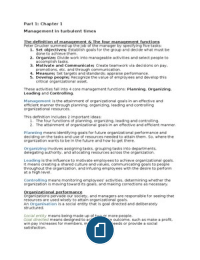
Peter Drucker summed up the job of the manager by specifying five tasks:
1. Set objectives; Establish goals for the group and decide what must be
done to achieve them.
2. Organize; Divide work into manageable activities and select people to
accomplish tasks.
3. Motivate and Communicate; Create teamwork via decisions on pay,
promotions, etc. and through communication.
4. Measure; Set targets and standards; appraise performance.
5. Develop people; Recognize the value of employees and develop this
critical organizational asset.
These activities fall into 4 core management functions: Planning, Organizing,
Leading and Controlling.
Management is the attainment of organizational goals in an effective and
efficient manner through planning, organizing, leading and controlling
organizational resources.
This definition includes 2 important ideas:
1. The four functions of planning, organizing, leading and controlling.
2. The attainment of organizational goals in an effective and efficient manner.
Planning means identifying goals for future organizational performance and
deciding on the tasks and use of resources needed to attain them. So, where the
organization wants to be in the future and how to get there.
Organizing involves assigning tasks, grouping tasks into departments,
delegating authority, and allocating resources across the organization.
Leading is the influence to motivate employees to achieve organizational goals.
It means creating a shared culture and values, communicating goals to people
throughout the organization, and infusing employees with the desire to perform
at a high level.
Controlling means monitoring employees’ activities, determining whether the
organization is moving toward its goals, and making corrections as necessary.
Organizational performance
Organizations pervade our society, and managers are responsible for seeing that
resources are used wisely to attain organizational goals.
An Organisation is a social entity that is goal directed and deliberately
structured.
Social entity means being made up of two or more people.
Goal directed means designed to achieve some outcome, such as make a profit,
win pay increases for members, meet spiritual needs or provide a social
satisfaction.
, Deliberately structured means that tasks are divides, and responsibility for their
performance is assigned to organization members. This definition applies to all
organizations, both profit and non-profit.
The manager’s responsibility is to coordinate resources in an effective and
efficient manner to accomplish the organization’s goals.
Organizational effectiveness is the degree to which the organization achieves a
stated goal, or succeeds in accomplishing what it tries to do. It means providing a
product or service that customers value.
Organizational efficiency refers to the amount of resources used to achieve an
organizational goal. It is based on how much raw material, money, and people
are necessary for producing a given volume of output. Efficiency can be
calculated as the amount of resources used to produce a product or service.
The ultimate responsibility of managers is to achieve high performance, which
is the attainment of organizational goals by using resources in an efficient and
effective manner.
Management skills
The necessary skills for managing a department or organization can be placed in
three categories:
1. Conceptual skills
2. Human skills
3. Technical skills
Conceptual skill is the cognitive ability to see the organization as a whole
system and the relationships among its parts. It involves knowing where one’s
team fits into the total organization and how the organization fits into the
industry, the community and the broader business and social environment. It
means the ability to think strategically and to identify, evaluate, and solve
complex problems.
Conceptual skills are needed for all managers, but especially for managers at the
top.
Human skill is the manager’s ability to work with and through other people and
to work effectively as a group member. Human skill is demonstrated in the way a
manager relates to other people, including the ability to motivate, facilitate,
coordinate, lead, communicate, and resolve conflicts. Human skills are essential
for frontline managers who work with employees directly on a daily basis.
Technical skill is the understanding of and proficiency in the performance of
specific tasks. Technical skill includes mastery of the methods, techniques, and
equipment involved in specific functions. Technical skills are particularly
important at lower organizational levels.
Part 1 : Chapter 2
The Evolution of Management Thinking
Management and Organization
Management in turbulent times
The definition of management & The four management functions
Peter Drucker summed up the job of the manager by specifying five tasks:
1. Set objectives; Establish goals for the group and decide what must be
done to achieve them.
2. Organize; Divide work into manageable activities and select people to
accomplish tasks.
3. Motivate and Communicate; Create teamwork via decisions on pay,
promotions, etc. and through communication.
4. Measure; Set targets and standards; appraise performance.
5. Develop people; Recognize the value of employees and develop this
critical organizational asset.
These activities fall into 4 core management functions: Planning, Organizing,
Leading and Controlling.
Management is the attainment of organizational goals in an effective and
efficient manner through planning, organizing, leading and controlling
organizational resources.
This definition includes 2 important ideas:
1. The four functions of planning, organizing, leading and controlling.
2. The attainment of organizational goals in an effective and efficient manner.
Planning means identifying goals for future organizational performance and
deciding on the tasks and use of resources needed to attain them. So, where the
organization wants to be in the future and how to get there.
Organizing involves assigning tasks, grouping tasks into departments,
delegating authority, and allocating resources across the organization.
Leading is the influence to motivate employees to achieve organizational goals.
It means creating a shared culture and values, communicating goals to people
throughout the organization, and infusing employees with the desire to perform
at a high level.
Controlling means monitoring employees’ activities, determining whether the
organization is moving toward its goals, and making corrections as necessary.
Organizational performance
Organizations pervade our society, and managers are responsible for seeing that
resources are used wisely to attain organizational goals.
An Organisation is a social entity that is goal directed and deliberately
structured.
Social entity means being made up of two or more people.
Goal directed means designed to achieve some outcome, such as make a profit,
win pay increases for members, meet spiritual needs or provide a social
satisfaction.
, Deliberately structured means that tasks are divides, and responsibility for their
performance is assigned to organization members. This definition applies to all
organizations, both profit and non-profit.
The manager’s responsibility is to coordinate resources in an effective and
efficient manner to accomplish the organization’s goals.
Organizational effectiveness is the degree to which the organization achieves a
stated goal, or succeeds in accomplishing what it tries to do. It means providing a
product or service that customers value.
Organizational efficiency refers to the amount of resources used to achieve an
organizational goal. It is based on how much raw material, money, and people
are necessary for producing a given volume of output. Efficiency can be
calculated as the amount of resources used to produce a product or service.
The ultimate responsibility of managers is to achieve high performance, which
is the attainment of organizational goals by using resources in an efficient and
effective manner.
Management skills
The necessary skills for managing a department or organization can be placed in
three categories:
1. Conceptual skills
2. Human skills
3. Technical skills
Conceptual skill is the cognitive ability to see the organization as a whole
system and the relationships among its parts. It involves knowing where one’s
team fits into the total organization and how the organization fits into the
industry, the community and the broader business and social environment. It
means the ability to think strategically and to identify, evaluate, and solve
complex problems.
Conceptual skills are needed for all managers, but especially for managers at the
top.
Human skill is the manager’s ability to work with and through other people and
to work effectively as a group member. Human skill is demonstrated in the way a
manager relates to other people, including the ability to motivate, facilitate,
coordinate, lead, communicate, and resolve conflicts. Human skills are essential
for frontline managers who work with employees directly on a daily basis.
Technical skill is the understanding of and proficiency in the performance of
specific tasks. Technical skill includes mastery of the methods, techniques, and
equipment involved in specific functions. Technical skills are particularly
important at lower organizational levels.
Part 1 : Chapter 2
The Evolution of Management Thinking
Management and Organization