Unit 6 Principles of Management, BTEC Level 3.
Essential knowledge and revision guide.
Contents
1. Introduction to the unit
2. Specification checklist with space to explain key terminology
3. Key notes from lead examiner reports, hints and tips
4. Breakdown of task weighting
5. Grade boundaries
Introduction to the unit
What’s the unit all about?
The aim of the Principles of Management unit is to develop your knowledge of how managers and leaders
influence and contribute to the overall success of a business.
Throughout the unit you will investigate and analyse the following:
How businesses adapt their approaches to management in response to challenges in their
environment.
The skill sets managers need to develop skill sets to enable them to work effectively in areas such as
the management of people, financial, resource and quality management, and the management of
change.
The issues that managers and leaders have to deal with in the workplace in making businesses
more efficient and ensuring their survival and growth.
How effective planning and organising of a business’s activity can significantly influence the success
of a business.
Here’s a summary of the assessment
You will be provided with a case study named Part A. This will allow you to gauge the context and
structure you revision.
It is advised you spend a minimum of 6 hours preparing notes and undertaking research on the
industry and context of the case study in addition to your usual revision structure.
The exam is under supervised conditions and lasts for 3 hours.
The exam is usually out of 88 marks and typically contains two activities which are both worth 44
marks. It is advised you split your time equally across both tasks.
There are sample assessments from previous academic years available and it is advised you attempt
at least one to gauge an understanding of the assessment structure and content etc.
Assessment outcomes:
AO1 Demonstrate knowledge and understanding of management and leadership principles,
concepts, key terms, functions and theories
AO2 Apply knowledge and understanding of management and leadership issues to real-life business
scenarios
AO3 Analyse and evaluate management information and data, demonstrating the ability to
interpret the potential impact and influence on business effectiveness in context
AO4 Be able to recommend management and leadership proposals in context with appropriate
justification, using a range of evidence to support arguments
, Table of content of everything you need to know for the exam:
(next page)
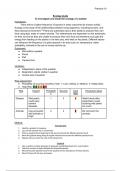
Specification Checklist with Space to Explain Key Terminology
Topic Your explanation of the terminology Exam
Ready?
A The definitions and functions of management
A1 Definitions of management and leadership
Management by objectives.
Situational and contingency.
Functional and action
centred.
Transformational and
transactional.
The concept of leadership
continuum for management
behaviour
A2 Functions of management and leadership
Functions of management:
Planning
Organising
Co-ordinating
Monitoring
Controlling
Delegating
Functions of leadership
Inspiring
Energising
Influencing stakeholders
Essential knowledge and revision guide.
Contents
1. Introduction to the unit
2. Specification checklist with space to explain key terminology
3. Key notes from lead examiner reports, hints and tips
4. Breakdown of task weighting
5. Grade boundaries
Introduction to the unit
What’s the unit all about?
The aim of the Principles of Management unit is to develop your knowledge of how managers and leaders
influence and contribute to the overall success of a business.
Throughout the unit you will investigate and analyse the following:
How businesses adapt their approaches to management in response to challenges in their
environment.
The skill sets managers need to develop skill sets to enable them to work effectively in areas such as
the management of people, financial, resource and quality management, and the management of
change.
The issues that managers and leaders have to deal with in the workplace in making businesses
more efficient and ensuring their survival and growth.
How effective planning and organising of a business’s activity can significantly influence the success
of a business.
Here’s a summary of the assessment
You will be provided with a case study named Part A. This will allow you to gauge the context and
structure you revision.
It is advised you spend a minimum of 6 hours preparing notes and undertaking research on the
industry and context of the case study in addition to your usual revision structure.
The exam is under supervised conditions and lasts for 3 hours.
The exam is usually out of 88 marks and typically contains two activities which are both worth 44
marks. It is advised you split your time equally across both tasks.
There are sample assessments from previous academic years available and it is advised you attempt
at least one to gauge an understanding of the assessment structure and content etc.
Assessment outcomes:
AO1 Demonstrate knowledge and understanding of management and leadership principles,
concepts, key terms, functions and theories
AO2 Apply knowledge and understanding of management and leadership issues to real-life business
scenarios
AO3 Analyse and evaluate management information and data, demonstrating the ability to
interpret the potential impact and influence on business effectiveness in context
AO4 Be able to recommend management and leadership proposals in context with appropriate
justification, using a range of evidence to support arguments
, Table of content of everything you need to know for the exam:
(next page)
Specification Checklist with Space to Explain Key Terminology
Topic Your explanation of the terminology Exam
Ready?
A The definitions and functions of management
A1 Definitions of management and leadership
Management by objectives.
Situational and contingency.
Functional and action
centred.
Transformational and
transactional.
The concept of leadership
continuum for management
behaviour
A2 Functions of management and leadership
Functions of management:
Planning
Organising
Co-ordinating
Monitoring
Controlling
Delegating
Functions of leadership
Inspiring
Energising
Influencing stakeholders