Problem 6
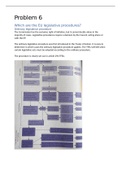
Which are the EU legislative procedures?
Ordinary legislative procedure
The Commission has the exclusive right of initiative, but it cannot decide alone in the
majority of cases. Legislative procedures require a decision by the Council, acting alone or
with the EP.
The ordinary legislative procedure was first introduced in the Treaty of Lisbon. It is easy to
determine in which cases the ordinary legislative procedure applies. The TFEU will tell when
certain legislative acts must be adopted according to the ordinary procedure.
The procedure is clearly set out in article 294 TFEU.
, During this procedure, the position of the European Parliament is not equal to that of the
Council. Examples of this are:
- The Council is not bound by time limits in the first or second readings
- It is easier for the Parliament to agree with the Council than to disagree with it
Special legislative procedure
Just like in the ordinary legislative procedure, in the legal basis is stipulated which acts must
be adopted according to the special legislative procedure. Such procedures tend to apply in
areas of political sensitivity. It is to make sure that the different preferences of member
states are closely aligned.
Special legislative procedures regulate decision-making by the Council, usually following
consultation of the EP. The Council has to wait for its opinion, or risk annulment (art. 263
TFEU). The TFEU does not provide a time limit, but the Council can provide such limit
through the procedure of article 218(6)(b), but special requirements have to be met.
The Parliament can delay the decision-making of the Council. Article 13(2) TEU establishes
the principle of sincere cooperation between the two institutions. From that point, the
Council can start a procedure on the non-acting of the Parliament, in which the latter will
have to give an explanation for its misbehaving (art. 267 TFEU).
Through article 48(7) TEU (passerelle clause), the European Council can, when voted for
unanimously, decide that legislative acts handled through the special procedure will
henceforth be taken care of through the ordinary procedure.
How, based on what procedure, can private parties
challenge an EU act through their national courts?
Introduction
Preliminary ruling procedure is regulated in article 267 TFEU. It is the linking pin between the
courts of member states and the Court of Justice and General Court (these institutions are
prescribed to ensure correct application of EU law, art. 19(1) TEU).
The preliminary ruling procedure provides that national courts may, and in certain cases
must, make a reference to the Court of Justice with a question on how to apply EU law in the
national legal order.
Admissibility
The preliminary ruling procedure is applied in the framework of proceedings before the
national courts of the member states. The conditions governing the admissibility of a
procedure pursuant to article 267 TFEU are therefore unconnected to the admissibility and
merits of the cation before the national court.
Jurisdiction
Pursuant to article 267 TFEU, the Court of Justice has jurisdiction to give preliminary rulings.
Article 256(3) TFEU provides that the General Court has jurisdiction to hear and determine
Which are the EU legislative procedures?
Ordinary legislative procedure
The Commission has the exclusive right of initiative, but it cannot decide alone in the
majority of cases. Legislative procedures require a decision by the Council, acting alone or
with the EP.
The ordinary legislative procedure was first introduced in the Treaty of Lisbon. It is easy to
determine in which cases the ordinary legislative procedure applies. The TFEU will tell when
certain legislative acts must be adopted according to the ordinary procedure.
The procedure is clearly set out in article 294 TFEU.
, During this procedure, the position of the European Parliament is not equal to that of the
Council. Examples of this are:
- The Council is not bound by time limits in the first or second readings
- It is easier for the Parliament to agree with the Council than to disagree with it
Special legislative procedure
Just like in the ordinary legislative procedure, in the legal basis is stipulated which acts must
be adopted according to the special legislative procedure. Such procedures tend to apply in
areas of political sensitivity. It is to make sure that the different preferences of member
states are closely aligned.
Special legislative procedures regulate decision-making by the Council, usually following
consultation of the EP. The Council has to wait for its opinion, or risk annulment (art. 263
TFEU). The TFEU does not provide a time limit, but the Council can provide such limit
through the procedure of article 218(6)(b), but special requirements have to be met.
The Parliament can delay the decision-making of the Council. Article 13(2) TEU establishes
the principle of sincere cooperation between the two institutions. From that point, the
Council can start a procedure on the non-acting of the Parliament, in which the latter will
have to give an explanation for its misbehaving (art. 267 TFEU).
Through article 48(7) TEU (passerelle clause), the European Council can, when voted for
unanimously, decide that legislative acts handled through the special procedure will
henceforth be taken care of through the ordinary procedure.
How, based on what procedure, can private parties
challenge an EU act through their national courts?
Introduction
Preliminary ruling procedure is regulated in article 267 TFEU. It is the linking pin between the
courts of member states and the Court of Justice and General Court (these institutions are
prescribed to ensure correct application of EU law, art. 19(1) TEU).
The preliminary ruling procedure provides that national courts may, and in certain cases
must, make a reference to the Court of Justice with a question on how to apply EU law in the
national legal order.
Admissibility
The preliminary ruling procedure is applied in the framework of proceedings before the
national courts of the member states. The conditions governing the admissibility of a
procedure pursuant to article 267 TFEU are therefore unconnected to the admissibility and
merits of the cation before the national court.
Jurisdiction
Pursuant to article 267 TFEU, the Court of Justice has jurisdiction to give preliminary rulings.
Article 256(3) TFEU provides that the General Court has jurisdiction to hear and determine