Energy and ecosystems
Food chains and energy transfer
Different groups of organisms:
Producers are photosynthetic organisms that manufacture organic substances using light energy,
water, carbon dioxide, and mineral ions
Consumers are organisms that obtain their energy by feeding on other organisms
• Primary consumers eat producers
• Secondary consumers are animals that eat primary consumers
Saprobionts (decomposers) are a group of organisms that break down the complex materials in
dead organisms into simple ones.
• They release valuable minerals and elements in a form that can be absorbed by plants and so
contribute to recycling. e.g. fungi and bacteria
• Secrete hydrolytic enzymes onto dead material then absorb products of hydrolysis
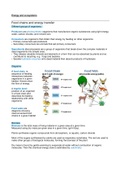
Diagrams:
A food chain is
sequence of feeding
interactions between
organisms in a given
habitat. Arrows show
the flow of energy.
A trophic level:
position of an organism
in a food chain and
describes its feeding
relationship with other
organisms
Food webs are
diagrams showing
interconnected food
chains in a given habitat
Biomass
Biomass is the total mass of living material in a given area at a given time
Measured using dry mass per given area in a given time. (g/m2/day).
Plants synthesise organic compounds from atmospheric, or aquatic, carbon dioxide
Most of the sugars synthesised by plants are used as respiratory substrates. The rest are used to
make other groups of biological molecules, forming the biomass of the plant
Dry mass is found by gentle warming to evaporate all water without combustion of organic
molecules. Then the chemical energy store is estimated by calorimetry
, Calorimetry estimates the chemical store in the dry mass
• Dry material weighed and burned in oxygen within a sealed chamber
• Insulated container to reduce heat loss to surroundings
• Calculate energy released from the burnt biomass in kJ/kg
• Stirrer distributes heat evenly
• Thermometer measures temperature rise of the water
Energy transfer and production
The sun
The main source of energy for ecosystems is the sun.
Some energy is lost from the transfer from light energy to producers:
• Most reflected back into space
• Not all wavelengths of light can be used by plants in photosynthesis.
• Energy lost as heat (respiration)
• Light may not fall on a chlorophyll molecule
• Other factors may limit the rate of photosynthesis
Primary production
Gross primary production (GPP) is the chemical energy store in plant biomass, in a given area or
volume.
Net primary production (NPP) is the chemical energy store in plant biomass after respiratory
losses (GPP-R)
• This net primary production is available for plant growth and reproduction. It is also available to
other trophic levels in the ecosystem
• This value is important to farmers as it represents the yield of the crop/how much biomass is
left.
To increase NPP: Reduce energy loss to other organisms by simplifying the food chain - e.g. using
pesticides and herbicides
Energy transfer
When one organism consumes another organism, not all energy is transferred.
Reasons for energy loss between trophic levels
• Some parts of the organism are not consumed
• Some parts are not digested and so egested as faeces.
• Some energy lost in excretion
• Some energy losses occur as heat from respiration
How this varies between organisms:
• Larger organisms lose less heat per gram of tissue (smaller SA:V ratio)
• Warm blooded organisms lose more heat per gram of tissue
• Herbivores egest more food as plants are more indigestible due to cellulose content
• Efficiency increases up the food chain due to carnivores instead of herbivores.
Most food chains have 4-5 trophic levels as there is insufficient energy to support populations at
higher trophic levels
Food chains and energy transfer
Different groups of organisms:
Producers are photosynthetic organisms that manufacture organic substances using light energy,
water, carbon dioxide, and mineral ions
Consumers are organisms that obtain their energy by feeding on other organisms
• Primary consumers eat producers
• Secondary consumers are animals that eat primary consumers
Saprobionts (decomposers) are a group of organisms that break down the complex materials in
dead organisms into simple ones.
• They release valuable minerals and elements in a form that can be absorbed by plants and so
contribute to recycling. e.g. fungi and bacteria
• Secrete hydrolytic enzymes onto dead material then absorb products of hydrolysis
Diagrams:
A food chain is
sequence of feeding
interactions between
organisms in a given
habitat. Arrows show
the flow of energy.
A trophic level:
position of an organism
in a food chain and
describes its feeding
relationship with other
organisms
Food webs are
diagrams showing
interconnected food
chains in a given habitat
Biomass
Biomass is the total mass of living material in a given area at a given time
Measured using dry mass per given area in a given time. (g/m2/day).
Plants synthesise organic compounds from atmospheric, or aquatic, carbon dioxide
Most of the sugars synthesised by plants are used as respiratory substrates. The rest are used to
make other groups of biological molecules, forming the biomass of the plant
Dry mass is found by gentle warming to evaporate all water without combustion of organic
molecules. Then the chemical energy store is estimated by calorimetry
, Calorimetry estimates the chemical store in the dry mass
• Dry material weighed and burned in oxygen within a sealed chamber
• Insulated container to reduce heat loss to surroundings
• Calculate energy released from the burnt biomass in kJ/kg
• Stirrer distributes heat evenly
• Thermometer measures temperature rise of the water
Energy transfer and production
The sun
The main source of energy for ecosystems is the sun.
Some energy is lost from the transfer from light energy to producers:
• Most reflected back into space
• Not all wavelengths of light can be used by plants in photosynthesis.
• Energy lost as heat (respiration)
• Light may not fall on a chlorophyll molecule
• Other factors may limit the rate of photosynthesis
Primary production
Gross primary production (GPP) is the chemical energy store in plant biomass, in a given area or
volume.
Net primary production (NPP) is the chemical energy store in plant biomass after respiratory
losses (GPP-R)
• This net primary production is available for plant growth and reproduction. It is also available to
other trophic levels in the ecosystem
• This value is important to farmers as it represents the yield of the crop/how much biomass is
left.
To increase NPP: Reduce energy loss to other organisms by simplifying the food chain - e.g. using
pesticides and herbicides
Energy transfer
When one organism consumes another organism, not all energy is transferred.
Reasons for energy loss between trophic levels
• Some parts of the organism are not consumed
• Some parts are not digested and so egested as faeces.
• Some energy lost in excretion
• Some energy losses occur as heat from respiration
How this varies between organisms:
• Larger organisms lose less heat per gram of tissue (smaller SA:V ratio)
• Warm blooded organisms lose more heat per gram of tissue
• Herbivores egest more food as plants are more indigestible due to cellulose content
• Efficiency increases up the food chain due to carnivores instead of herbivores.
Most food chains have 4-5 trophic levels as there is insufficient energy to support populations at
higher trophic levels