Psychology and the Brain: Week 4
Structure, function and broken computers
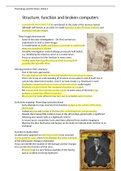
- Leonardo da Vinci (1452–1519) contributed to the study of the nervous system.
Although well-known as an artist, he made extensive study of human anatomy and
produced intricate images.
These images demonstrate:
- Some of the early investigations – De Vinci carried out
experiments as well as drew images
- A consideration of health and disease as he tried to understand
what was changing in disease.
- Scientific investigation could challenge previously held beliefs,
e.g. identifying the olfactory nerve as a cranial nerve.
- Focus on structure to infer function in many cases.
- Moving away from hypothesizing and into investigation-
progress into scientific ideas
Inferring function from structure:
- One of the early approaches
- The idea that we can fully understand function from structure is untrue.
- This is not to say an understanding of structure is not useful in and of itself, but it
cannot fully determine function, even if we look closely e.g. Brodmann’s work
- Brodmann categorized brain in terms of microstructure- really helpful
- Structure can give info on the complexity/function of a system
- But components that look structurally similar to some areas of the brain may
perform a completely different function
- Structures that looks different may turn out to complete same function
Early brain mapping- Phrenology (pseudoscience)
- Early attempts to map structure from function looked at the surface of the skull-
phrenology
- Looked at lump and bumps of skull to infer underlying brain and personality
- Despite there being little evidence base of this phrenology gained quite a significant
following and ‘posed’ well as a legitimate science
- In recent years, researchers have used data collected from modern imaging to
disprove the idea that lumps and bumps on the skull can indicate brain function in an
individual
Function to dysfunction:
An alternative approach to inferring function from structure
was to examine cases where brain damage has arisen and look
at the subsequent changes in behaviour.
If you can identify the location of the damage and the changes
you can infer the function of that area:
- Phineas Gage is a very famous example of this having
had an accident involving explosives.
, Psychology and the Brain: Week 4
- Was a railroad construction worker- do controlled explosions
- He shot the rod straight through his skull, causing damage to the frontal lobe.
- He survived but had various reported changes including to personality.
- His case has been hugely exaggerated but also very influential e.g. contributing the
use of lobotomies.
- Accidental brain lesion- uncontrolled incidents
- Causes damage/trauma unique to the individual
- Be cautious of case studies
- Moving on we attempt to look at them as controlled events
Live mapping: Penfield
One of the pioneers of modern brain mapping is Wilder
Penfield.
A neurosurgeon and developed a technique for stimulating the
brain during surgery:
- During procedures on patients with epilepsy, prior to
treatment, he electrically stimulated areas of the motor
and sensory cortices.
- In doing this he was able to map out specific body areas
- Very controlled conditions
- No pain receptors in brain- patients were conscious and awake
- Must be precise or will disrupt other structure with key functions
Limitations to looking at dysfunction:
- In all cases the function of the healthy brain was being inferred from a brain not in a
healthy state.
- No reason subjecting healthy person to a risky surgery
- Cannot infer function of structures by breaking(lesions) or by looking at broken ones
(broken computers)
- Current focus is on looking at the healthy, functioning brain
Early studies of the brain observed it post-mortem and inferred function from structure
alone.
Later studies looked at brain damage and inferred function of regions by changes following
damage.
Finally, early functional mapping studies mapped the brain during surgeries for different
conditions.
Neuroimaging Techniques
Structural imaging techniques:
CT scanning:
Computerised tomography is an X-ray based approached to examining brain structure:
Structure, function and broken computers
- Leonardo da Vinci (1452–1519) contributed to the study of the nervous system.
Although well-known as an artist, he made extensive study of human anatomy and
produced intricate images.
These images demonstrate:
- Some of the early investigations – De Vinci carried out
experiments as well as drew images
- A consideration of health and disease as he tried to understand
what was changing in disease.
- Scientific investigation could challenge previously held beliefs,
e.g. identifying the olfactory nerve as a cranial nerve.
- Focus on structure to infer function in many cases.
- Moving away from hypothesizing and into investigation-
progress into scientific ideas
Inferring function from structure:
- One of the early approaches
- The idea that we can fully understand function from structure is untrue.
- This is not to say an understanding of structure is not useful in and of itself, but it
cannot fully determine function, even if we look closely e.g. Brodmann’s work
- Brodmann categorized brain in terms of microstructure- really helpful
- Structure can give info on the complexity/function of a system
- But components that look structurally similar to some areas of the brain may
perform a completely different function
- Structures that looks different may turn out to complete same function
Early brain mapping- Phrenology (pseudoscience)
- Early attempts to map structure from function looked at the surface of the skull-
phrenology
- Looked at lump and bumps of skull to infer underlying brain and personality
- Despite there being little evidence base of this phrenology gained quite a significant
following and ‘posed’ well as a legitimate science
- In recent years, researchers have used data collected from modern imaging to
disprove the idea that lumps and bumps on the skull can indicate brain function in an
individual
Function to dysfunction:
An alternative approach to inferring function from structure
was to examine cases where brain damage has arisen and look
at the subsequent changes in behaviour.
If you can identify the location of the damage and the changes
you can infer the function of that area:
- Phineas Gage is a very famous example of this having
had an accident involving explosives.
, Psychology and the Brain: Week 4
- Was a railroad construction worker- do controlled explosions
- He shot the rod straight through his skull, causing damage to the frontal lobe.
- He survived but had various reported changes including to personality.
- His case has been hugely exaggerated but also very influential e.g. contributing the
use of lobotomies.
- Accidental brain lesion- uncontrolled incidents
- Causes damage/trauma unique to the individual
- Be cautious of case studies
- Moving on we attempt to look at them as controlled events
Live mapping: Penfield
One of the pioneers of modern brain mapping is Wilder
Penfield.
A neurosurgeon and developed a technique for stimulating the
brain during surgery:
- During procedures on patients with epilepsy, prior to
treatment, he electrically stimulated areas of the motor
and sensory cortices.
- In doing this he was able to map out specific body areas
- Very controlled conditions
- No pain receptors in brain- patients were conscious and awake
- Must be precise or will disrupt other structure with key functions
Limitations to looking at dysfunction:
- In all cases the function of the healthy brain was being inferred from a brain not in a
healthy state.
- No reason subjecting healthy person to a risky surgery
- Cannot infer function of structures by breaking(lesions) or by looking at broken ones
(broken computers)
- Current focus is on looking at the healthy, functioning brain
Early studies of the brain observed it post-mortem and inferred function from structure
alone.
Later studies looked at brain damage and inferred function of regions by changes following
damage.
Finally, early functional mapping studies mapped the brain during surgeries for different
conditions.
Neuroimaging Techniques
Structural imaging techniques:
CT scanning:
Computerised tomography is an X-ray based approached to examining brain structure: