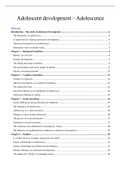
Adolescent development – Adolescence
Inhoud
Introduction – The study of adolescent development ................................................................................. 4
The boundaries of adolescence ................................................................................................................... 4
A framework for studying adolescent development .................................................................................... 4
Theoretical perspectives on adolescence..................................................................................................... 5
Stereotypes versus scientific study ............................................................................................................. 5
Chapter 1 – Biological transitions ............................................................................................................... 6
Puberty: an overview ................................................................................................................................. 6
Somatic development ................................................................................................................................. 7
The timing and tempo of puberty ............................................................................................................... 8
The psychological and social impact of puberty ......................................................................................... 8
Obesity and eating disorders .................................................................................................................... 10
Chapter 2 – Cognitive transitions ............................................................................................................. 11
Changes in cognition................................................................................................................................ 11
Theoretical perspectives on adolescent thinking ....................................................................................... 11
The adolescent brain ................................................................................................................................ 12
Individual differences in intelligence in adolescence ................................................................................ 14
Adolescent thinking in context ................................................................................................................. 14
Chapter 3 – Social transitions ................................................................................................................... 15
Social redefinition and psychosocial development .................................................................................... 15
The elongation of adolescence ................................................................................................................. 15
Adolescence as a social invention ............................................................................................................ 16
Changes in status during adolescence ....................................................................................................... 16
The process of social redefinition ............................................................................................................. 17
Variations in social transitions ................................................................................................................. 17
The transitions into adulthood in contemporary society ............................................................................ 18
The influence of neighbourhood conditions on adolescent development ................................................... 19
Chapter 4 – Families .................................................................................................................................. 20
Is conflict between teenagers and parents inevitable? ............................................................................... 20
Family relationships at adolescence.......................................................................................................... 21
Family relationships and adolescent development .................................................................................... 22
Genetic influences on adolescent development ......................................................................................... 24
The adolescent’s family in a changing society .......................................................................................... 25
, The importance of the family in adolescent development.......................................................................... 27
Chapter 5 – Peer groups ............................................................................................................................ 28
The origins of adolescent peer groups in contemporary society................................................................. 28
The nature of adolescent peer groups ....................................................................................................... 28
Adolescents and their crowds ................................................................................................................... 30
Adolescents and their cliques ................................................................................................................... 30
Popularity, rejection, and bullying ............................................................................................................ 32
The peer group and psychosocial development ......................................................................................... 35
Chapter 6 – Schools ................................................................................................................................... 35
The broader context of U.S. secondary education ..................................................................................... 35
The social organisation of schools ............................................................................................................ 36
Classroom climate ................................................................................................................................... 39
Beyond high school ................................................................................................................................. 40
Schools and adolescent development........................................................................................................ 41
Chapter 7 – Work, leisure, and media ...................................................................................................... 41
Adolescents’ free time in contemporary society........................................................................................ 41
Adolescents and work .............................................................................................................................. 42
Adolescents and leisure............................................................................................................................ 43
Adolescents and screen time .................................................................................................................... 45
Adolescents and social media................................................................................................................... 46
Free time and adolescent development ..................................................................................................... 47
Chapter 8 – Identity................................................................................................................................... 47
Identity as an adolescent issue .................................................................................................................. 47
Changes in self-conceptions ..................................................................................................................... 47
Changes in self-esteem............................................................................................................................. 48
The adolescent identity crisis ................................................................................................................... 49
Research on identity development ............................................................................................................ 50
Identity and ethnicity ............................................................................................................................... 50
Identity and gender .................................................................................................................................. 51
Chapter 9 – Autonomy .............................................................................................................................. 52
Autonomy as an adolescent issue ............................................................................................................. 52
The development of emotional autonomy ................................................................................................. 52
The development of behavioural autonomy .............................................................................................. 54
The development of cognitive autonomy .................................................................................................. 55
Chapter 10 – Intimacy ............................................................................................................................... 58
Intimacy as an adolescent issue ................................................................................................................ 58
, Theoretical perspectives on adolescent intimacy....................................................................................... 59
The development of intimacy in adolescence............................................................................................ 60
Dating and romantic relationships ............................................................................................................ 63
Intimacy and psychosocial development................................................................................................... 65
Chapter 11 – Sexuality............................................................................................................................... 65
Sexuality as an adolescent issue ............................................................................................................... 65
Sexual activity during adolescence ........................................................................................................... 65
The sexually active adolescent ................................................................................................................. 66
Risky sex and its prevention..................................................................................................................... 69
Chapter 12 – Achievement ........................................................................................................................ 71
Achievement as an adolescent issue ......................................................................................................... 71
The importance of noncognitive factors.................................................................................................... 72
Environmental influences on achievement................................................................................................ 74
Educational achievement ......................................................................................................................... 75
Occupational achievement ....................................................................................................................... 77
Chapter 13 – Psychosocial problems in adolescence................................................................................. 78
Some general principles about problems in adolescence ........................................................................... 78
Psychosocial problems: their nature and covariation ................................................................................. 78
Substance use and abuse .......................................................................................................................... 79
Externalizing problems ............................................................................................................................ 81
Internalizing problems ............................................................................................................................. 83
Stress and coping ..................................................................................................................................... 85
, Introduction – The study of adolescent development
The boundaries of adolescence
The word adolescence is derived from the Latin word adolescere, which means ‘to grow into adulthood’. It is
a period of transitions. There are a variety of boundaries we might draw between childhood and adolescence,
and between adolescence and adulthood. The boundaries we use define the period. Determining the beginning
and ending of adolescence is more a matter of opinion than of absolute fact. Rather than argue about which
boundaries are the correct ones, it makes more sense to
think of development during adolescence as involving a
series of transition from immaturity into maturity. The
various aspects of adolescence have different
beginnings and endings for every individual. This book
defines adolescence roughly from age 10 until the early
20s. The adolescent period has lengthened considerably
in the past 100 years, both because physical maturation
occurs earlier and because so many individuals delay
entering work and marriage until their mid-20s.
Early, middle and late adolescence
Most social scientists and practitioners view adolescence as composed of a series of phase rather than one single
stage. Early adolescence is the period spanning roughly ages 10-13, middle adolescence is the period spanning
roughly ages 14-17, and late adolescence is the period spanning roughly ages 18-21. Some writers have
suggested a new phase of life, called emerging adulthood, characterizes the early and mid-20s. Despite the
popularity of this idea in the mass media, there is little evidence that emerging adulthood is a universal stage or
that most young people in their mid-20s are in some sort of psychological or social limbo. One study about
expectations for the future found three distinct groups: early starters, employment focused, and education
focused.
A framework for studying adolescent development
The fundamental changes of adolescence
This component of Hill’s framework encompasses biological, cognitive and social dimensions. According to
Hill, three features of adolescent development give the period its special flavour and significance: (1) the onset
of puberty (biological), (2) the emergence of more advanced thinking abilities (cognitive), and (3) the transition
into new roles in society (social). These are universal changes. The biological changes (puberty) involve
changes in the young person’s appearance and the development of the ability to conceive children. The cognitive
dimension refers to changes in thinking abilities. Changes in rights, privileges, and responsibilities constitute
the social dimension. In some cultures, the social changes of adolescence are marked by a formal ceremony, a
rite of passage.
The contexts of adolescence
The effects of the changes are not uniform for all young people. The psychological impact of biological,
cognitive, and social changes of adolescence is shaped by the environment in which the changes take place. It
is a product of the interplay between a set of universal changes and the context in which these changes are
experienced. Therefore, the second component of Hill’s framework is the context of adolescence. According to
the ecological perspective on human development (Bronfenbrenner) we cannot understand development
without examining the environment in which it occurs. There are four contexts in which young people spend
time: (1) families, (2) peer groups, (3) schools, and (4) work and leisure settings. The contexts themselves are
shaped and defined by the larger society in which people live.
The psychosocial developments of adolescence
The final component of Hill’s framework concerns the major psychosocial developments of adolescence as well
as certain psychosocial problems that may arise at this age. The word psychosocial is used to describe aspects
of development that are both psychological and social in nature: (1) identity, (2) autonomy, (3) intimacy, (4)
Inhoud
Introduction – The study of adolescent development ................................................................................. 4
The boundaries of adolescence ................................................................................................................... 4
A framework for studying adolescent development .................................................................................... 4
Theoretical perspectives on adolescence..................................................................................................... 5
Stereotypes versus scientific study ............................................................................................................. 5
Chapter 1 – Biological transitions ............................................................................................................... 6
Puberty: an overview ................................................................................................................................. 6
Somatic development ................................................................................................................................. 7
The timing and tempo of puberty ............................................................................................................... 8
The psychological and social impact of puberty ......................................................................................... 8
Obesity and eating disorders .................................................................................................................... 10
Chapter 2 – Cognitive transitions ............................................................................................................. 11
Changes in cognition................................................................................................................................ 11
Theoretical perspectives on adolescent thinking ....................................................................................... 11
The adolescent brain ................................................................................................................................ 12
Individual differences in intelligence in adolescence ................................................................................ 14
Adolescent thinking in context ................................................................................................................. 14
Chapter 3 – Social transitions ................................................................................................................... 15
Social redefinition and psychosocial development .................................................................................... 15
The elongation of adolescence ................................................................................................................. 15
Adolescence as a social invention ............................................................................................................ 16
Changes in status during adolescence ....................................................................................................... 16
The process of social redefinition ............................................................................................................. 17
Variations in social transitions ................................................................................................................. 17
The transitions into adulthood in contemporary society ............................................................................ 18
The influence of neighbourhood conditions on adolescent development ................................................... 19
Chapter 4 – Families .................................................................................................................................. 20
Is conflict between teenagers and parents inevitable? ............................................................................... 20
Family relationships at adolescence.......................................................................................................... 21
Family relationships and adolescent development .................................................................................... 22
Genetic influences on adolescent development ......................................................................................... 24
The adolescent’s family in a changing society .......................................................................................... 25
, The importance of the family in adolescent development.......................................................................... 27
Chapter 5 – Peer groups ............................................................................................................................ 28
The origins of adolescent peer groups in contemporary society................................................................. 28
The nature of adolescent peer groups ....................................................................................................... 28
Adolescents and their crowds ................................................................................................................... 30
Adolescents and their cliques ................................................................................................................... 30
Popularity, rejection, and bullying ............................................................................................................ 32
The peer group and psychosocial development ......................................................................................... 35
Chapter 6 – Schools ................................................................................................................................... 35
The broader context of U.S. secondary education ..................................................................................... 35
The social organisation of schools ............................................................................................................ 36
Classroom climate ................................................................................................................................... 39
Beyond high school ................................................................................................................................. 40
Schools and adolescent development........................................................................................................ 41
Chapter 7 – Work, leisure, and media ...................................................................................................... 41
Adolescents’ free time in contemporary society........................................................................................ 41
Adolescents and work .............................................................................................................................. 42
Adolescents and leisure............................................................................................................................ 43
Adolescents and screen time .................................................................................................................... 45
Adolescents and social media................................................................................................................... 46
Free time and adolescent development ..................................................................................................... 47
Chapter 8 – Identity................................................................................................................................... 47
Identity as an adolescent issue .................................................................................................................. 47
Changes in self-conceptions ..................................................................................................................... 47
Changes in self-esteem............................................................................................................................. 48
The adolescent identity crisis ................................................................................................................... 49
Research on identity development ............................................................................................................ 50
Identity and ethnicity ............................................................................................................................... 50
Identity and gender .................................................................................................................................. 51
Chapter 9 – Autonomy .............................................................................................................................. 52
Autonomy as an adolescent issue ............................................................................................................. 52
The development of emotional autonomy ................................................................................................. 52
The development of behavioural autonomy .............................................................................................. 54
The development of cognitive autonomy .................................................................................................. 55
Chapter 10 – Intimacy ............................................................................................................................... 58
Intimacy as an adolescent issue ................................................................................................................ 58
, Theoretical perspectives on adolescent intimacy....................................................................................... 59
The development of intimacy in adolescence............................................................................................ 60
Dating and romantic relationships ............................................................................................................ 63
Intimacy and psychosocial development................................................................................................... 65
Chapter 11 – Sexuality............................................................................................................................... 65
Sexuality as an adolescent issue ............................................................................................................... 65
Sexual activity during adolescence ........................................................................................................... 65
The sexually active adolescent ................................................................................................................. 66
Risky sex and its prevention..................................................................................................................... 69
Chapter 12 – Achievement ........................................................................................................................ 71
Achievement as an adolescent issue ......................................................................................................... 71
The importance of noncognitive factors.................................................................................................... 72
Environmental influences on achievement................................................................................................ 74
Educational achievement ......................................................................................................................... 75
Occupational achievement ....................................................................................................................... 77
Chapter 13 – Psychosocial problems in adolescence................................................................................. 78
Some general principles about problems in adolescence ........................................................................... 78
Psychosocial problems: their nature and covariation ................................................................................. 78
Substance use and abuse .......................................................................................................................... 79
Externalizing problems ............................................................................................................................ 81
Internalizing problems ............................................................................................................................. 83
Stress and coping ..................................................................................................................................... 85
, Introduction – The study of adolescent development
The boundaries of adolescence
The word adolescence is derived from the Latin word adolescere, which means ‘to grow into adulthood’. It is
a period of transitions. There are a variety of boundaries we might draw between childhood and adolescence,
and between adolescence and adulthood. The boundaries we use define the period. Determining the beginning
and ending of adolescence is more a matter of opinion than of absolute fact. Rather than argue about which
boundaries are the correct ones, it makes more sense to
think of development during adolescence as involving a
series of transition from immaturity into maturity. The
various aspects of adolescence have different
beginnings and endings for every individual. This book
defines adolescence roughly from age 10 until the early
20s. The adolescent period has lengthened considerably
in the past 100 years, both because physical maturation
occurs earlier and because so many individuals delay
entering work and marriage until their mid-20s.
Early, middle and late adolescence
Most social scientists and practitioners view adolescence as composed of a series of phase rather than one single
stage. Early adolescence is the period spanning roughly ages 10-13, middle adolescence is the period spanning
roughly ages 14-17, and late adolescence is the period spanning roughly ages 18-21. Some writers have
suggested a new phase of life, called emerging adulthood, characterizes the early and mid-20s. Despite the
popularity of this idea in the mass media, there is little evidence that emerging adulthood is a universal stage or
that most young people in their mid-20s are in some sort of psychological or social limbo. One study about
expectations for the future found three distinct groups: early starters, employment focused, and education
focused.
A framework for studying adolescent development
The fundamental changes of adolescence
This component of Hill’s framework encompasses biological, cognitive and social dimensions. According to
Hill, three features of adolescent development give the period its special flavour and significance: (1) the onset
of puberty (biological), (2) the emergence of more advanced thinking abilities (cognitive), and (3) the transition
into new roles in society (social). These are universal changes. The biological changes (puberty) involve
changes in the young person’s appearance and the development of the ability to conceive children. The cognitive
dimension refers to changes in thinking abilities. Changes in rights, privileges, and responsibilities constitute
the social dimension. In some cultures, the social changes of adolescence are marked by a formal ceremony, a
rite of passage.
The contexts of adolescence
The effects of the changes are not uniform for all young people. The psychological impact of biological,
cognitive, and social changes of adolescence is shaped by the environment in which the changes take place. It
is a product of the interplay between a set of universal changes and the context in which these changes are
experienced. Therefore, the second component of Hill’s framework is the context of adolescence. According to
the ecological perspective on human development (Bronfenbrenner) we cannot understand development
without examining the environment in which it occurs. There are four contexts in which young people spend
time: (1) families, (2) peer groups, (3) schools, and (4) work and leisure settings. The contexts themselves are
shaped and defined by the larger society in which people live.
The psychosocial developments of adolescence
The final component of Hill’s framework concerns the major psychosocial developments of adolescence as well
as certain psychosocial problems that may arise at this age. The word psychosocial is used to describe aspects
of development that are both psychological and social in nature: (1) identity, (2) autonomy, (3) intimacy, (4)