7th February 2022
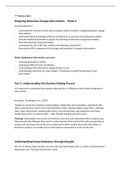
Designing Behaviour Change Interventions – Week 4
Learning Objectives:
- understand the relevance of the socio-ecological model of health in designing behavior change
interventions
- understand which psychological theories of behaviour to use when developing intervention
- Describe models/frameworks to support the planning of behaviour change interventions
- Describe behaviour change techniques
- understand the role of the logic model in developing an intervention
- Describe the MRC framework for the design and evaluation fo complex interventions
Before designing an intervention, you must:
- understand people in context
- understand different levels of influence
- understanding which Behavioral change theories to use
- understanding that there are many models / frameworks to guide the planning of your
intervention
Part 1: Understanding the Decision Making Process
It is important to understand how people make decisions in different context before designing an
intervention.
Key Quote: Greenhalgh et al., (2004)
‘People are not passive recipients of interventions. Rather they seek innovations, experiment with
them, evaluate them, find (or fail to find) meaning in them, develop feeligns about them, challenge
them, worry about them, complain about them, work around them, gain experience with them,
modify them and try to improve them – often through dialogue with other users’.
Meaning: when people come across interventions, they don’t just experience them in passive way,
they evaluate and challenge them and it is really important that we have this wider perspectives as
people seek meaning in the world. It is so important to think carefully about the intervention as
behaviour change is so complex and is context/person deoendent in terms of outcome.
Understanding human behaviour through thought
We are not always logical humans, we have slow and fast thinking. This is a notion coined by Daniel
Kahneman in his ‘Thinking, fast and slow’ book.
, System 1: fast, instinctive and emotion, cant be shut off at will. This surprisingly drives our decision
making and behaviour most of the time, but can get us out of trouble as it is fast thinking.
System 2: slow, deliberative and logical, requires will and intention. This system takes over when we
are faced with a new challenge, but this system also gets easily tired and distracted.
Implications of these systems for health:
- food industry targets the system 1 by using bright colours, and monochrome colours where the
warnings and nutritional info is
- We should be using similar techniques such as ‘nudge interventions’ that tap into automatic
decision making, but to promote good health.
‘Conditioned Hypereating’ – exploitation of system 1 David Kesla
Discusses how food industry taps into our system 1 thinking to affect health negatively. Theory is
that over course of years, the food industry has created environment where those who are
susceptible to over eat have been conditioned.
Examples: we have cues everywhere such as packages, marketing, smells, even the food itself has
become more fatty, sugary etc.
Consuming foods like this is conditioning as they are neuro-chemically rewarding. We have the cue –
then the urge – then the reward (Eating) and this then cycles back, so these become locked in
behaviours. Our memory stores cues around the behaviour, and so it becomes habitual, maintained
by our system 1 automatic thinking.
Cognitive Biases
We are influenced by unconscious desires, but also cognitive biases. These are predictable
systematic errors that come from brain using number of heuristics to simplify decision making. We
unconsciously simplify problems using system 1 to make it easier to cope with.
There are 4 categories of coping:
1. When we have too much info:
a. we tend to notice things already primed in memory
b. we are drawn to things that confirm our existing perspective
2. When there isn’t enough meaning in the info we are given:
a. we find patterns and stories in sparse data
b. We fill In the data gaps using stereotypes, generalities and past histories
3. When we need to act fast:
a. We favour immediate relatable thing over the delayed and distant
b. We favour options that seem smple over complex, ambiguous options
4. When faced with dilemma of what to remember about something:
a. We tend to discard specific info and form generalities instead
b. We reduce events to their key elements
Designing Behaviour Change Interventions – Week 4
Learning Objectives:
- understand the relevance of the socio-ecological model of health in designing behavior change
interventions
- understand which psychological theories of behaviour to use when developing intervention
- Describe models/frameworks to support the planning of behaviour change interventions
- Describe behaviour change techniques
- understand the role of the logic model in developing an intervention
- Describe the MRC framework for the design and evaluation fo complex interventions
Before designing an intervention, you must:
- understand people in context
- understand different levels of influence
- understanding which Behavioral change theories to use
- understanding that there are many models / frameworks to guide the planning of your
intervention
Part 1: Understanding the Decision Making Process
It is important to understand how people make decisions in different context before designing an
intervention.
Key Quote: Greenhalgh et al., (2004)
‘People are not passive recipients of interventions. Rather they seek innovations, experiment with
them, evaluate them, find (or fail to find) meaning in them, develop feeligns about them, challenge
them, worry about them, complain about them, work around them, gain experience with them,
modify them and try to improve them – often through dialogue with other users’.
Meaning: when people come across interventions, they don’t just experience them in passive way,
they evaluate and challenge them and it is really important that we have this wider perspectives as
people seek meaning in the world. It is so important to think carefully about the intervention as
behaviour change is so complex and is context/person deoendent in terms of outcome.
Understanding human behaviour through thought
We are not always logical humans, we have slow and fast thinking. This is a notion coined by Daniel
Kahneman in his ‘Thinking, fast and slow’ book.
, System 1: fast, instinctive and emotion, cant be shut off at will. This surprisingly drives our decision
making and behaviour most of the time, but can get us out of trouble as it is fast thinking.
System 2: slow, deliberative and logical, requires will and intention. This system takes over when we
are faced with a new challenge, but this system also gets easily tired and distracted.
Implications of these systems for health:
- food industry targets the system 1 by using bright colours, and monochrome colours where the
warnings and nutritional info is
- We should be using similar techniques such as ‘nudge interventions’ that tap into automatic
decision making, but to promote good health.
‘Conditioned Hypereating’ – exploitation of system 1 David Kesla
Discusses how food industry taps into our system 1 thinking to affect health negatively. Theory is
that over course of years, the food industry has created environment where those who are
susceptible to over eat have been conditioned.
Examples: we have cues everywhere such as packages, marketing, smells, even the food itself has
become more fatty, sugary etc.
Consuming foods like this is conditioning as they are neuro-chemically rewarding. We have the cue –
then the urge – then the reward (Eating) and this then cycles back, so these become locked in
behaviours. Our memory stores cues around the behaviour, and so it becomes habitual, maintained
by our system 1 automatic thinking.
Cognitive Biases
We are influenced by unconscious desires, but also cognitive biases. These are predictable
systematic errors that come from brain using number of heuristics to simplify decision making. We
unconsciously simplify problems using system 1 to make it easier to cope with.
There are 4 categories of coping:
1. When we have too much info:
a. we tend to notice things already primed in memory
b. we are drawn to things that confirm our existing perspective
2. When there isn’t enough meaning in the info we are given:
a. we find patterns and stories in sparse data
b. We fill In the data gaps using stereotypes, generalities and past histories
3. When we need to act fast:
a. We favour immediate relatable thing over the delayed and distant
b. We favour options that seem smple over complex, ambiguous options
4. When faced with dilemma of what to remember about something:
a. We tend to discard specific info and form generalities instead
b. We reduce events to their key elements