Lectures & Slidecasts Political Participation & Protest
Lecture 1: Introduction
Exam style
3x 30 points exam
10 points extra
100 points = 10 (Grade)
Slidecasts about literature + lectures afterwards
Why is political participation important for democracy?
-> Does elected government have consent of the people?
-> Sufficient popular support for policies
-> If both are under pressure and people do not act, we have a legitimacy problem
-> Governments need to be scrutinized and monitored
-> Only effective if citizens are engaged
-> Not only at election, but also in-between elections. If people are not interested, we have a
monitoring problem
Political participation is beneficial and valuable for citizens; people are empowered and learn
valuable skills
-> It helps to enrich the lives of individuals/societies
,Lectures & Slidecasts Political Participation & Protest
In short: activists enable democracies to thrive
Types of political participation
Electoral: voting, contacting officials, campaigning, donating to parties, party memberships
Non-electoral: signing petitions, demonstrations, boycotts, blockades
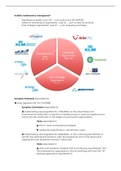
Diamond Model
Demand side: citizens -> they want to influence the state (supply side)
What routes can citizens take if they want to influence the state?
Either via Political Representation System (electoral) or via Social Movements (non-eletoral)
Slidecasts lecture 1
1.1
Types of political participation
Electoral: voting, contacting officials, campaigning, donating to parties, party memberships
Non-electoral: signing petitions, demonstrations, boycotts, blockades
Voter turnout: high in Belgium, Denmark, Brazil, Sweden, Italy, Netherlands
Low in US, South Korea
Low turnout in municipality elections; general downward trend regarding voting turnout
,Lectures & Slidecasts Political Participation & Protest
Remarkable: in the 60s, quite a lot of riots, 2009 more anti-government demonstrations
Why? -> protest normalized, start of financial crisis in 2009 (= anti-government)
1.2 Van Deth (2014)
As long as we do not have a clear definition/conceptualization, we cannot make proper comparisons
What is political participation? (multiple definitions)
-> Political participation is an attempt to influence politics (Bradley, 1999 et al)
-> Political participation is an individual or collective action at the national or local level that
supports or opposes decisions regarding allocation of public goods (Conge, 1988)
Critique by Van Deth (2014): too many definitions/categorizations political participation (3 reasons)
1. The definitions are too time-period dependent (what was non-conventional 30 years ago is
not anymore)
2. About conclusions about development that are difficult to draw overtime if not the same
definitions are used
3. How to deal with the expansion of modes of participation (e.g. internet activism): if it’s not
included in your definition, how are you measuring/comparing?
Van Deth wants a minimalist definition (where most scholars can agree on)
Van Deth notes that new modes of participation are continuously emerging that take place outside
the governmental arena and therefore suggests 3 additional questions:
Table Van Deth: next page
Van Deth merges three types of operational concepts in one definition in which we can compare
political participation along time and between countries
, Lectures & Slidecasts Political Participation & Protest
Diamond model:
Political Participation-1 is mostly linked to the electoral arena
Political Participation-2 is more linked to social movements
-> Difference: van Deth adds community & motivational participation, not there in Diamond model
1.3 (Hutter & Kriesi, 2013)
Comparing party politics & movement politics: movements on the left and right
Political participation: an attempt by ordinary citizens to influence policies
They can do so via the political arena (mainly researched via Political Science), but also in the protest
arena (Sociology)
-> Political Scientists mostly focus on political right-wing mobilization, sociologist focused mostly on
left-wing mobilization
-> Until Hutter & Kriesi, no comparison between the two arena’s
Hutte & Kriesi argue that the left-oriented winners of globalizations mobilize in the protest arena,
while the right-oriented losers of globalization mobilize in the party arena
-> 2 studies to support this argument
Study 1 (related to the protest arena)
What do we see in the streets? What changes? -> Issue salience
This shows 4 issues related to globalization (see next page)
Question: did the issue salience change over those 30 years?
Answer: Yes.
What we see is that the protest arena gives the winners of globalization a platform to protest on
globalization issues
Lecture 1: Introduction
Exam style
3x 30 points exam
10 points extra
100 points = 10 (Grade)
Slidecasts about literature + lectures afterwards
Why is political participation important for democracy?
-> Does elected government have consent of the people?
-> Sufficient popular support for policies
-> If both are under pressure and people do not act, we have a legitimacy problem
-> Governments need to be scrutinized and monitored
-> Only effective if citizens are engaged
-> Not only at election, but also in-between elections. If people are not interested, we have a
monitoring problem
Political participation is beneficial and valuable for citizens; people are empowered and learn
valuable skills
-> It helps to enrich the lives of individuals/societies
,Lectures & Slidecasts Political Participation & Protest
In short: activists enable democracies to thrive
Types of political participation
Electoral: voting, contacting officials, campaigning, donating to parties, party memberships
Non-electoral: signing petitions, demonstrations, boycotts, blockades
Diamond Model
Demand side: citizens -> they want to influence the state (supply side)
What routes can citizens take if they want to influence the state?
Either via Political Representation System (electoral) or via Social Movements (non-eletoral)
Slidecasts lecture 1
1.1
Types of political participation
Electoral: voting, contacting officials, campaigning, donating to parties, party memberships
Non-electoral: signing petitions, demonstrations, boycotts, blockades
Voter turnout: high in Belgium, Denmark, Brazil, Sweden, Italy, Netherlands
Low in US, South Korea
Low turnout in municipality elections; general downward trend regarding voting turnout
,Lectures & Slidecasts Political Participation & Protest
Remarkable: in the 60s, quite a lot of riots, 2009 more anti-government demonstrations
Why? -> protest normalized, start of financial crisis in 2009 (= anti-government)
1.2 Van Deth (2014)
As long as we do not have a clear definition/conceptualization, we cannot make proper comparisons
What is political participation? (multiple definitions)
-> Political participation is an attempt to influence politics (Bradley, 1999 et al)
-> Political participation is an individual or collective action at the national or local level that
supports or opposes decisions regarding allocation of public goods (Conge, 1988)
Critique by Van Deth (2014): too many definitions/categorizations political participation (3 reasons)
1. The definitions are too time-period dependent (what was non-conventional 30 years ago is
not anymore)
2. About conclusions about development that are difficult to draw overtime if not the same
definitions are used
3. How to deal with the expansion of modes of participation (e.g. internet activism): if it’s not
included in your definition, how are you measuring/comparing?
Van Deth wants a minimalist definition (where most scholars can agree on)
Van Deth notes that new modes of participation are continuously emerging that take place outside
the governmental arena and therefore suggests 3 additional questions:
Table Van Deth: next page
Van Deth merges three types of operational concepts in one definition in which we can compare
political participation along time and between countries
, Lectures & Slidecasts Political Participation & Protest
Diamond model:
Political Participation-1 is mostly linked to the electoral arena
Political Participation-2 is more linked to social movements
-> Difference: van Deth adds community & motivational participation, not there in Diamond model
1.3 (Hutter & Kriesi, 2013)
Comparing party politics & movement politics: movements on the left and right
Political participation: an attempt by ordinary citizens to influence policies
They can do so via the political arena (mainly researched via Political Science), but also in the protest
arena (Sociology)
-> Political Scientists mostly focus on political right-wing mobilization, sociologist focused mostly on
left-wing mobilization
-> Until Hutter & Kriesi, no comparison between the two arena’s
Hutte & Kriesi argue that the left-oriented winners of globalizations mobilize in the protest arena,
while the right-oriented losers of globalization mobilize in the party arena
-> 2 studies to support this argument
Study 1 (related to the protest arena)
What do we see in the streets? What changes? -> Issue salience
This shows 4 issues related to globalization (see next page)
Question: did the issue salience change over those 30 years?
Answer: Yes.
What we see is that the protest arena gives the winners of globalization a platform to protest on
globalization issues