{ free fall } Chapter 4
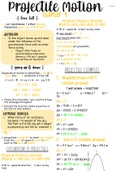
projectile projected vertically
o x air resistance / other forces upwards which falls below og level:
therefore grav acc = 9.8 m.s-2
Vi @ A = upwards V decr as obj rises
@ max height, Vf = 0
Definition:
o If the object moves up and down max height when fall, Vi = 0
under the influence of the Vi at A = -Vi at C
gravitational force with no other
Vf = maximum (at ground/D)
force acting
o Object falls freely w/ Δt AB = Δt BC
gravitational acceleration
Δttotal = Δt AB + BC + CD
where g = 9.8 m.s-2 towards
the surface of the Earth Δy = distance of AD
a = k (9.8m.s-2)
{ going up & down }
Equations of motion to determine v, Δt & Δx
PROJECTILE EXAMPLES:
(Δy) bcz a = k (constant) in free fall
( l o o k @ d i a g r a m o n p g 3 1)
Vf = Vi + aΔt
TAKE DOWN = POSITIVE
Δy = ViΔt + ½aΔt2
Vi = 0 m.s-1 a = 9.8m.s-2 Δt =
Vf2 = Vi2 + 2aΔy 3s
➢ Choose direction (down / up) = positive & keep
this unchanged throughout. Δy = ?
➢ Indicate the direction chosen as positive at Δy = ViΔt + ½ a Δt2
the start of your answers.
Δy = (0)(3) + ½ (9.8)(3)2
Terminal velocity: Δy = 44.1 m (down)
o When force of air resistance
becomes = to weight of the obj, Vf = ?
\\
the Fnet is 0 & the obj will x longer Vf = Vi + aΔt
accelerate by will fall w/ constant v
Vf = 0 + (9.8)(3)
! NB ! Vf = 29.4 m.s-1 , down
➢ projectiles = same Δt to reach max height
from the point of upward launch to fall
back to the point of launch
Vi = 4.7 m.s-1 a = 9.8m.s-2 Δy = 44.1 m
EXPLANATION OF PROJECTILES Δt = ?
b
projectile projected vertically Vf2 = Vi2 + 2aΔy
upwards & falls back to same level: Vf2 = (4.7)2 + 2(9.8)(44.1)
Vi @ A = upwards direction V decr as obj Vf = 29.77 m.s-1 , down
rises
Vf = Vi + aΔt
projectile projected vertically
o x air resistance / other forces upwards which falls below og level:
therefore grav acc = 9.8 m.s-2
Vi @ A = upwards V decr as obj rises
@ max height, Vf = 0
Definition:
o If the object moves up and down max height when fall, Vi = 0
under the influence of the Vi at A = -Vi at C
gravitational force with no other
Vf = maximum (at ground/D)
force acting
o Object falls freely w/ Δt AB = Δt BC
gravitational acceleration
Δttotal = Δt AB + BC + CD
where g = 9.8 m.s-2 towards
the surface of the Earth Δy = distance of AD
a = k (9.8m.s-2)
{ going up & down }
Equations of motion to determine v, Δt & Δx
PROJECTILE EXAMPLES:
(Δy) bcz a = k (constant) in free fall
( l o o k @ d i a g r a m o n p g 3 1)
Vf = Vi + aΔt
TAKE DOWN = POSITIVE
Δy = ViΔt + ½aΔt2
Vi = 0 m.s-1 a = 9.8m.s-2 Δt =
Vf2 = Vi2 + 2aΔy 3s
➢ Choose direction (down / up) = positive & keep
this unchanged throughout. Δy = ?
➢ Indicate the direction chosen as positive at Δy = ViΔt + ½ a Δt2
the start of your answers.
Δy = (0)(3) + ½ (9.8)(3)2
Terminal velocity: Δy = 44.1 m (down)
o When force of air resistance
becomes = to weight of the obj, Vf = ?
\\
the Fnet is 0 & the obj will x longer Vf = Vi + aΔt
accelerate by will fall w/ constant v
Vf = 0 + (9.8)(3)
! NB ! Vf = 29.4 m.s-1 , down
➢ projectiles = same Δt to reach max height
from the point of upward launch to fall
back to the point of launch
Vi = 4.7 m.s-1 a = 9.8m.s-2 Δy = 44.1 m
EXPLANATION OF PROJECTILES Δt = ?
b
projectile projected vertically Vf2 = Vi2 + 2aΔy
upwards & falls back to same level: Vf2 = (4.7)2 + 2(9.8)(44.1)
Vi @ A = upwards direction V decr as obj Vf = 29.77 m.s-1 , down
rises
Vf = Vi + aΔt