FLG 222: Reproduction
Female
The Basics - Sex Determination
- The embryo exhibits gender bipotentiality. It has the Mullerian ducts (which are the female
primordial reproductive duct) & the Wolffian ducts (which develops into male genitalia).
- Has Mullerian & Wolffian ducts
o Around week seven of foetal development the SRY gene is activated. The gene is found on
the Y chromosome. It directs the development of the male gonads.
o SRY = directs development of gonads
SRY Gene
PRESENCE OF SRY
- Causes gonads to descend & develop into testes
- Testes - produce male sex hormones (testosterone & AMH - anti-Mullerian hormone)
ABSENCE OF SRY
- Causes gonads to develop into ovaries
- Ovaries - produce female sex hormones and ova
Gender Determination
-
-
o
o
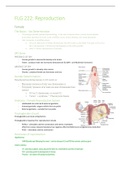
Anatomy - Female Reproductive System
- subdivided into internal & external genitalia
- Internal genitalia =organs within the true pelvis
- External genitalia - outside the true pelvis
Prostaglandins (local)
Prostaglandins are local acting factors.
Prostaglandins important for reproduction include
- PGF2α – stimulates uterine contraction and exerts a luteolytic
effect (on corpus luteum) luteolysis has negative effect (inhibitory) on progesterone production
- PGE2 – stimulates uterine contraction
Hormones of reproduction
Hypothalamus
- GnRH (Gonadotropin Releasing Hormone) – controls release of LH and FSH from anterior pituitary gland
Anterior pituitary
- LH - promotes ovulation, corpus luteum formation (i.e. luteotrophic); secretion of oestrogen
- FSH - promotes growth & development of follicles
- Prolactin - stimulates milk production/synthesis
, Posterior Pituitary
- Oxytocin – promotes milk letdown reflex, contraction of uterus during parturition, transport of sperm via Fallopian tube
(peristalsis)
Ovaries
- Oestrogen (theca cells) – is secreted by theca cells of the follicles. The principal oestrogen is oestradiol. It causes the growth
of reproductive organs and promotes the development of secondary sex characteristics.
- Relaxin (granulosa cells) – relaxes pelvic ligaments
- Inhibin (granulosa cells) – inhibits FSH
- Progesterone (corpus luteum) - It is important for the maintenance of pregnancy and for the growth of mammary glands in
preparation for lactation.
Placenta
- Human chorionic gonadotropin (hCG) – species specific hormone, maintains pregnancy by supporting CL; It is similar in
structure to LH; levels - pregnancy detection
- Relaxin – relaxes ligaments in the pelvis; softens & widens the cervix
- Progesterone
Functions of Progesterone
- Note. initially secreted by Corpus Luteum
- Subsequently, secreted mostly by placenta
- Actions:
o Development of uterine endometrium
o Decrease/inhibits contractility of uterus
o Contributes to development of ovum prior to implantation
o Prepares breast for lactation
Oogenesis
Oogenesis is the formation of the ova from an oogonia (primordial germ cells). This process is only completed
if fertilisation occurs. If fertilisation has not occurred, the process is arrested following the formation of a
secondary oocyte (i.e. in metaphase II).
The process of Oogenesis
- During embryonic development, oogonia (diploid cells) divide by mitosis and ultimately form
thousands of primary oocytes. Each primary oocyte will enter Meiosis I just before birth. Meiosis
I is not completed, but is arrested in prophase I.
- At puberty, in response to rising levels of LH and FSH, the primary oocyte completes meiosis I to
form a secondary oocyte and a polar body. The secondary oocyte enters meiosis II and cell division
is arrested in metaphase II. If fertilisation occurs, the oocyte completes meiosis II to form an
ovum and a polar body. Polar bodies disintegrate.
Female
The Basics - Sex Determination
- The embryo exhibits gender bipotentiality. It has the Mullerian ducts (which are the female
primordial reproductive duct) & the Wolffian ducts (which develops into male genitalia).
- Has Mullerian & Wolffian ducts
o Around week seven of foetal development the SRY gene is activated. The gene is found on
the Y chromosome. It directs the development of the male gonads.
o SRY = directs development of gonads
SRY Gene
PRESENCE OF SRY
- Causes gonads to descend & develop into testes
- Testes - produce male sex hormones (testosterone & AMH - anti-Mullerian hormone)
ABSENCE OF SRY
- Causes gonads to develop into ovaries
- Ovaries - produce female sex hormones and ova
Gender Determination
-
-
o
o
Anatomy - Female Reproductive System
- subdivided into internal & external genitalia
- Internal genitalia =organs within the true pelvis
- External genitalia - outside the true pelvis
Prostaglandins (local)
Prostaglandins are local acting factors.
Prostaglandins important for reproduction include
- PGF2α – stimulates uterine contraction and exerts a luteolytic
effect (on corpus luteum) luteolysis has negative effect (inhibitory) on progesterone production
- PGE2 – stimulates uterine contraction
Hormones of reproduction
Hypothalamus
- GnRH (Gonadotropin Releasing Hormone) – controls release of LH and FSH from anterior pituitary gland
Anterior pituitary
- LH - promotes ovulation, corpus luteum formation (i.e. luteotrophic); secretion of oestrogen
- FSH - promotes growth & development of follicles
- Prolactin - stimulates milk production/synthesis
, Posterior Pituitary
- Oxytocin – promotes milk letdown reflex, contraction of uterus during parturition, transport of sperm via Fallopian tube
(peristalsis)
Ovaries
- Oestrogen (theca cells) – is secreted by theca cells of the follicles. The principal oestrogen is oestradiol. It causes the growth
of reproductive organs and promotes the development of secondary sex characteristics.
- Relaxin (granulosa cells) – relaxes pelvic ligaments
- Inhibin (granulosa cells) – inhibits FSH
- Progesterone (corpus luteum) - It is important for the maintenance of pregnancy and for the growth of mammary glands in
preparation for lactation.
Placenta
- Human chorionic gonadotropin (hCG) – species specific hormone, maintains pregnancy by supporting CL; It is similar in
structure to LH; levels - pregnancy detection
- Relaxin – relaxes ligaments in the pelvis; softens & widens the cervix
- Progesterone
Functions of Progesterone
- Note. initially secreted by Corpus Luteum
- Subsequently, secreted mostly by placenta
- Actions:
o Development of uterine endometrium
o Decrease/inhibits contractility of uterus
o Contributes to development of ovum prior to implantation
o Prepares breast for lactation
Oogenesis
Oogenesis is the formation of the ova from an oogonia (primordial germ cells). This process is only completed
if fertilisation occurs. If fertilisation has not occurred, the process is arrested following the formation of a
secondary oocyte (i.e. in metaphase II).
The process of Oogenesis
- During embryonic development, oogonia (diploid cells) divide by mitosis and ultimately form
thousands of primary oocytes. Each primary oocyte will enter Meiosis I just before birth. Meiosis
I is not completed, but is arrested in prophase I.
- At puberty, in response to rising levels of LH and FSH, the primary oocyte completes meiosis I to
form a secondary oocyte and a polar body. The secondary oocyte enters meiosis II and cell division
is arrested in metaphase II. If fertilisation occurs, the oocyte completes meiosis II to form an
ovum and a polar body. Polar bodies disintegrate.