Timeline & plan
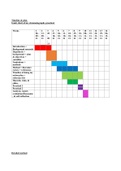
Gantt chart of my chromatography practical
Weeks 1 2 3 4 5 6 7 8 9 10 11 12 13 14
06- 13- 20 27- 04- 11- 18- 25- 01- 08- 15- 22- 29- 06-
09- 09- - 10- 10- 10- 10- 10- 11- 11- 11- 11- 11- 12-
21 21 09 21 21 21 21 21 21 21 21 21 21 21
-
21
Introduction +
Background research
Hypothesis +
background + aims
& objectives +
variables
Limitations +
methods
Method + literature
review + references
Timeline of doing my
action plan +
reference list
Hazards, risks, &
ethics
Practical 1
Practical 2
Analysis, report,
evaluation/discussion
, & self-reflection
Detailed method
, Are expensive felt tip pens different from the cheaper brands?
Aim: The aim of this activity is to separate the pen pigments using paper chromatography
Overview:
The experiment involves three stages
- Make dots using the expensive & inexpensive pen
- Set up a paper chromatography run
- Attempt to identify the separate pigments
Equipment:
1. 2x 400ml Beaker
2. 2x Chromatography filter paper
3. 2x Stirring glass rod
4. 60ml Distilled water
5. 40ml Acetone
6. Ruler
7. Black felt tip pens as stated (Cheap: Berol Colour Fine Pen – Black & Essentials. Expensive: Fine
liner Pen – Black).
8. 2x measuring cylinders
9. Scissors
10. Pencil
11. 2x Aluminium foil
Independent variable: Inexpensive & expensive pens
Dependent variable: Colours produced on the chromatography paper
Control variable: Solvent, distilled water, beaker, chromatography paper, stirring rod, acetone, ruler,
measuring cylinder, scissors, & pencil
METHOD FOR PAPER CHROMATOGRAPHY SEPARATION
Method:
1. Prepare the chromatography paper by cutting a strip using scissors or a ruler that is a bit longer than
the beaker & will not touch the sides. Stand the paper in the beaker & fold the top of the paper over
the edge of the beaker so that it supports itself (2x expensive & inexpensive pens).
2. Make a small lid for the beaker out of aluminium foil.
3. Draw a pencil line 3 cm from the bottom of the chromatography paper. Write your name at the top of
the paper in pencil (for the expensive & inexpensive pens).
4. In the middle put a spot on the chromatography paper for how many times needed for it to be
concentrated & before applying make sure its dry (depending how concentrated the spot is).
5. Measure out using a measuring cylinder 20ml of acetone & 30ml of distilled water.
6. Pour the chromatography solvent into the beaker with a stirring rod (2x expensive & inexpensive
pens).
7. Stand the paper in the beaker ensuring the spot is not in the solvent
8. Place the aluminium lid on the beakers and fold it down to give a good seal.
9. Allow the solvent to climb the chromatography paper until within 1 cm of the top. If you, can it is a
good idea to photograph the progress (expensive & inexpensive pens).
10. Remove the chromatograms from the beaker & mark the position of the solvent front in pencil until
the finished
11. Ring each spot on the chromatograms with a pencil to mark its position, as the spots will fade with
time. Also, next to each spot write its colour.
12. Measure the distance from the starting line to the solvent front.
Gantt chart of my chromatography practical
Weeks 1 2 3 4 5 6 7 8 9 10 11 12 13 14
06- 13- 20 27- 04- 11- 18- 25- 01- 08- 15- 22- 29- 06-
09- 09- - 10- 10- 10- 10- 10- 11- 11- 11- 11- 11- 12-
21 21 09 21 21 21 21 21 21 21 21 21 21 21
-
21
Introduction +
Background research
Hypothesis +
background + aims
& objectives +
variables
Limitations +
methods
Method + literature
review + references
Timeline of doing my
action plan +
reference list
Hazards, risks, &
ethics
Practical 1
Practical 2
Analysis, report,
evaluation/discussion
, & self-reflection
Detailed method
, Are expensive felt tip pens different from the cheaper brands?
Aim: The aim of this activity is to separate the pen pigments using paper chromatography
Overview:
The experiment involves three stages
- Make dots using the expensive & inexpensive pen
- Set up a paper chromatography run
- Attempt to identify the separate pigments
Equipment:
1. 2x 400ml Beaker
2. 2x Chromatography filter paper
3. 2x Stirring glass rod
4. 60ml Distilled water
5. 40ml Acetone
6. Ruler
7. Black felt tip pens as stated (Cheap: Berol Colour Fine Pen – Black & Essentials. Expensive: Fine
liner Pen – Black).
8. 2x measuring cylinders
9. Scissors
10. Pencil
11. 2x Aluminium foil
Independent variable: Inexpensive & expensive pens
Dependent variable: Colours produced on the chromatography paper
Control variable: Solvent, distilled water, beaker, chromatography paper, stirring rod, acetone, ruler,
measuring cylinder, scissors, & pencil
METHOD FOR PAPER CHROMATOGRAPHY SEPARATION
Method:
1. Prepare the chromatography paper by cutting a strip using scissors or a ruler that is a bit longer than
the beaker & will not touch the sides. Stand the paper in the beaker & fold the top of the paper over
the edge of the beaker so that it supports itself (2x expensive & inexpensive pens).
2. Make a small lid for the beaker out of aluminium foil.
3. Draw a pencil line 3 cm from the bottom of the chromatography paper. Write your name at the top of
the paper in pencil (for the expensive & inexpensive pens).
4. In the middle put a spot on the chromatography paper for how many times needed for it to be
concentrated & before applying make sure its dry (depending how concentrated the spot is).
5. Measure out using a measuring cylinder 20ml of acetone & 30ml of distilled water.
6. Pour the chromatography solvent into the beaker with a stirring rod (2x expensive & inexpensive
pens).
7. Stand the paper in the beaker ensuring the spot is not in the solvent
8. Place the aluminium lid on the beakers and fold it down to give a good seal.
9. Allow the solvent to climb the chromatography paper until within 1 cm of the top. If you, can it is a
good idea to photograph the progress (expensive & inexpensive pens).
10. Remove the chromatograms from the beaker & mark the position of the solvent front in pencil until
the finished
11. Ring each spot on the chromatograms with a pencil to mark its position, as the spots will fade with
time. Also, next to each spot write its colour.
12. Measure the distance from the starting line to the solvent front.