17.02.2020
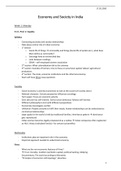
Economy and Society in India
Week 1: Monday
R103, Prof. V. Sujatha
Syllabus
- Connecting economy and society relationships
- State plays central role in Indian economy
- 1st section
o Social life of things → commodity and things (Social life of potato etc.), what does
Marx define as commodity?
o Sociology have an entrenched bias
o Links between readings,
o SEWA – self-employed women association
nd
- 2 section: What colonialization did to the colonies
- 3nd section: Suicides of farmers, tries to focus on provincial capital/ labour/ agricultural
production,
- 4rd section: The state, economic institutions and the informal economy
- Exam will have three essay questions
Tuesday
- Social economy is used by economists to look at the social-civil society sector
- National character: Certain perspective influences sociology
- Term paper: Focus on economic activity
- Even altruism has self-interest. Every human behaviour follows self-interest.
- Different philosophers start with different propositions
- Economists-Sociologists conflict
- Utilitarian: People consume to fulfil their needs, human relationships can be understood as
contractual relationships
- large capital in the world is held by traditional families, inheritance pattern → dominance
gets reproduced
- Indian woman becomes legally empowered as a widow → Indian companies often registered
as HUV, Hindu Undivided Family (= for certain tax benefits)
Wednesday
- Institutions play an important role in the economy
- Empirical approach needed to understand economy
Firms
- What are the non-economic features of firms?
→ Trust, morality, tradition (symbolic capital), political backing, lobbying
Documentary: The world according to Monsanto
- “Principles of economic anthropology”, Bourdieu
1
, 17.02.2020
Economic and the market are neutral, it doesn’t see race, colour, religions
- Strength of a firm comes from the money it commands in the market, e.g. big market share
(JIO, Lays or Pepsi launch in India → huge amount of capital guaranteed entering the Indian
market easier, in spite of making losses at the beginning)
- Life-history of the firm = sector in which they are operating, dispossession of the director,
firms operate under certain constrains → all firms are geared towards economic efficiency
Concept of network
- Organization through network of people → Social networks undergo economic actions,
economic networks are formed over social networks
- Formal and informal sectors
Firms are dominated by certain factors:
➢ Institutions
➢ Network (socially)
➢ Power (politically)
➢ Cognition: The way people see the world, not ideological (particular knowledge)
2
, 24.02.2020
Economy and Society in India
Week 2: Monday
R103, Guest Lecturer
- Adam Smith, looking at the system in terms of a mechanism → notion of mechanism design
- The great depression = ‘Keynesian revolution’, state cannot stand away → requires state
intervention, i.e. state has to spend/ public expenditure
- Persistence of semi-feudal elements in agricultural sectors; production shared with the
landlord
- Level of the wage influenced by the time labour power can be reproduced
- Incredibly low workforce participation rates in India
- Development and underdevelopment are both of the same mechanism → Underdeveloped
countries are where they are because of the developed once
- Different stages of disengagement
- Hardly any examples of countries which got themselves out of the stage of
“underdeveloped” (perhaps Japan, South Korea, Taiwan) → What happens in the core,
determines what happens in the developing world
- Per-capita GDP is not a clear signifier for the development of a country → Different indexes
of development
Tuesday
- “David Knoke”, Atomism (one seller is in touch with multiple clients) = Power Structures of
Policy Networks
➔ Rational utility maximization;
- Network: Formal and informal networks have an important economic-social role
- Pierre Bourdieu
- Symbolic exchanges => Act of giving is important, not the price tag
- Bourdieu’s concept of a field, i.e. magnetic field => Agents come together
- Different forms of capital, not solely economic capital:
1. Financial capital
2. Cultural capital (e.g. virtues)
3. Technological capital
4. Juridical capital
5. Organizational capital (i.e. how well information flows within the corporation)
6. Commercial capital (i.e. marketing)
7. Social capital (= informal/formal mobilization of people/ firms)
8. Symbolic capital (branding, return-policies etc.)
1
Economy and Society in India
Week 1: Monday
R103, Prof. V. Sujatha
Syllabus
- Connecting economy and society relationships
- State plays central role in Indian economy
- 1st section
o Social life of things → commodity and things (Social life of potato etc.), what does
Marx define as commodity?
o Sociology have an entrenched bias
o Links between readings,
o SEWA – self-employed women association
nd
- 2 section: What colonialization did to the colonies
- 3nd section: Suicides of farmers, tries to focus on provincial capital/ labour/ agricultural
production,
- 4rd section: The state, economic institutions and the informal economy
- Exam will have three essay questions
Tuesday
- Social economy is used by economists to look at the social-civil society sector
- National character: Certain perspective influences sociology
- Term paper: Focus on economic activity
- Even altruism has self-interest. Every human behaviour follows self-interest.
- Different philosophers start with different propositions
- Economists-Sociologists conflict
- Utilitarian: People consume to fulfil their needs, human relationships can be understood as
contractual relationships
- large capital in the world is held by traditional families, inheritance pattern → dominance
gets reproduced
- Indian woman becomes legally empowered as a widow → Indian companies often registered
as HUV, Hindu Undivided Family (= for certain tax benefits)
Wednesday
- Institutions play an important role in the economy
- Empirical approach needed to understand economy
Firms
- What are the non-economic features of firms?
→ Trust, morality, tradition (symbolic capital), political backing, lobbying
Documentary: The world according to Monsanto
- “Principles of economic anthropology”, Bourdieu
1
, 17.02.2020
Economic and the market are neutral, it doesn’t see race, colour, religions
- Strength of a firm comes from the money it commands in the market, e.g. big market share
(JIO, Lays or Pepsi launch in India → huge amount of capital guaranteed entering the Indian
market easier, in spite of making losses at the beginning)
- Life-history of the firm = sector in which they are operating, dispossession of the director,
firms operate under certain constrains → all firms are geared towards economic efficiency
Concept of network
- Organization through network of people → Social networks undergo economic actions,
economic networks are formed over social networks
- Formal and informal sectors
Firms are dominated by certain factors:
➢ Institutions
➢ Network (socially)
➢ Power (politically)
➢ Cognition: The way people see the world, not ideological (particular knowledge)
2
, 24.02.2020
Economy and Society in India
Week 2: Monday
R103, Guest Lecturer
- Adam Smith, looking at the system in terms of a mechanism → notion of mechanism design
- The great depression = ‘Keynesian revolution’, state cannot stand away → requires state
intervention, i.e. state has to spend/ public expenditure
- Persistence of semi-feudal elements in agricultural sectors; production shared with the
landlord
- Level of the wage influenced by the time labour power can be reproduced
- Incredibly low workforce participation rates in India
- Development and underdevelopment are both of the same mechanism → Underdeveloped
countries are where they are because of the developed once
- Different stages of disengagement
- Hardly any examples of countries which got themselves out of the stage of
“underdeveloped” (perhaps Japan, South Korea, Taiwan) → What happens in the core,
determines what happens in the developing world
- Per-capita GDP is not a clear signifier for the development of a country → Different indexes
of development
Tuesday
- “David Knoke”, Atomism (one seller is in touch with multiple clients) = Power Structures of
Policy Networks
➔ Rational utility maximization;
- Network: Formal and informal networks have an important economic-social role
- Pierre Bourdieu
- Symbolic exchanges => Act of giving is important, not the price tag
- Bourdieu’s concept of a field, i.e. magnetic field => Agents come together
- Different forms of capital, not solely economic capital:
1. Financial capital
2. Cultural capital (e.g. virtues)
3. Technological capital
4. Juridical capital
5. Organizational capital (i.e. how well information flows within the corporation)
6. Commercial capital (i.e. marketing)
7. Social capital (= informal/formal mobilization of people/ firms)
8. Symbolic capital (branding, return-policies etc.)
1