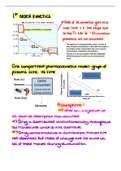
1st ORDER KINETICS
Rate of elimination
gets less
over time I e the slope due
to the 12 life tr Elimination
processes are not saturated
D
One compartmentpharmacokinetics model
graph of
vs time
plasma conc
Assumptions
after an i v
injection or
as soon as absorption has occurred
Drug is distributed instantaneously throughout
all tissues into which it will distribute
Drug concentrations in distribution tissues are
not identical but rates of
change are the same in
all of these tissues elimination
during
, I E It assumes the
drug distributes instantaneously
to all parts of the body
Two compartmentpharmacokinetic model
This divides the body into a central and peripheral
compartment the central compartment consists of
the plasma and the tissues where the distribution of
instantaneous
drug in practically The peripheral
compartment consists of tissues where the distribution
of the drug in 0 lower
Drug in lost from the plasma in two phases DRapid
decline seen immediately after I v injection or after
absorption in due to movement of drug from central
to peripheral compartment distribution phase Elimination
is also
taking place at this point but it is slaver than
the rate of distribution
Once equilibrium has been reached the rate ofdecline
in
drug conc in highly and poorlyperfused tissues becomes
identical and isgovernedbyrate of elimination eliminationphase
Rate of elimination
gets less
over time I e the slope due
to the 12 life tr Elimination
processes are not saturated
D
One compartmentpharmacokinetics model
graph of
vs time
plasma conc
Assumptions
after an i v
injection or
as soon as absorption has occurred
Drug is distributed instantaneously throughout
all tissues into which it will distribute
Drug concentrations in distribution tissues are
not identical but rates of
change are the same in
all of these tissues elimination
during
, I E It assumes the
drug distributes instantaneously
to all parts of the body
Two compartmentpharmacokinetic model
This divides the body into a central and peripheral
compartment the central compartment consists of
the plasma and the tissues where the distribution of
instantaneous
drug in practically The peripheral
compartment consists of tissues where the distribution
of the drug in 0 lower
Drug in lost from the plasma in two phases DRapid
decline seen immediately after I v injection or after
absorption in due to movement of drug from central
to peripheral compartment distribution phase Elimination
is also
taking place at this point but it is slaver than
the rate of distribution
Once equilibrium has been reached the rate ofdecline
in
drug conc in highly and poorlyperfused tissues becomes
identical and isgovernedbyrate of elimination eliminationphase