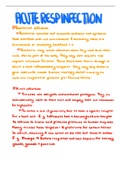
ACUTERESP INFECTION
Bacterial infection
Bacteria colonise our mucosal surfaces and epithelia
that interface with our environment Eventually there is a
commensal or
mutually beneficial r s
Bacteria may cause infection when they move to an
othe wise
sterile part of the body They may also acquire and
express virulence factors These facilitate tissue damage or
illicit a host
inflammatory response They may help bacteria
gain nutrients evade tissues multiply whilst evading an
immune response or produce pre formed toxins
Viral infection
Viruses are
obligate intracellular pathogens They are
inert on their own and host cell mechanism
metabolically employ
to replicate
To enter a cell it generally has to have a
specificreceptor
for a E g Influenza has a haemagluttin in receptor
host cell
to attach to sialic acid proteins proteins in human resp cells
viruses have tropism A preference for certain tissues
Many
to infect meaning it can enter at one site but travel to another
C
g Mumps Enters resp tract but has tropism for salivary
glands gonads pacreas
, Rabies Enters soft tissue but has tropisin for nervous
tissue
5 outcomes after viral infection
Cell lysis These cells are killed after the virus
has replicated itself E.g Influenza
Persistence Cell stays alive and the virus continues
to levels f
replicate at low
g Hep B
Latency Virus remains in cell but does not replicate
C g Herpes
Incorporation
into host genome All future
daughter
cells then become infected
E.g retroviruses such as
HIV
Malignant transformation Viruses that are oncogenic
cause cancer f HPV Cervical cancer Epstein Barr
g
Nasopharyngael cancer Some viruses remain latent in
life infection when reactivated
cells
long and cause 2
possibly in response to stress or immuno compromise
Bacterial infection
Bacteria colonise our mucosal surfaces and epithelia
that interface with our environment Eventually there is a
commensal or
mutually beneficial r s
Bacteria may cause infection when they move to an
othe wise
sterile part of the body They may also acquire and
express virulence factors These facilitate tissue damage or
illicit a host
inflammatory response They may help bacteria
gain nutrients evade tissues multiply whilst evading an
immune response or produce pre formed toxins
Viral infection
Viruses are
obligate intracellular pathogens They are
inert on their own and host cell mechanism
metabolically employ
to replicate
To enter a cell it generally has to have a
specificreceptor
for a E g Influenza has a haemagluttin in receptor
host cell
to attach to sialic acid proteins proteins in human resp cells
viruses have tropism A preference for certain tissues
Many
to infect meaning it can enter at one site but travel to another
C
g Mumps Enters resp tract but has tropism for salivary
glands gonads pacreas
, Rabies Enters soft tissue but has tropisin for nervous
tissue
5 outcomes after viral infection
Cell lysis These cells are killed after the virus
has replicated itself E.g Influenza
Persistence Cell stays alive and the virus continues
to levels f
replicate at low
g Hep B
Latency Virus remains in cell but does not replicate
C g Herpes
Incorporation
into host genome All future
daughter
cells then become infected
E.g retroviruses such as
HIV
Malignant transformation Viruses that are oncogenic
cause cancer f HPV Cervical cancer Epstein Barr
g
Nasopharyngael cancer Some viruses remain latent in
life infection when reactivated
cells
long and cause 2
possibly in response to stress or immuno compromise