Property Law Basics
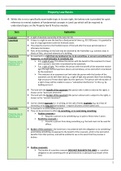
❖ Whilst this is not a specifically examinable topic in its own right, the below note is provided for quick
reference to remind students of fundamental concepts in Land Law which will be required to
understand topics on the Property law & Practice module.
Term Explanation
Freehold ❖ A right of absolute ownership of the land, for life.
Leasehold ❖ A lease is a right to own the land for a fixed period of time e.g. years. It is granted by
way of a legal agreement with the freehold owner.
❖ The property reverts to the freehold owner of the land after the lease period expires or
otherwise terminates.
❖ Parts of the buildings on the land may be retained by the freeholder e.g. common areas in
blocks of flats, structural elements of a building.
Easements ❖ An easement is a right that one landowner has to do something, or prevent something from
happening, on land belonging to somebody else.
Property Law & ➢ E.g. a right of way: This allows the person with the benefit of the easement to travel
Practice, 3.5 over a person’s land who is burdened by the easement.
➢ E.g. a right of light: This entitles the person with the benefit of the easement receive
light through defined apertures (doors and windows), across land which is burdened
by the easement.
➢ The existence of an easement can limit what the person with the burden of the
easement can do with their land e.g. a right of light may prevent them from building
high structures if these block light into the apertures. The person with the burden of
a right of way will be unable to cause a “substantial interference” to this e.g. by
building across it.
❖ The land with the benefit of the easement (the person who is able to exercise the right), is
known as the “dominant tenement”.
❖ The land with the burden of the easement (the person whose land is subject to the right), is
known as the “servient tenement”.
❖ Can be created expressly (i.e. in writing, on the sale of land), impliedly (e.g. by virtue of
necessity), or by long user (prescription – requires 20 years uninterrupted use).
Covenants ❖ A covenant is an enforceable promise.
❖ They can be promises to either do something, or to avoid doing something:
Property Law & ➢ Positive covenant =
Practice, 3.6 ▪ Requires a person to do something e.g. to paint a fence every 5 years.
➢ Restrictive covenant =
▪ Prevents a person from doing something e.g. the land must not be used for
offices.
❖ Burden of the covenant = the land that is encumbered with the obligation to do something /
avoid doing something, as opposed to the benefit of the covenant, which is the land which
benefits from that promise, and will be entitled to sue in the event that the promise is
broken.
❖ Positive covenants:
➢ The burden of a positive covenant DOES NOT RUN WITH THE LAND i.e. a positive
obligation to do something will not generally bind a subsequent purchaser of the
land.
1
, ❖ Restrictive covenants:
➢ The burden of a positive covenant can run with the land if the rule in Tulk v Moxhay
(1848) 2 Ph 774 applies.
➢ For the purposes of the LPC, the key point is that the burden of a restrictive
covenant will always run with freehold land if the restrictive covenant appears on
the Register of Title.
➢ So if you are acting for a purchaser on land and you know that that land has a
restrictive covenant to prevent use as offices, you know that your client will be
bound by that restriction and will need to be advised accordingly as to the limitation
on their use.
Co-Ownership ❖ Co-owned land will always be held on trust. The co-owners hold the land as trustees for each
other as beneficiaries.
Property Law &
Practice, 3.8 ❖ There are two types of trust of land in English Law:
❖ Joint Tenancy:
➢ Both tenants own 100% of the property jointly. They do not hold distinct shares.
➢ In the event of sale, the joint tenants will split the proceeds of the property evenly
between them.
➢ When one joint tenant dies, the remaining tenant automatically inherits the
deceased’s share.
➢ This means that a purchaser can deal solely with the one remaining joint tenant
(unlike with a Tenancy in Common, see below).
❖ Tenancy in Common:
➢ By contrast with a joint tenancy, tenants in common each own distinct shares in the
Property.
➢ E.g. Person A owns 30%, Person B owns 70%.
➢ When a tenant in common dies, their share of the property will pass under their will
or intestacy.
❖ Where co-owners wish to hold the land as Tenants in Common, the Land Registry will place a
restriction on the proprietorship register of the title, known as a “Form A Restriction”:
No disposition by a sole proprietor of the registered estate (except a trust corporation) under
which capital money arises is to be registered unless authorised by an order of the court.
❖ This alerts third parties dealing with the land that a trust of land is in existence, meaning that
any sale of the legal estate will need to be effected by two trustees.
❖ If one tenant in common dies and the surviving co-owner wishes to sell, they will need to
appoint a second trustee before completion of the transaction (because the sale must be
effected by two trustees).
❖ If there is no restriction on the register, the buyer is entitled to assume that the co-owners
were joint tenants and will take a good title from the survivor.
Mortgages ❖ A mortgage is a legal agreement where a bank lends money to the borrower, in exchange for
the borrower agrees to:
Property Law & ➢ (a) Repay the loan
Practice 3.9 ➢ (b) Pay interest on the loan, and
➢ (c) Grant the lender title to their property as security until the debt is discharged.
❖ The mortgage must be registered as a registered charge in the charges register of the
borrower’s title.
❖ When acting for a buyer, we need to bear in mind that the mortgage will be inherited by the
buyer unless the seller takes specific steps to discharge this before sale.
2
,❖ The lender retains a power to sell the property in the event of default on the loan by the
borrower, subject to certain conditions.
3
, Real Estate – W1 -Taking Instructions
Outline of a simple transaction
Seller Buyer
EARLY STAGES
Marketing the property
The transaction will begin with the seller putting the property on
the market.
➢ Will usually engage in an estate agent.
➢ Will need to have commissioned an Energy Performance
Certificate.
Once a buyer is found, and price agreed, the conveyancing process
can then begin.
➢ Should be understood that the parties have not entered
any legally binding relationship with each other, and can
walk away from the transaction at any point until
exchange of contracts.
Energy Performance Certificate
Must have been commissioned (even though not received) before
the property can be marketed.
➢ Obligation to use all reasonable efforts to ensure that it
is received within seven days of marketing.
➢ If not received, further 21 days.
➢ Once obtained, estate agent must provide a copy of the
EPC with the sale particulars and in the advising.
➢ Responsibility of seller or landlord to ensure that a valid
EPC free of charge is given to the person who becomes
the buyer or tenant.
➢ Green Deal – EPC will disclose: Government initiation
that enables property owners and tenants to carry out
range of energy efficiency measures with no upfront
cost.
Minimum energy efficiency standard: From April 2018
➢ Landlords of certain domestic or non-domestic buildings
will not be able to grant new tenancies or renew existing
if the building does not meet EPC rating E.
➢ A landlord who wishes to rent a sub-standard property
will have to undertake relevant improvements… unless:
▪ obtained an opinion that improvement will have
negative impact on fabric/structure
▪ tenant’s consent has not been forthcoming.
▪ would result in reduction of more than 5% of price
PRE-CONTRACT STAGE Due diligence most time heavy aspect
Take instructions Take instructions
Obtain proof of the client’s identity due to money laundering Obtain proof of the client’s identity due to money laundering
regulations. regulations.
Indirect instructions (e.g. from an estate agent on behalf of the Indirect instructions (e.g. from an estate agent on behalf of the
client) must be confirmed directly by the client). client) must be confirmed directly by the client).
Prepare pre-contract package
o The draft contract, showing what land the seller is selling and
on what terms;
o Evidence of the seller’s legal title to the property;
o Sometimes, the results of pre-contract searches which the
seller has made.
Commission survey
Pre-contract searches and enquiries
Application of the caveat emptor (place sole responsibility on the
buyer to check suitability of the property) principle which makes
pre-contract searches necessary. Let the buyer beware.
4
❖ Whilst this is not a specifically examinable topic in its own right, the below note is provided for quick
reference to remind students of fundamental concepts in Land Law which will be required to
understand topics on the Property law & Practice module.
Term Explanation
Freehold ❖ A right of absolute ownership of the land, for life.
Leasehold ❖ A lease is a right to own the land for a fixed period of time e.g. years. It is granted by
way of a legal agreement with the freehold owner.
❖ The property reverts to the freehold owner of the land after the lease period expires or
otherwise terminates.
❖ Parts of the buildings on the land may be retained by the freeholder e.g. common areas in
blocks of flats, structural elements of a building.
Easements ❖ An easement is a right that one landowner has to do something, or prevent something from
happening, on land belonging to somebody else.
Property Law & ➢ E.g. a right of way: This allows the person with the benefit of the easement to travel
Practice, 3.5 over a person’s land who is burdened by the easement.
➢ E.g. a right of light: This entitles the person with the benefit of the easement receive
light through defined apertures (doors and windows), across land which is burdened
by the easement.
➢ The existence of an easement can limit what the person with the burden of the
easement can do with their land e.g. a right of light may prevent them from building
high structures if these block light into the apertures. The person with the burden of
a right of way will be unable to cause a “substantial interference” to this e.g. by
building across it.
❖ The land with the benefit of the easement (the person who is able to exercise the right), is
known as the “dominant tenement”.
❖ The land with the burden of the easement (the person whose land is subject to the right), is
known as the “servient tenement”.
❖ Can be created expressly (i.e. in writing, on the sale of land), impliedly (e.g. by virtue of
necessity), or by long user (prescription – requires 20 years uninterrupted use).
Covenants ❖ A covenant is an enforceable promise.
❖ They can be promises to either do something, or to avoid doing something:
Property Law & ➢ Positive covenant =
Practice, 3.6 ▪ Requires a person to do something e.g. to paint a fence every 5 years.
➢ Restrictive covenant =
▪ Prevents a person from doing something e.g. the land must not be used for
offices.
❖ Burden of the covenant = the land that is encumbered with the obligation to do something /
avoid doing something, as opposed to the benefit of the covenant, which is the land which
benefits from that promise, and will be entitled to sue in the event that the promise is
broken.
❖ Positive covenants:
➢ The burden of a positive covenant DOES NOT RUN WITH THE LAND i.e. a positive
obligation to do something will not generally bind a subsequent purchaser of the
land.
1
, ❖ Restrictive covenants:
➢ The burden of a positive covenant can run with the land if the rule in Tulk v Moxhay
(1848) 2 Ph 774 applies.
➢ For the purposes of the LPC, the key point is that the burden of a restrictive
covenant will always run with freehold land if the restrictive covenant appears on
the Register of Title.
➢ So if you are acting for a purchaser on land and you know that that land has a
restrictive covenant to prevent use as offices, you know that your client will be
bound by that restriction and will need to be advised accordingly as to the limitation
on their use.
Co-Ownership ❖ Co-owned land will always be held on trust. The co-owners hold the land as trustees for each
other as beneficiaries.
Property Law &
Practice, 3.8 ❖ There are two types of trust of land in English Law:
❖ Joint Tenancy:
➢ Both tenants own 100% of the property jointly. They do not hold distinct shares.
➢ In the event of sale, the joint tenants will split the proceeds of the property evenly
between them.
➢ When one joint tenant dies, the remaining tenant automatically inherits the
deceased’s share.
➢ This means that a purchaser can deal solely with the one remaining joint tenant
(unlike with a Tenancy in Common, see below).
❖ Tenancy in Common:
➢ By contrast with a joint tenancy, tenants in common each own distinct shares in the
Property.
➢ E.g. Person A owns 30%, Person B owns 70%.
➢ When a tenant in common dies, their share of the property will pass under their will
or intestacy.
❖ Where co-owners wish to hold the land as Tenants in Common, the Land Registry will place a
restriction on the proprietorship register of the title, known as a “Form A Restriction”:
No disposition by a sole proprietor of the registered estate (except a trust corporation) under
which capital money arises is to be registered unless authorised by an order of the court.
❖ This alerts third parties dealing with the land that a trust of land is in existence, meaning that
any sale of the legal estate will need to be effected by two trustees.
❖ If one tenant in common dies and the surviving co-owner wishes to sell, they will need to
appoint a second trustee before completion of the transaction (because the sale must be
effected by two trustees).
❖ If there is no restriction on the register, the buyer is entitled to assume that the co-owners
were joint tenants and will take a good title from the survivor.
Mortgages ❖ A mortgage is a legal agreement where a bank lends money to the borrower, in exchange for
the borrower agrees to:
Property Law & ➢ (a) Repay the loan
Practice 3.9 ➢ (b) Pay interest on the loan, and
➢ (c) Grant the lender title to their property as security until the debt is discharged.
❖ The mortgage must be registered as a registered charge in the charges register of the
borrower’s title.
❖ When acting for a buyer, we need to bear in mind that the mortgage will be inherited by the
buyer unless the seller takes specific steps to discharge this before sale.
2
,❖ The lender retains a power to sell the property in the event of default on the loan by the
borrower, subject to certain conditions.
3
, Real Estate – W1 -Taking Instructions
Outline of a simple transaction
Seller Buyer
EARLY STAGES
Marketing the property
The transaction will begin with the seller putting the property on
the market.
➢ Will usually engage in an estate agent.
➢ Will need to have commissioned an Energy Performance
Certificate.
Once a buyer is found, and price agreed, the conveyancing process
can then begin.
➢ Should be understood that the parties have not entered
any legally binding relationship with each other, and can
walk away from the transaction at any point until
exchange of contracts.
Energy Performance Certificate
Must have been commissioned (even though not received) before
the property can be marketed.
➢ Obligation to use all reasonable efforts to ensure that it
is received within seven days of marketing.
➢ If not received, further 21 days.
➢ Once obtained, estate agent must provide a copy of the
EPC with the sale particulars and in the advising.
➢ Responsibility of seller or landlord to ensure that a valid
EPC free of charge is given to the person who becomes
the buyer or tenant.
➢ Green Deal – EPC will disclose: Government initiation
that enables property owners and tenants to carry out
range of energy efficiency measures with no upfront
cost.
Minimum energy efficiency standard: From April 2018
➢ Landlords of certain domestic or non-domestic buildings
will not be able to grant new tenancies or renew existing
if the building does not meet EPC rating E.
➢ A landlord who wishes to rent a sub-standard property
will have to undertake relevant improvements… unless:
▪ obtained an opinion that improvement will have
negative impact on fabric/structure
▪ tenant’s consent has not been forthcoming.
▪ would result in reduction of more than 5% of price
PRE-CONTRACT STAGE Due diligence most time heavy aspect
Take instructions Take instructions
Obtain proof of the client’s identity due to money laundering Obtain proof of the client’s identity due to money laundering
regulations. regulations.
Indirect instructions (e.g. from an estate agent on behalf of the Indirect instructions (e.g. from an estate agent on behalf of the
client) must be confirmed directly by the client). client) must be confirmed directly by the client).
Prepare pre-contract package
o The draft contract, showing what land the seller is selling and
on what terms;
o Evidence of the seller’s legal title to the property;
o Sometimes, the results of pre-contract searches which the
seller has made.
Commission survey
Pre-contract searches and enquiries
Application of the caveat emptor (place sole responsibility on the
buyer to check suitability of the property) principle which makes
pre-contract searches necessary. Let the buyer beware.
4