Commercial Law
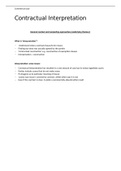
Contractual Interpretation
General context and competing approaches (underlying themes):
What is ‘interpretation’?
Understand what a contract/clause/term means
Finding out what was actually agreed by the parties
‘Contractual construction’ e.g. construction of exemption clauses
Interpretation = construction
Interpretation: some issues:
Contractual interpretation has resulted in a vast amount of case law in senior/appellate courts
Parties include causes that do not make sense
Ps disagree as to particular meaning of clause
1 party says issue is covered by contract, whilst other says it is not
Even if the contract is clear, it yields a commercially absurd/unfair result
,Commercial Law
Different approaches to interpretation:
When a court interprets a contract, what factors should the court consider? Literal approach OR
contextual approach
LITERAL APPROACH (CERTAINTY):
Give words their literal meaning
Consider only the written words and construe them on their ordinary meaning (certainty)
Restricts extent to which courts ‘interfere’
Sanctity of contract/party autonomy – pursuit of certainty
The idea that courts should stick to clear meaning of express words even if these do not strictly
produce a result the parties actually intended
This promotes certainty/predictability – parties just act on contract according to its plain terms
Simpler and easier – has the merits of simplicity – just do as the contract says
Don’t need to consult commercial experts/witnesses
Courts = simply look at words used, work out what they mean, apply
Makes litigation process more straightforward = the only real evidence required is the contract
itself
Beneficial for 3rd parties (who can rely on the literal meaning of the contract and not worry about
what the courts might interpret) – know where they stand – don’t need to second-guess what
the court will interpret
Promotes and enhances commercial certainty:
Parties can be sure that the answer will be found in the contractual document itself
The courts are adhering to what the contract says in express terms – and the parties’
performance can be guided by this
‘Sanctity of contract/party autonomy’:
Value the words in the contract, even if it seems unusual to agree to/may seem harsh
on one party
There has presumably been a lot of negotiation and discussion before the terms of the contract
were decided, so the courts assume that the written contract expresses the wishes of the parties
, Commercial Law
very well. This means they can simply read and apply what is in the contract without thinking too
much about what the parties might have meant by it.
HOWEVER, there is risk that this ignores the parties’ true bargain
The courts gradually started to abandon this strict literal approach
The courts have deviated from this approach
This has resulted in a huge amount of case law on contractual interpretation
Abandonment of this strict approach shows a movement towards a more flexible, contextual
CONTEXTUAL APPROACH (ACCURACY):
Contextual (purposive) approach
Consider the words according to their broader (factual) context and background (accuracy)
Links closely to the pursuit of accuracy
Involves looking at the surrounding circumstances including commercial common sense
Concerned with the parties’ intentions rather than the language of the contractual document
Getting to understand what the parties actually intended (objectively speaking)
What the parties actually wanted and meant
Concerned with the factual context of parties’ relationship – what is commercially sensible in the
eyes of the court
This approach has developed considerably over the recent years
Arnold v Britton (2015) – in certain circumstances, the brakes have been applied and a stricter,
‘natural reading’, approach has been returned to
Contractual Interpretation
General context and competing approaches (underlying themes):
What is ‘interpretation’?
Understand what a contract/clause/term means
Finding out what was actually agreed by the parties
‘Contractual construction’ e.g. construction of exemption clauses
Interpretation = construction
Interpretation: some issues:
Contractual interpretation has resulted in a vast amount of case law in senior/appellate courts
Parties include causes that do not make sense
Ps disagree as to particular meaning of clause
1 party says issue is covered by contract, whilst other says it is not
Even if the contract is clear, it yields a commercially absurd/unfair result
,Commercial Law
Different approaches to interpretation:
When a court interprets a contract, what factors should the court consider? Literal approach OR
contextual approach
LITERAL APPROACH (CERTAINTY):
Give words their literal meaning
Consider only the written words and construe them on their ordinary meaning (certainty)
Restricts extent to which courts ‘interfere’
Sanctity of contract/party autonomy – pursuit of certainty
The idea that courts should stick to clear meaning of express words even if these do not strictly
produce a result the parties actually intended
This promotes certainty/predictability – parties just act on contract according to its plain terms
Simpler and easier – has the merits of simplicity – just do as the contract says
Don’t need to consult commercial experts/witnesses
Courts = simply look at words used, work out what they mean, apply
Makes litigation process more straightforward = the only real evidence required is the contract
itself
Beneficial for 3rd parties (who can rely on the literal meaning of the contract and not worry about
what the courts might interpret) – know where they stand – don’t need to second-guess what
the court will interpret
Promotes and enhances commercial certainty:
Parties can be sure that the answer will be found in the contractual document itself
The courts are adhering to what the contract says in express terms – and the parties’
performance can be guided by this
‘Sanctity of contract/party autonomy’:
Value the words in the contract, even if it seems unusual to agree to/may seem harsh
on one party
There has presumably been a lot of negotiation and discussion before the terms of the contract
were decided, so the courts assume that the written contract expresses the wishes of the parties
, Commercial Law
very well. This means they can simply read and apply what is in the contract without thinking too
much about what the parties might have meant by it.
HOWEVER, there is risk that this ignores the parties’ true bargain
The courts gradually started to abandon this strict literal approach
The courts have deviated from this approach
This has resulted in a huge amount of case law on contractual interpretation
Abandonment of this strict approach shows a movement towards a more flexible, contextual
CONTEXTUAL APPROACH (ACCURACY):
Contextual (purposive) approach
Consider the words according to their broader (factual) context and background (accuracy)
Links closely to the pursuit of accuracy
Involves looking at the surrounding circumstances including commercial common sense
Concerned with the parties’ intentions rather than the language of the contractual document
Getting to understand what the parties actually intended (objectively speaking)
What the parties actually wanted and meant
Concerned with the factual context of parties’ relationship – what is commercially sensible in the
eyes of the court
This approach has developed considerably over the recent years
Arnold v Britton (2015) – in certain circumstances, the brakes have been applied and a stricter,
‘natural reading’, approach has been returned to