Gross Negligence Manslaughter Criminal Law
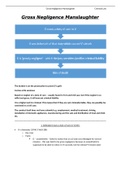
Gross Negligence Manslaughter
The burden is on the prosecution to prove D’s guilt
Carries a life sentence
Based on neglect of a duty of care – usually found in Tort and Civil Law, but if the neglect is so
wilful and gross, it will warrant criminal liability
It is a higher test for criminal. This means that if they are not criminally liable, they can possibly be
convicted in a civil case.
The conduct itself does not have unlawful e.g. employment, medical treatment, driving,
installation of domestic appliances, manufacturing and the sale and distribution of food and drink
etc.
--------------------------------------------------------------------------------------------------------------------------------------
1. Defendant owes a duty of care to Victim:
R v Adomako [1994] 3 WLR 288:
o Key case
o Facts:
D – anaesthetist – failed to notice that an o2 tube was dislodged for several
minutes – this was held to be gross negligence because an anaesthetist is
supposed to be able to notice in 15 seconds, but he noticed 9 minutes later
, Gross Negligence Manslaughter Criminal Law
Lord Mackay stated in the case of Adomako (laid down the 4 principles and stated that it was a
common law offence) that the civil principles of the law of negligence can be used in order to
establish whether a duty of care is needed.
The principle established in Donoghue v Stevenson, and is called the Neighbour Test.
o You must avoid any actions/omissions which are likely to injure your neighbour
o “You must take reasonable care to avoid acts and omission which you can reasonably
foresee would be likely to injure your neighbour” – Donoghue v Stevenson (1932)
o Your neighbour is anyone who is directly/closely affected by your acts/omissions
o “Who….is my neighbour….persons who are so closely affected by my act that I ought
to reasonably have them in contemplation as being so affected when I am directing
my mind to the acts or omissions which are called into question” – Donoghue v
Stevenson (1932)
Modern test = Caparo v Dickman
Requirements:
o Reasonable foresight of harm
o A relationship of proximity
o Fair, just and reasonable to impose a duty of care
Duty of care – question of law for judge (rather than a jury) – R v Winter and Winter 2010
Can be when a duty arises from an omission:
Case Duty Owed by whom Facts and held Basis of the duty
S4 Road Traffic Statutory duty
Act
Pittwood Employment Employer Failed to close Contractual
contract the gate at the
tracks (which led
to death/injury)
Stone and Look after sister Brother and his Failed to look Voluntary
Dobinson wife/partner after anorexic assumption of
sister Fanny care
Gibbons and Look after child Parents to child Neglect of child Special
Proctor relationship
Miller Duty to get help Squatter – Creating a
when creating a created a fire and dangerous
dangerous did nothing to situation
situation extinguish it nor
did he get help
Dytham Duty to intervene Police officer to Off-duty police Official position
as a police officer public officer failed to
stop a fight
Gross Negligence Manslaughter
The burden is on the prosecution to prove D’s guilt
Carries a life sentence
Based on neglect of a duty of care – usually found in Tort and Civil Law, but if the neglect is so
wilful and gross, it will warrant criminal liability
It is a higher test for criminal. This means that if they are not criminally liable, they can possibly be
convicted in a civil case.
The conduct itself does not have unlawful e.g. employment, medical treatment, driving,
installation of domestic appliances, manufacturing and the sale and distribution of food and drink
etc.
--------------------------------------------------------------------------------------------------------------------------------------
1. Defendant owes a duty of care to Victim:
R v Adomako [1994] 3 WLR 288:
o Key case
o Facts:
D – anaesthetist – failed to notice that an o2 tube was dislodged for several
minutes – this was held to be gross negligence because an anaesthetist is
supposed to be able to notice in 15 seconds, but he noticed 9 minutes later
, Gross Negligence Manslaughter Criminal Law
Lord Mackay stated in the case of Adomako (laid down the 4 principles and stated that it was a
common law offence) that the civil principles of the law of negligence can be used in order to
establish whether a duty of care is needed.
The principle established in Donoghue v Stevenson, and is called the Neighbour Test.
o You must avoid any actions/omissions which are likely to injure your neighbour
o “You must take reasonable care to avoid acts and omission which you can reasonably
foresee would be likely to injure your neighbour” – Donoghue v Stevenson (1932)
o Your neighbour is anyone who is directly/closely affected by your acts/omissions
o “Who….is my neighbour….persons who are so closely affected by my act that I ought
to reasonably have them in contemplation as being so affected when I am directing
my mind to the acts or omissions which are called into question” – Donoghue v
Stevenson (1932)
Modern test = Caparo v Dickman
Requirements:
o Reasonable foresight of harm
o A relationship of proximity
o Fair, just and reasonable to impose a duty of care
Duty of care – question of law for judge (rather than a jury) – R v Winter and Winter 2010
Can be when a duty arises from an omission:
Case Duty Owed by whom Facts and held Basis of the duty
S4 Road Traffic Statutory duty
Act
Pittwood Employment Employer Failed to close Contractual
contract the gate at the
tracks (which led
to death/injury)
Stone and Look after sister Brother and his Failed to look Voluntary
Dobinson wife/partner after anorexic assumption of
sister Fanny care
Gibbons and Look after child Parents to child Neglect of child Special
Proctor relationship
Miller Duty to get help Squatter – Creating a
when creating a created a fire and dangerous
dangerous did nothing to situation
situation extinguish it nor
did he get help
Dytham Duty to intervene Police officer to Off-duty police Official position
as a police officer public officer failed to
stop a fight