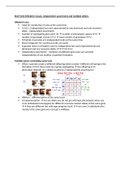
BLGY1232 Dihybrid crosses, independent assortment and multiple alleles
Dihybrid cross
Used for monitoring 2 traits at the same time
9:3:3:1 2 independent loci each represented by one dominant and one recessive
allele – independent assortment
Number of segregating gene pairs (n) number of phenotypic classes (2^n)
number of genotypic classes (3^n) total number of genotypes (4^n)
Trihybrid cross looks at 3 independent traits at the same time
Branch diagrams for numerous traits are easier
Expected ratios in trihybrid cross for independent loci each represented by one
dominant and one recessive allele; 27:9:9:9:3:3:3:1
Independent assortment – members of different gene pairs are assorted
independently of one another at gamete formation
Multiple genes controlling same trait
When 2 parents create a different offspring which creates 4 different off spring in the
formation 9:3:3:1 there must be 2 genes segregating the offspring of F1
phenotype depends on 2 alleles located at 2 independently assorting loci
Allelism – different genes at the same locus
Complementation - If loci are allelic you do not get wild type phenotypes when you
cross individuals homozygous for different recessive mutant alleles of the same gene
if they are different loci wild type progeny result if we cross 2 individuals who
mutate in he same gene you cant get a wildtype
Dihybrid cross
Used for monitoring 2 traits at the same time
9:3:3:1 2 independent loci each represented by one dominant and one recessive
allele – independent assortment
Number of segregating gene pairs (n) number of phenotypic classes (2^n)
number of genotypic classes (3^n) total number of genotypes (4^n)
Trihybrid cross looks at 3 independent traits at the same time
Branch diagrams for numerous traits are easier
Expected ratios in trihybrid cross for independent loci each represented by one
dominant and one recessive allele; 27:9:9:9:3:3:3:1
Independent assortment – members of different gene pairs are assorted
independently of one another at gamete formation
Multiple genes controlling same trait
When 2 parents create a different offspring which creates 4 different off spring in the
formation 9:3:3:1 there must be 2 genes segregating the offspring of F1
phenotype depends on 2 alleles located at 2 independently assorting loci
Allelism – different genes at the same locus
Complementation - If loci are allelic you do not get wild type phenotypes when you
cross individuals homozygous for different recessive mutant alleles of the same gene
if they are different loci wild type progeny result if we cross 2 individuals who
mutate in he same gene you cant get a wildtype