BLGY1232 The genetic material
Genetic material
Must be capable of replication with sufficient fidelity so that organisms can pass on
their characteristics to their offspring
Must be capable of undergoing some change otherwise evolution could not have
occurred
Must be capable of encoding vast amounts of information in order to program the
complexity of living organisms
Time line
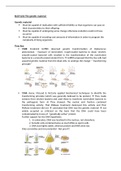
1928: Frederick Griffith observed genetic transformation of Diplococcus
pneumoniae. - Exposure of nonvirulent, rough-coated bacteria to dead, virulent,
smooth-coated bacterial cells resulted in the transformation of the nonvirulent
bacteria to a smooth-coated virulent form Griffith proposed that the live cells had
acquired genetic material from the dead cells, to undergo the change - “transforming
principle”
1944: Avery, McLeod & McCarty applied biochemical techniques to identify the
transforming principle (which was generally believed to be protein) They made
extracts from virulent bacteria and used these to transform nonvirulent bacteria to
the pathogenic form They showed; The nucleic acid fraction contained
transforming activity, That DNAase treatment destroyed this activity and That
RNAase treatment did not concluded that DNA was the genetic material not
widely accepted as criticized on the basis that the DNA could have been
contaminated by traces of “genetically active” protein
Further support for the DNA hypothesis:
1. In eukaryotes, DNA was localised in the nucleus, not elsewhere.
2. Somatic cells contained twice as much DNA as sperm cells
3. DNA was highly stable, whereas protein and RNA were not.
Only correlative and circumstantial - Not proof!!
Genetic material
Must be capable of replication with sufficient fidelity so that organisms can pass on
their characteristics to their offspring
Must be capable of undergoing some change otherwise evolution could not have
occurred
Must be capable of encoding vast amounts of information in order to program the
complexity of living organisms
Time line
1928: Frederick Griffith observed genetic transformation of Diplococcus
pneumoniae. - Exposure of nonvirulent, rough-coated bacteria to dead, virulent,
smooth-coated bacterial cells resulted in the transformation of the nonvirulent
bacteria to a smooth-coated virulent form Griffith proposed that the live cells had
acquired genetic material from the dead cells, to undergo the change - “transforming
principle”
1944: Avery, McLeod & McCarty applied biochemical techniques to identify the
transforming principle (which was generally believed to be protein) They made
extracts from virulent bacteria and used these to transform nonvirulent bacteria to
the pathogenic form They showed; The nucleic acid fraction contained
transforming activity, That DNAase treatment destroyed this activity and That
RNAase treatment did not concluded that DNA was the genetic material not
widely accepted as criticized on the basis that the DNA could have been
contaminated by traces of “genetically active” protein
Further support for the DNA hypothesis:
1. In eukaryotes, DNA was localised in the nucleus, not elsewhere.
2. Somatic cells contained twice as much DNA as sperm cells
3. DNA was highly stable, whereas protein and RNA were not.
Only correlative and circumstantial - Not proof!!