BLGY1232 PCR
The 21st century: the “post-genomic” age
The completion of an increasing number of genome sequencing projects has
ushered in the “post-genomic age” We now have access to genome sequence
information via the internet, and this has enabled a new set of experimental
approaches
Comparative genome studies - comparing the organisation of genomes, and the
sequences of homologous genes from different organisms provides us with
information about the evolutionary relationship between extant species, and the
ways in which new gene functions have evolved as ancestral genes become
duplicated and subject to divergent selection over evolutionary time globin
gene evolution;
It is now possible to purify any gene for which sequence information is available,
without the need for the “cut-ligate-screen” procedures of gene cloning, by
using the POLYMERASE CHAIN REACTION (PCR)
PCR utilises the property of DNA polymerase: this enzyme will extend an
oligonucleotide primer annealed to a single-stranded DNA template
Allows the selective amplification of any gene from a genome, without the need
for cut-paste-screen cloning, provided that sufficient sequence information is
available
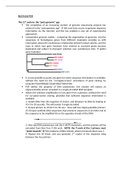
1. Isolate DNA from the organism of choice, and denature its DNA by heating at
95 C for 30 seconds. This will render it single-stranded.
2. Anneal primers at 45-60 C for 30 secs - Now add two oligonucleotide primers:
25-30 base synthetic DNA sequences that anneal to sequences (i) at either end of
the sequence to be amplified (ii) on the opposite strands of the DNA:
3. Now add DNA polymerase and the 4 dNTP monomers, and the primers will be
extended from their free 3’-OH ends. NOTE: the 3’-ends of the 2 primers must
“point inwards” This produces 2 DNA strands, where previously there was 1.
4. Repeat this 30 times, and you generate 2 30 copies of the sequence lying
between the two primers.
The 21st century: the “post-genomic” age
The completion of an increasing number of genome sequencing projects has
ushered in the “post-genomic age” We now have access to genome sequence
information via the internet, and this has enabled a new set of experimental
approaches
Comparative genome studies - comparing the organisation of genomes, and the
sequences of homologous genes from different organisms provides us with
information about the evolutionary relationship between extant species, and the
ways in which new gene functions have evolved as ancestral genes become
duplicated and subject to divergent selection over evolutionary time globin
gene evolution;
It is now possible to purify any gene for which sequence information is available,
without the need for the “cut-ligate-screen” procedures of gene cloning, by
using the POLYMERASE CHAIN REACTION (PCR)
PCR utilises the property of DNA polymerase: this enzyme will extend an
oligonucleotide primer annealed to a single-stranded DNA template
Allows the selective amplification of any gene from a genome, without the need
for cut-paste-screen cloning, provided that sufficient sequence information is
available
1. Isolate DNA from the organism of choice, and denature its DNA by heating at
95 C for 30 seconds. This will render it single-stranded.
2. Anneal primers at 45-60 C for 30 secs - Now add two oligonucleotide primers:
25-30 base synthetic DNA sequences that anneal to sequences (i) at either end of
the sequence to be amplified (ii) on the opposite strands of the DNA:
3. Now add DNA polymerase and the 4 dNTP monomers, and the primers will be
extended from their free 3’-OH ends. NOTE: the 3’-ends of the 2 primers must
“point inwards” This produces 2 DNA strands, where previously there was 1.
4. Repeat this 30 times, and you generate 2 30 copies of the sequence lying
between the two primers.