BLGY1232 Eukaryotic transcription
General
Understanding how genes are regulated in eukaryotes is more difficult than in
bacteria as they are more complex
We still use the study of mutants in which the normal process of gene expression is
disrupted, in order to learn about gene regulation the complexity of most
eukaryotes complicates this
In bacteria transcription and translation are coupled and multiple proteins are
encoded by a single mRNA
In eukaryotes, transcription and translation occur in different compartments and
individual genes encode individual protein
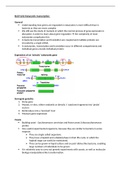
Expression of an ‘eclectic’ eukaryotic gene
Surrogate genetics
1. Clone gene
2. Mutate, in vitro, either randomly or directly // subclone fragments into ‘probe’
vectors
3. Reintroduce into a ‘test-bed’ host
4. Measure gene expression
Yeasts
Budding yeast - Saccharomyces cerevisiae and fission yeast Schizosaccharomyces
pombe
Very useful experimental organisms, because they are similar to bacteria in some
respects:
They are single celled organisms.
They have a haploid and a diploid phase in their life cycle, in which the
haploid stage can easily be maintained.
They can be grown in liquid culture and on petri dishes like bacteria, enabling
large numbers of individuals to be grown.
It is relatively easy to carry out genetic experiments with yeasts, as well as molecular
biology manipulations like transformation.
, Yeasts do not help us understand the processes which go on in multicellular
organisms, especially the genetic control of cellular differentiation and development.
Most commonly used model organisms for genetic analysis of processes in complex
eukaryotes
The nematode worm Caenorhabditis elegann and The fruit fly Drosophila
melanogaster - These small invertebrates are model organisms in that they
reproduce rapidly, producing many offspring. are small and easy to maintain in
laboratories, and have been extensively studied in terms of both their molecular
biology and their “classical” genetics. Both have had their entire genome sequences
determined.
The zebra fish and The mouse - These are model vertebrates. The zebra fish has only
been studied for a relatively short time, but it has many of the features of a good
model. It is small, has a relatively small genome, and can be manipulated by genetic
transformation. The mouse is used as a mammalian model. We cannot use human
beings for genetic analysis, but mice are good models for studying the genetics of
diseases. They also have short life cycles (for mammals) and produce lots of
offspring.
Maize (Zea mays) and Arabidopsis thaliana - Maize was one of the first organisms to
be adopted as a model for genetic studies. It is mainly studied in the US, where it is a
major crop, and where the climate is more conducive to its growth. The big
disadvantages of maize as a model are that (i) it is large and (ii) it has a very large
genome. Arabidopsis, a small mustard, has now become the most commonly used
plant. It is small, has a short life cycle and has had its genome completely sequenced.
Promoter-reporter fusions
Principle: clone the promoter region of your gene of interest immediately adjacent
to a reporter gene – one whose product is easily assay
Introduce to a suitable host, and measure the accumulation of the gene product
1. Clone the gene whose regulation we wish to study.
2. Mutate the gene in the test-tube.
3. Return the gene to the organism from which it came, by genetic transformation, and
determine how the mutated gene is regulated.
Eukaryotic genes comprise coding sequences and regulatory sequences For
transcriptional regulation, the regulatory sequences make up the promoter of the
gene: the DNA sequences that are bound by the transcriptional machinery (RNA
polymerase and its associated transcription factors)
We can identify the regulatory DNA sequences within the promoter, by using a
“surrogate genetics” experimental approach fuse the promoter of our gene of
General
Understanding how genes are regulated in eukaryotes is more difficult than in
bacteria as they are more complex
We still use the study of mutants in which the normal process of gene expression is
disrupted, in order to learn about gene regulation the complexity of most
eukaryotes complicates this
In bacteria transcription and translation are coupled and multiple proteins are
encoded by a single mRNA
In eukaryotes, transcription and translation occur in different compartments and
individual genes encode individual protein
Expression of an ‘eclectic’ eukaryotic gene
Surrogate genetics
1. Clone gene
2. Mutate, in vitro, either randomly or directly // subclone fragments into ‘probe’
vectors
3. Reintroduce into a ‘test-bed’ host
4. Measure gene expression
Yeasts
Budding yeast - Saccharomyces cerevisiae and fission yeast Schizosaccharomyces
pombe
Very useful experimental organisms, because they are similar to bacteria in some
respects:
They are single celled organisms.
They have a haploid and a diploid phase in their life cycle, in which the
haploid stage can easily be maintained.
They can be grown in liquid culture and on petri dishes like bacteria, enabling
large numbers of individuals to be grown.
It is relatively easy to carry out genetic experiments with yeasts, as well as molecular
biology manipulations like transformation.
, Yeasts do not help us understand the processes which go on in multicellular
organisms, especially the genetic control of cellular differentiation and development.
Most commonly used model organisms for genetic analysis of processes in complex
eukaryotes
The nematode worm Caenorhabditis elegann and The fruit fly Drosophila
melanogaster - These small invertebrates are model organisms in that they
reproduce rapidly, producing many offspring. are small and easy to maintain in
laboratories, and have been extensively studied in terms of both their molecular
biology and their “classical” genetics. Both have had their entire genome sequences
determined.
The zebra fish and The mouse - These are model vertebrates. The zebra fish has only
been studied for a relatively short time, but it has many of the features of a good
model. It is small, has a relatively small genome, and can be manipulated by genetic
transformation. The mouse is used as a mammalian model. We cannot use human
beings for genetic analysis, but mice are good models for studying the genetics of
diseases. They also have short life cycles (for mammals) and produce lots of
offspring.
Maize (Zea mays) and Arabidopsis thaliana - Maize was one of the first organisms to
be adopted as a model for genetic studies. It is mainly studied in the US, where it is a
major crop, and where the climate is more conducive to its growth. The big
disadvantages of maize as a model are that (i) it is large and (ii) it has a very large
genome. Arabidopsis, a small mustard, has now become the most commonly used
plant. It is small, has a short life cycle and has had its genome completely sequenced.
Promoter-reporter fusions
Principle: clone the promoter region of your gene of interest immediately adjacent
to a reporter gene – one whose product is easily assay
Introduce to a suitable host, and measure the accumulation of the gene product
1. Clone the gene whose regulation we wish to study.
2. Mutate the gene in the test-tube.
3. Return the gene to the organism from which it came, by genetic transformation, and
determine how the mutated gene is regulated.
Eukaryotic genes comprise coding sequences and regulatory sequences For
transcriptional regulation, the regulatory sequences make up the promoter of the
gene: the DNA sequences that are bound by the transcriptional machinery (RNA
polymerase and its associated transcription factors)
We can identify the regulatory DNA sequences within the promoter, by using a
“surrogate genetics” experimental approach fuse the promoter of our gene of