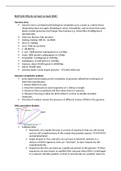
BLGY1232 Why do we have so much DNA?
Genome sizes
Genome size is correlated with biological complexity up to a point as a direct linear
relationship does not apply (Arabidopsis versus Drosophila), and we know that some
plants contain genomes much larger than humans e.g. Some lilies 25,000genes in
300,000 Mbp
Mad cow disease: 0bp (protein)
Cadang-Cadang: 300 nts (ss-RNA)
FC174: 5000bp
m13: 7000 nts (ss-DNA)
l: 48,000 bp
E. coli : 4288 protein-coding genes in 4.6 Mbp
Yeast: 5800 protein coding genes in 12Mbp
Drosophila: 14,000genes in 165Mbp
Arabidopsis: 25,000 genes in 125Mbp
Humans: about 40,000 genes in 3000Mbp
Lilium: 90,000 mbp
Amoeba dubia: world largest genome – 670,000 million bp
Genome complexity analysis
Early experiments looking at the complexity of genomes utilised the techniques of
DNA-DNA hybridisation
1. Extract DNA from cells.
2. Shear the molecules to short fragments of 1-200 bp in length
3. Denature them completely and then allow them to reanneal.
4. Measure how long it takes for all the DNA to re-form as double-stranded
molecules.
This kind of analysis reveals the presence of different classes of DNA in the genome.
DNA association kinetics
Foldback DNA;
Reanneals very rapidly because it consists of sequences that can self-anneal
and are self-complementary like simple dinucleotide repeats: TATATATATA
and GCGCGCGCGC.
Single strands of (TA)n and (GC)n do not have to find their partners in a
mixture of DNA fragments, they can “fold back” to form hairpins by self-
complementarity
Sequences like this can make up a significant portion of the genome These
sequences are also known as satellite DNA, because when DNA is centrifuged
in a caesium chloride gradient, so that it concentrates at a position where its
Genome sizes
Genome size is correlated with biological complexity up to a point as a direct linear
relationship does not apply (Arabidopsis versus Drosophila), and we know that some
plants contain genomes much larger than humans e.g. Some lilies 25,000genes in
300,000 Mbp
Mad cow disease: 0bp (protein)
Cadang-Cadang: 300 nts (ss-RNA)
FC174: 5000bp
m13: 7000 nts (ss-DNA)
l: 48,000 bp
E. coli : 4288 protein-coding genes in 4.6 Mbp
Yeast: 5800 protein coding genes in 12Mbp
Drosophila: 14,000genes in 165Mbp
Arabidopsis: 25,000 genes in 125Mbp
Humans: about 40,000 genes in 3000Mbp
Lilium: 90,000 mbp
Amoeba dubia: world largest genome – 670,000 million bp
Genome complexity analysis
Early experiments looking at the complexity of genomes utilised the techniques of
DNA-DNA hybridisation
1. Extract DNA from cells.
2. Shear the molecules to short fragments of 1-200 bp in length
3. Denature them completely and then allow them to reanneal.
4. Measure how long it takes for all the DNA to re-form as double-stranded
molecules.
This kind of analysis reveals the presence of different classes of DNA in the genome.
DNA association kinetics
Foldback DNA;
Reanneals very rapidly because it consists of sequences that can self-anneal
and are self-complementary like simple dinucleotide repeats: TATATATATA
and GCGCGCGCGC.
Single strands of (TA)n and (GC)n do not have to find their partners in a
mixture of DNA fragments, they can “fold back” to form hairpins by self-
complementarity
Sequences like this can make up a significant portion of the genome These
sequences are also known as satellite DNA, because when DNA is centrifuged
in a caesium chloride gradient, so that it concentrates at a position where its