Joana Inês da Costa Santos
Student number: 2732721
Conflict and Crimes
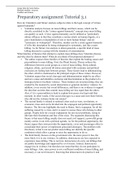
Preparatory assignment Tutorial 3.1
How do Valentino's and Straus' analysis subjects relate to the legal concept of 'crimes
against humanity?
Valentino analysis focuses on mass killings and their causes, which can be
directly correlated to the "crimes against humanity" concept since mass killing
can qualify as such. Crimes against humanity can be defined as "particularly
odious offences in that they constitute a serious attack on human dignity, or a
grave humiliation or degradation of one or more human beings" and are
"systematic or widespread". Therefore, murder can be a crime against humanity
if it fits this description by being widespread or systematic, just like a mass
killing. As for Straus', his analysis is about genocide, a specific kind of mass
killing directed to a group with the intention of extermination.
What families of theories that attempt to explain mass killings does Valentino discuss,
and why does he dismiss them? What do you think of his proposed alternative?
The author exposes three families of theories that explain the leading causes and
preconditions to mass killing. First, the Plural Society Theory enfaces the
differences between social groups as a root of mass killing. Deep cultural,
religious, ethnic, and social divisions associated with economic and political
exclusion are fueling hate between groups. These factors lead to dehumanizing
the other, which is mentioned as the principal origin of these crimes. However,
Valentino argues that social cleavages and dehumanization might be an effect
and not a cause and identifies exclusion and discrimination as the product of a
strategical plan to facilitate violence. These features are not preexisting; they are
created by the moment by social interactions or generate incentive violence. In
addition, every society has social differences, and there is no evidence to support
the idea that societies that commit mass killing are less equal than the others.
Also, if it is a precondition is hard to explain how peace was kept until that
moment. In other words, if the social cleavages is a cause and were there before,
why did not the violence broke out sooner?
The second family is related to national crises such as wars, revolutions, or
economic crises and can be divided into the scapegoat and political opportunity
theories. The first one highlights the need to blame, find a scapegoat, for all the
suffering caused by a crisis, and it is easier to accuse those who belong to other
groups. People look for a social explanation for not social problems, trying to
alleviate their frustration and fear of the crisis. The argument dismissing this
theory is that mass killing usually does not need civil support; a powerful group
mainly carries it out with a political agenda. As for the political opportunity, the
theory argues that crisis provides the opportunity, cover and encourages elites to
consolidate their power or implement genocidal ideologies. The problem with
this theory is that it can not predict mass killing nor identify the specific
conditions which allow a group to seize the opportunity to do so.
The third family focuses on the government role; the more power it has, the
more likely it is to use violence. In addition, democracies are less expected to
experience mass killing. This is not true; democracies do carry out killings that
are public knowledge and supported by civil society. Indeed, democracies
engage less in violence, but that does not mean that they do not participate in
mass killings. Also, since power is not a sufficient condition of mass killing, just
necessary, it can not forecast it. Knowing that democracies do practise it and
Student number: 2732721
Conflict and Crimes
Preparatory assignment Tutorial 3.1
How do Valentino's and Straus' analysis subjects relate to the legal concept of 'crimes
against humanity?
Valentino analysis focuses on mass killings and their causes, which can be
directly correlated to the "crimes against humanity" concept since mass killing
can qualify as such. Crimes against humanity can be defined as "particularly
odious offences in that they constitute a serious attack on human dignity, or a
grave humiliation or degradation of one or more human beings" and are
"systematic or widespread". Therefore, murder can be a crime against humanity
if it fits this description by being widespread or systematic, just like a mass
killing. As for Straus', his analysis is about genocide, a specific kind of mass
killing directed to a group with the intention of extermination.
What families of theories that attempt to explain mass killings does Valentino discuss,
and why does he dismiss them? What do you think of his proposed alternative?
The author exposes three families of theories that explain the leading causes and
preconditions to mass killing. First, the Plural Society Theory enfaces the
differences between social groups as a root of mass killing. Deep cultural,
religious, ethnic, and social divisions associated with economic and political
exclusion are fueling hate between groups. These factors lead to dehumanizing
the other, which is mentioned as the principal origin of these crimes. However,
Valentino argues that social cleavages and dehumanization might be an effect
and not a cause and identifies exclusion and discrimination as the product of a
strategical plan to facilitate violence. These features are not preexisting; they are
created by the moment by social interactions or generate incentive violence. In
addition, every society has social differences, and there is no evidence to support
the idea that societies that commit mass killing are less equal than the others.
Also, if it is a precondition is hard to explain how peace was kept until that
moment. In other words, if the social cleavages is a cause and were there before,
why did not the violence broke out sooner?
The second family is related to national crises such as wars, revolutions, or
economic crises and can be divided into the scapegoat and political opportunity
theories. The first one highlights the need to blame, find a scapegoat, for all the
suffering caused by a crisis, and it is easier to accuse those who belong to other
groups. People look for a social explanation for not social problems, trying to
alleviate their frustration and fear of the crisis. The argument dismissing this
theory is that mass killing usually does not need civil support; a powerful group
mainly carries it out with a political agenda. As for the political opportunity, the
theory argues that crisis provides the opportunity, cover and encourages elites to
consolidate their power or implement genocidal ideologies. The problem with
this theory is that it can not predict mass killing nor identify the specific
conditions which allow a group to seize the opportunity to do so.
The third family focuses on the government role; the more power it has, the
more likely it is to use violence. In addition, democracies are less expected to
experience mass killing. This is not true; democracies do carry out killings that
are public knowledge and supported by civil society. Indeed, democracies
engage less in violence, but that does not mean that they do not participate in
mass killings. Also, since power is not a sufficient condition of mass killing, just
necessary, it can not forecast it. Knowing that democracies do practise it and