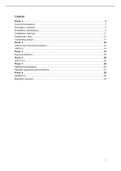
Content
Week 1………………………………………………………………………………………...2
General introduction…………………………………………………………………………...2
Descriptive statistics…………………………………………………………………………...4
Probability distributions……………………………………………………………………….9
Confidence intervals………………………………………………………………………….11
Significance tests……………………………………………………………………………..12
Comparing groups……………………………………………………………………………15
Week 2……………………………………………………………………………………….16
Linear regression and correlation……………………………………………………………..16
ANOVA ……………………………………………………………………………………...18
Week 3……………………………………………………………………………………….19
Factorial ANOVA…………………………………………………………………………….19
Week 4……………………………………………………………………………………….20
ANCOVA…………………………………………………………………………………….20
Week 5……………………………………………………………………………………….20
Mediation/moderation………………………………………………………………………..20
Multiple regression and correlation…………………………………………………………..23
Week 6……………………………………………………………………………………….28
MANOVA……………………………………………………………………………………28
Repeated measures…………………………………………………………………………...29
1
,Week 1
General introduction
Data are the collectively gathered observations on the characteristics of interest. Databases
are existing archived collections of data. A data file has a separate row of data for each
subject and a separate column for each characteristic, software can apply statistical methods
to data files. Statistics consists of a body of methods for obtaining and analysing data.
Statistical science provides methods for:
1. Design. Planning how to gather data for a research study to investigate questions of
interest to us.
2. Description. Summarising the data obtained in the study to help understand the
information that the data provide.
3. Inference. Making predictions based on the data, to help us deal with uncertainty in
an objective manner.
Descriptive statistics are graphs, tables, and numerical summaries like averages and
percentages that are used to simply describe data and make them understandable. Statistical
inferences are predictions made about a population using data from a sample of that
population.
The entities on which a study makes observations are called the subjects, these are usually
people. A population is the total set of subjects of interest in a study. A sample is the subset
of the population on which the study collects data.
A descriptive statistic is a numerical summary of the sample data. A parameter is the
corresponding numerical summary of the population. Parameters always include a margin of
error.
A measure should have validity and reliability. Validity means the measure should measure
what it is intended to measure. A lack of validity leads to bias Reliability means that the
measure should be consistent in the sense that a subject will give the same response when
asked again. A lack of reliability leads to error.
A variable is a characteristic that can vary among subjects in a sample or population. A
measurement scale describes the values a variable can take.
A variable is qualitative/categorical if the measurement scale is a set of categories (marital
status; single, married, divorced). The possible values can form a nominal scale; not one
value differs in magnitude. The values of a qualitative variable can also form an ordinal
scale; categorical values are ordered or ranked.
A variable is quantitative if the measurement scale has numerical values that represent
different magnitudes of that variable (annual income, number of siblings, age). The possible
numerical values are said to form an interval scale when they have the same numerical
distance or interval between each pair of levels. In addition, a ratio scale contains a true zero.
Allows for Allows for Uses equal Possesses real
categorising ranking intervals zero point
Nominal X
Ordinal X X
Interval X X X
Ratio X X X X
2
, A variable is discrete if its possible values form a set of separate numbers with gaps in
between. A variable is continuous if it can take an infinite continuum of possible real number
values (including decimals).
Randomisation is the mechanism for achieving a good sample representation so that
inferences can be made, and a parameter can be determined. Simple random sampling or
probability sampling of n subjects from a population is one type of randomisation in which
each possible sample of that size has the same probability of being selected. Simple random
sampling reduces the chance that the sample is biased and unrepresentative of the population.
A sampling frame is a list of all subjects in the population. The most common method for
selecting a random sample is:
1. Number the subjects in the sampling frame.
2. Generate a set of these numbers randomly (with a computer for example).
3. Sample the subjects whose numbers were generated.
Data often result from planned experiments. Randomised clinical trials are experiments
using randomisation. Observational studies are studies in which the researcher measures
subjects’ responses to the variables of interest but has no experimental control over the
subjects.
A sampling error of a statistic is the error that can occur when we use a statistic based on a
sample to predict the value of a population parameter.
There are three types of bias that can cause varying results from sample to sample:
• Sampling bias. In nonprobability sampling, it is not possible to determine the
probabilities of the possible samples. Nonprobability sampling leads to sampling bias.
There are three types of nonprobability sampling:
o Volunteer sampling. Only volunteers as subjects.
o Selection bias. Only one type of subject.
o Undercoverage. The sample lacks representation of some groups within the
population.
• Response bias. Poorly worded or confusing questions (or other external influences)
cause people to answer incorrectly.
• Nonresponse bias. This occurs when some of the sampled subjects cannot be reached
or refuse to participate resulting in missing data.
Systematic random sampling is a type of probability sampling, the method takes three
steps:
1. Skip number (k) = population (N) / sample (n)
2. Select a subject at random from the first k names in the sampling frame.
3. Select every kth subject listed after that one.
3
Week 1………………………………………………………………………………………...2
General introduction…………………………………………………………………………...2
Descriptive statistics…………………………………………………………………………...4
Probability distributions……………………………………………………………………….9
Confidence intervals………………………………………………………………………….11
Significance tests……………………………………………………………………………..12
Comparing groups……………………………………………………………………………15
Week 2……………………………………………………………………………………….16
Linear regression and correlation……………………………………………………………..16
ANOVA ……………………………………………………………………………………...18
Week 3……………………………………………………………………………………….19
Factorial ANOVA…………………………………………………………………………….19
Week 4……………………………………………………………………………………….20
ANCOVA…………………………………………………………………………………….20
Week 5……………………………………………………………………………………….20
Mediation/moderation………………………………………………………………………..20
Multiple regression and correlation…………………………………………………………..23
Week 6……………………………………………………………………………………….28
MANOVA……………………………………………………………………………………28
Repeated measures…………………………………………………………………………...29
1
,Week 1
General introduction
Data are the collectively gathered observations on the characteristics of interest. Databases
are existing archived collections of data. A data file has a separate row of data for each
subject and a separate column for each characteristic, software can apply statistical methods
to data files. Statistics consists of a body of methods for obtaining and analysing data.
Statistical science provides methods for:
1. Design. Planning how to gather data for a research study to investigate questions of
interest to us.
2. Description. Summarising the data obtained in the study to help understand the
information that the data provide.
3. Inference. Making predictions based on the data, to help us deal with uncertainty in
an objective manner.
Descriptive statistics are graphs, tables, and numerical summaries like averages and
percentages that are used to simply describe data and make them understandable. Statistical
inferences are predictions made about a population using data from a sample of that
population.
The entities on which a study makes observations are called the subjects, these are usually
people. A population is the total set of subjects of interest in a study. A sample is the subset
of the population on which the study collects data.
A descriptive statistic is a numerical summary of the sample data. A parameter is the
corresponding numerical summary of the population. Parameters always include a margin of
error.
A measure should have validity and reliability. Validity means the measure should measure
what it is intended to measure. A lack of validity leads to bias Reliability means that the
measure should be consistent in the sense that a subject will give the same response when
asked again. A lack of reliability leads to error.
A variable is a characteristic that can vary among subjects in a sample or population. A
measurement scale describes the values a variable can take.
A variable is qualitative/categorical if the measurement scale is a set of categories (marital
status; single, married, divorced). The possible values can form a nominal scale; not one
value differs in magnitude. The values of a qualitative variable can also form an ordinal
scale; categorical values are ordered or ranked.
A variable is quantitative if the measurement scale has numerical values that represent
different magnitudes of that variable (annual income, number of siblings, age). The possible
numerical values are said to form an interval scale when they have the same numerical
distance or interval between each pair of levels. In addition, a ratio scale contains a true zero.
Allows for Allows for Uses equal Possesses real
categorising ranking intervals zero point
Nominal X
Ordinal X X
Interval X X X
Ratio X X X X
2
, A variable is discrete if its possible values form a set of separate numbers with gaps in
between. A variable is continuous if it can take an infinite continuum of possible real number
values (including decimals).
Randomisation is the mechanism for achieving a good sample representation so that
inferences can be made, and a parameter can be determined. Simple random sampling or
probability sampling of n subjects from a population is one type of randomisation in which
each possible sample of that size has the same probability of being selected. Simple random
sampling reduces the chance that the sample is biased and unrepresentative of the population.
A sampling frame is a list of all subjects in the population. The most common method for
selecting a random sample is:
1. Number the subjects in the sampling frame.
2. Generate a set of these numbers randomly (with a computer for example).
3. Sample the subjects whose numbers were generated.
Data often result from planned experiments. Randomised clinical trials are experiments
using randomisation. Observational studies are studies in which the researcher measures
subjects’ responses to the variables of interest but has no experimental control over the
subjects.
A sampling error of a statistic is the error that can occur when we use a statistic based on a
sample to predict the value of a population parameter.
There are three types of bias that can cause varying results from sample to sample:
• Sampling bias. In nonprobability sampling, it is not possible to determine the
probabilities of the possible samples. Nonprobability sampling leads to sampling bias.
There are three types of nonprobability sampling:
o Volunteer sampling. Only volunteers as subjects.
o Selection bias. Only one type of subject.
o Undercoverage. The sample lacks representation of some groups within the
population.
• Response bias. Poorly worded or confusing questions (or other external influences)
cause people to answer incorrectly.
• Nonresponse bias. This occurs when some of the sampled subjects cannot be reached
or refuse to participate resulting in missing data.
Systematic random sampling is a type of probability sampling, the method takes three
steps:
1. Skip number (k) = population (N) / sample (n)
2. Select a subject at random from the first k names in the sampling frame.
3. Select every kth subject listed after that one.
3