-
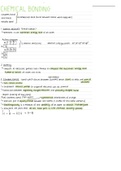
covalent bond
" a molecular bond (bond between atoms within molecules )
ionic bond
mega , , , , ☐on ,
1. Valence electrons ( group number )
>
electrons in the outermost
energy level of an atom
Aufbau diagram
3s
%
} 5 valence electrons electron
configuration
:
1522522ps 353ps
Zp
25
Is
2.
Valency
>
amount of electrons gained / lost / Shared to complete the outermost energy level
number of bonds an atom
•
can form
non -
metals
3. Covalent bonds :
bond which occurs between 2h atoms which share at least one pair of
electrons
> non -
metal atoms
> outermost orbitals overlap so unpaired electrons can be shared
attraction between electrons and
positively charged
>
negatively charged nuclei
( equal sharing of electrons )
pure covalent bond ( non
pdar# symmetrical distribution of charge
-
>
electron pair is
equally shared between the atoms (2 atoms of the same element )
>
tendency of
electronegativity is a measure of the an atom to attract a
bonding pair
?
lone pairs are pairs that do not take part in the chemical
bonding process
i
>
t
- -
>
- -
- -
, The
electronegativity (pauling ) scale
decrease down and increase across a
electronegativityes
-
>
a
group
a period
>
factors contributing :
1. The
charge on the nucleus (9 charge ,
T attractive force
,
P electronegativity /
2. The size of the atom ( t size ,
closer the nucleus is to the electron
pair T electronegativity
,
/
Polar covalent bonds →
unequal sharing of electrons leading to a dipole forming
(as a result of electronegativity difference,
is not shared
equally
>
bonding pair
( bigger pair closer )
>
different electronegativity values value pulls electron
> uneven distribution of charge
•
higher electronegativity value has a
slightly negative charge (
8- )
lower
electronegativity value has a
slightly positive charge (8-1)
•
.
'
St
8-
-
+ CI >
-
CI > -
CI
2, I 3,0
Dative covalent bonds
>
forms when a lone pair of electrons from one atom is shared with another atom which
empty orbital
has an in its outermost
energy level
Ammonium ions ( NHI)
>
formed when a
hydrogen bond ( Ht ) forms a dative covalent bond with an ammonia
molecule ( NH 5) +
+ -
-
^
. . - i
i
.
-
+ -
. : -
> -
: - - .
-
. . . .
- -
-
covalent bond
" a molecular bond (bond between atoms within molecules )
ionic bond
mega , , , , ☐on ,
1. Valence electrons ( group number )
>
electrons in the outermost
energy level of an atom
Aufbau diagram
3s
%
} 5 valence electrons electron
configuration
:
1522522ps 353ps
Zp
25
Is
2.
Valency
>
amount of electrons gained / lost / Shared to complete the outermost energy level
number of bonds an atom
•
can form
non -
metals
3. Covalent bonds :
bond which occurs between 2h atoms which share at least one pair of
electrons
> non -
metal atoms
> outermost orbitals overlap so unpaired electrons can be shared
attraction between electrons and
positively charged
>
negatively charged nuclei
( equal sharing of electrons )
pure covalent bond ( non
pdar# symmetrical distribution of charge
-
>
electron pair is
equally shared between the atoms (2 atoms of the same element )
>
tendency of
electronegativity is a measure of the an atom to attract a
bonding pair
?
lone pairs are pairs that do not take part in the chemical
bonding process
i
>
t
- -
>
- -
- -
, The
electronegativity (pauling ) scale
decrease down and increase across a
electronegativityes
-
>
a
group
a period
>
factors contributing :
1. The
charge on the nucleus (9 charge ,
T attractive force
,
P electronegativity /
2. The size of the atom ( t size ,
closer the nucleus is to the electron
pair T electronegativity
,
/
Polar covalent bonds →
unequal sharing of electrons leading to a dipole forming
(as a result of electronegativity difference,
is not shared
equally
>
bonding pair
( bigger pair closer )
>
different electronegativity values value pulls electron
> uneven distribution of charge
•
higher electronegativity value has a
slightly negative charge (
8- )
lower
electronegativity value has a
slightly positive charge (8-1)
•
.
'
St
8-
-
+ CI >
-
CI > -
CI
2, I 3,0
Dative covalent bonds
>
forms when a lone pair of electrons from one atom is shared with another atom which
empty orbital
has an in its outermost
energy level
Ammonium ions ( NHI)
>
formed when a
hydrogen bond ( Ht ) forms a dative covalent bond with an ammonia
molecule ( NH 5) +
+ -
-
^
. . - i
i
.
-
+ -
. : -
> -
: - - .
-
. . . .
- -
-